• About
  • Creative Writing
  • Recipes

Mileage Plus Pilgrim

~ Flying through Life

Mileage Plus Pilgrim

Tag Archives: Christianity

Rubies in the Rubbish – Day Eleven

04 Wednesday Dec 2013

Posted by noreennanz in Uncategorized

≈ 2 Comments

Tags

Cairo, Christianity, Copts, Education, Egypt, garbage pickers, Pilgrimage, travel, zebaleen

This morning I wake up refreshed, having slept comparatively well last night.  The extra blanket the sisters gave me really helped.

On the way to and from school I notice parents touching their children lovingly.  Here, mothers always carry their babies in their arms.  The roads are probably too bumpy anyway to push a stroller.  I see a father with his arm wrapped around the shoulder of his son, about twelve.  The son appears to have been crying.  I love how these people are so open with their emotions!  When they are sad, they cry.  When they are angry, they also let that out.  I’m not used to that, and when I see anger or irritation, I feel afraid.  But what tenderness there is here!  I love the way these children smile at me, looking long and warmly into my eyes.  I feel almost washed away by this tenderness.  Josuf, one of my sixth-graders, comes to me so eagerly when I ask him to come to the front of the classroom.  Every time I praise him for a correct answer, his entire face lights up.  It melts my heart.  I see some of the girls looking at me with open adoration when I try and explain something.  It embarrasses me, but also moves me profoundly.  I’m sometimes overwhelmed by the number of kids who crowd around me, wanting to shake my hand and say hello.  But I’m also deeply touched.

This morning we do our usual “ABC” song, “Head and Shoulders”, and “Jesus Loves Me”, plus writing the alphabet.  Some of the kids are up to “W” by now.  Kindergarten kids.

While Mariem waits for her mother and I wait for my driver, I help her with her English.  She also looks at me adoringly after I praise her for her perfect rendition of, “Mona baked a cake”.

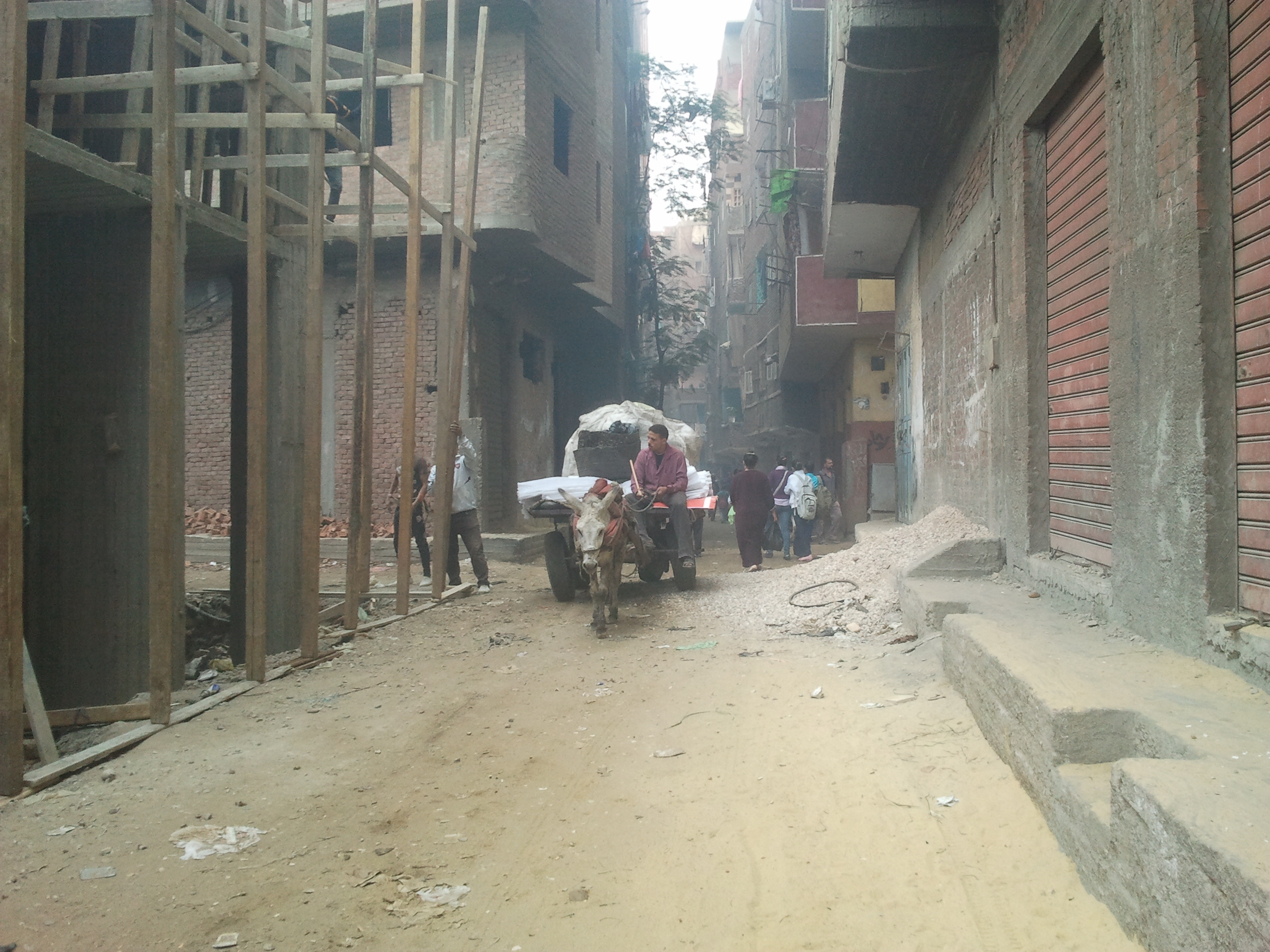
I ask Marleen, the school director, about the life of the garbage pickers.  They have certain customers they travel to by donkey and pick up their garbage.  It has to be in the area – they are not allowed to travel long distances with their donkeys, or they’ll get picked up by the police.  They get paid to pick up the garbage.  Once they’ve collected all the garbage, they bring it to the garbage area, where they sort it.  Apparently the glass area is next to the school, because I always hear glass being sorted.  Marleen says they sort it by color.

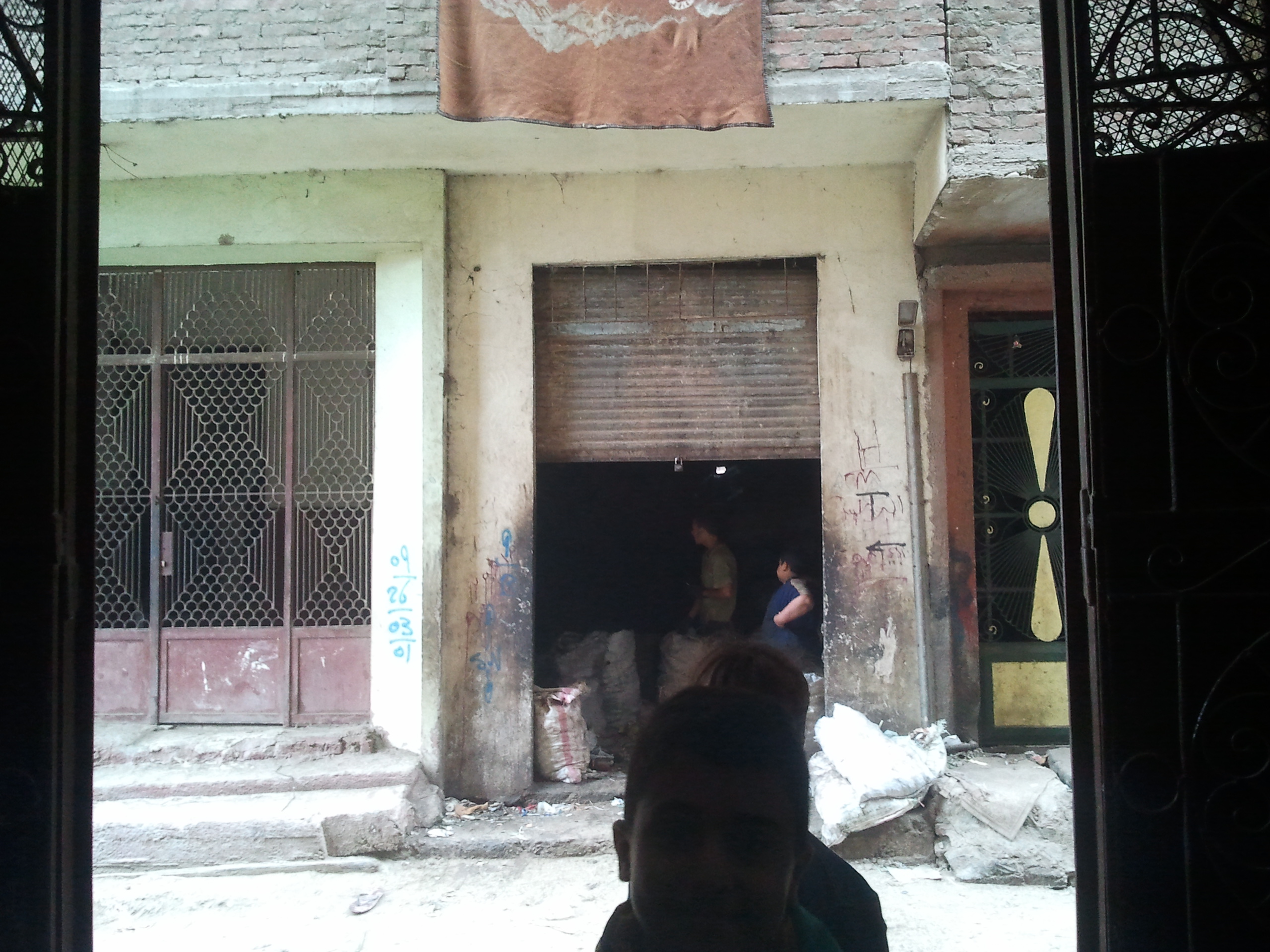
A father and son, presumably, sorting glass across the street from the school

A father and son, presumably, sorting glass across the street from the school

They separate paper and cardboard, and also plastic.  They also collect food waste.  In the past, pigs that lived in the area ate the food waste, but the government has made raising pigs illegal, so I don’t know what happens to the food waste now.  Does it go to the chickens?  To the dogs running around loose in the streets?  The zebaleen (garbage pickers) are able to sell some of what they collect, for a little money.

According to the British newspaper, the Guardian, the zebaleen do raise at least some pigs in the back of their houses.  The article goes on to say, however, that with the swine flu scare in 2009, all the pigs in Cairo were killed.  More than 300,000 pigs were killed in one day, reducing the income of the zebaleen, who raised these pigs to be sold, in half.  In all the days I’ve been working in the school, I have never heard a sound from a pig, although I’ve heard plenty of chickens.  My school is in the second largest garbage area of Cairo.  I guess I’d have to get invited to a few homes to find out for sure.  One thing I do know – these garbage pickers are really poor.

Rubies in the Rubbish – Digging through Trash to Find Truth

01 Sunday Dec 2013

Posted by noreennanz in Uncategorized

≈ Leave a comment

Tags

Cairo, Christianity, Egypt, fundamentalists, Morsi, Obama, Pilgrimage, politics, travel

One thing about our evening chats – they’re stimulating, and sometimes downright confusing.  I cherish all my conversations with Marleen, Reda and Emet, the afterschool director, who also presides over the Mahaba School.  These are the only people I can talk about life outside the convent with.  When Emet joins us, though, I have to rely on Reda’s translations.  Emet speaks very little English.  I think he understands a lot, though, because when Reda and I speak in the evenings and Emet is also there, he nods his head as though he understands us.  With Emet, I get a third perspective on Egyptian life.

It seems that every time we talk, at one point the subject comes around to Obama and the Americans.  “Sorry,” Reda says each time.  “You are a wonderful person and I like Americans personally.  But we don’t like your president.”  Emet echoes his sentiment, as does Sister Maria and everybody I meet who mentions the name “Obama”.   I tell Reda that I voted twice for Obama.  The first time I was really excited about having him for President, but by the second time, I wasn’t sure whether President Obama and I shared the same values at all.  After all, Guantanamo is still there, there’s more internet spying than there ever was after Bush signed the Patriot Act, America is still high-handed with other nations, and now my military uses anonymous drones to kill non-military “objects”.  I don’t really know what Obama is trying to do when he talks about easing sanctions on Iran, when it seems obvious that the Iranians are hell-bent on developing their atomic bomb.  I know the Israeli government is really afraid of this happening.  If anything, it seems the world is a more dangerous place under Obama’s presidency than before.  So I’ve got my questions.

“Why did Obama support Morsi?” Reda asks me.

“Because Morsi was elected democratically.  We want to support democracy.”

“But he wasn’t elected democratically,” say Reda and Emet in unison.  “Amed Shafik actually won the election.  It was rigged.”  It’s the first time I’ve heard this news, but I later find the same claim in the internet.
“Morsi supports terrorism!  The Muslim Brotherhood is like Al Qaida – they’re terrorists!  Why did Obama spend American money for the Muslim Brotherhood?”

“To promote democracy,” I answer.

“You are deceived,” they answer.  “How can the Americans support a terrorist?” they ask.  I want to say that my government wants to support a democratically elected leader, even if he may have some undemocrtic ideas.   In a democracy, you don’t have a revolution every time someone who has different ideas than you are in power.  You try and work together.  You support the process, even if it isn’t a smooth one.  But what do I know?  My government has supported plenty of undemocratic tyrants in the past, and even helped to overthrow democratially elected leaders.

Reda tells me that he loves the military.  “Egyptians love the military,” he adds.  “Each time I run into one of the soldiers, I walk up and shake his hand.  I tell him that we support the military.”

He goes on to say that what happened in July was not a military coup – it was the will of the people.

“We, the Egyptians, wanted no more of Morsi.  Not just the Copts – the Muslims too.  They want no more of the Muslim Brotherhood.  Eighty per cent of the Egyptians are in favor of the military takeover.

“You should have seen the demonstrations!” he says.  “Fourteen million Egyptians on the streets.  I was there too.”

I seem to recall that about a year ago, everybody hated the military, especially those who favored democracy.

One evening I tell Reda about an article I read in the New York Times about a man named Tomahy.  He’s never heard of Tomahy.  “He is the new head of the intelligence service,” I say.

“It says in the article that Tomahy was responsible for the military killing about a thousand Islamists.”

“No, the military didn’t do that,” answers Reda.  “Where are these thousand dead?  These are lies.  The American press is deceiving you.”

As with each other time I’ve been in Egypt, at some point I feel almost dizzy with disorientation.  The version I hear about my government’s role in Egypt is diametrically opposed to what Egyptians tell me.  Last time I was in Egypt, I heard that the young Americans and Germans working for nongovernemtal organizations were actually spies sent to foment agitation among the Egyptians.  Now I’m hearing that Obama is a sponsor of terrorism.  I wonder if it is possible to know the truth here.  I think Egypt is a country rife with conspiracy theories about everything.  But when I’m in Egypt, I start to wonder if the powers at be in the world aren’t indeed parties to conspiracy.  Who is to know?

One thing about Obama and the US government that does disturb me deeply is all the internet spying that’s been going on, and their witch hunt for Edward Snowden.  I tell this to Redy.  He’s never heard about the internet spying.  He’s never even heard of the name “Edward Snowden”.  I wonder who is being misinformed.

“You think we are a divided country,” Reda says.  “You Americans think the Muslims and the Christians are opposed to each other.  But it’s not true.  How old is America?”

I tell him the US declared independence from England in 1776.

“You see?  Your democracy is only a little over 200 years old.  Our country is over 4,000 years old, and we are united.  I’m not sure whether your nation will survive.  Ours will.”

At one point, Reda notices that I am visibly uncomfortable with our discussion.  “Shall we talk about something else?” he asks.  “This talk makes you unhappy.  You shouldn’t be unhappy.”  This immeasurably considerate thought delights me, but also throws me into further confusion.  My own German-American son would never try to protect me from an unhappy discussion.  I’m not even sure I’d be unhappy in such a discussion.  I might be confused, but I’d be in the thick of a stimulating discussion.   I’m not sure if I’d be any surer of the truth at the end, but there’d be a heck of a lot to think about.  As there is now.  I’m grateful for these discussions, because they show me what concerns the Copts and perhaps a lot more Egyptians, and it makes me a bit more hesitant to swallow everything I read in my own press.

It seems that, the older I get, the less sure I am about the truth of anything.  It so often depends upon one’s perspective on things.  I grew up in a dogmatic, in some ways fundamentalist Christian family and church.  I was taught to tell the truth, and I was told in no uncertain terms what the truth was.  Either I was on the side of their version of truth, or I was opposed.  The militancy of these conservative Christians in their religion – and their politics – intimidated me so much, I believed I had to know where I stood on everything, and I had to be able to defend my position.  If I was on the other side of an issue, I had to even trump their arguments, because I’d have to prove to them that they were wrong.  Someone was always wrong and the other one right.  This put me under a lot of pressure.  Looking back, it was pressure I never asked for, and demands for me to hold positions on issues the others were concerned about.

This need for truth is deeply ingrained in me.  I’m grateful for it, for the most part.  I still try to tell the truth as much as I understand it, but I find it really difficult to discern what is true in some areas, particularly in politics.

My fellow Americans always seem so sure of themselves, whatever side of the issue they’re on, and whether they’re fundamentalists or die-hard liberals.  I’m not sure those liberals are any more tolerant than the fundamentalists they love to mock.  I’m not sure of a lot of things anymore.  How glad I am not to have to work in politics, or in a job where I’d have to persuade people of my version of the truth.  It feels good to know that my cut-and-dried job of teaching English suits me much better.

I decide to leave the conversation and go to dinner.  I doubt I’ll never know whether Obama intends to support terrorists or not.  I can’t imagine this reasonable, calm-sounding man could ever be on the side of terrorists.  But I’m finally learning, late in life, that I don’t have to have a position on every issue.  There are some things I don’t know, and that I don’t have to know.  And that is a relief.

Rubies in the Rubbish – At the Salam Center

24 Sunday Nov 2013

Posted by noreennanz in Uncategorized

≈ Leave a comment

Tags

Cairo, Christianity, Copts, Education, Egypt, Pilgrimage, travel

Life has fallen into a sort of rhythm by now.  I set my alarm for 6:15 every morning.  If I’ve slept poorly the night before, I need the alarm.  If I’ve slept well, I wake up just before the alarm goes off.  For the past couple of nights, I haven’t been sleeping so well.  It’s getting colder at night, and my one sheet-blanket isn’t enough anymore.  There is another blanket I’ve tried to use, but it stinks of ancient dust and dirt.  I have to do something about that.

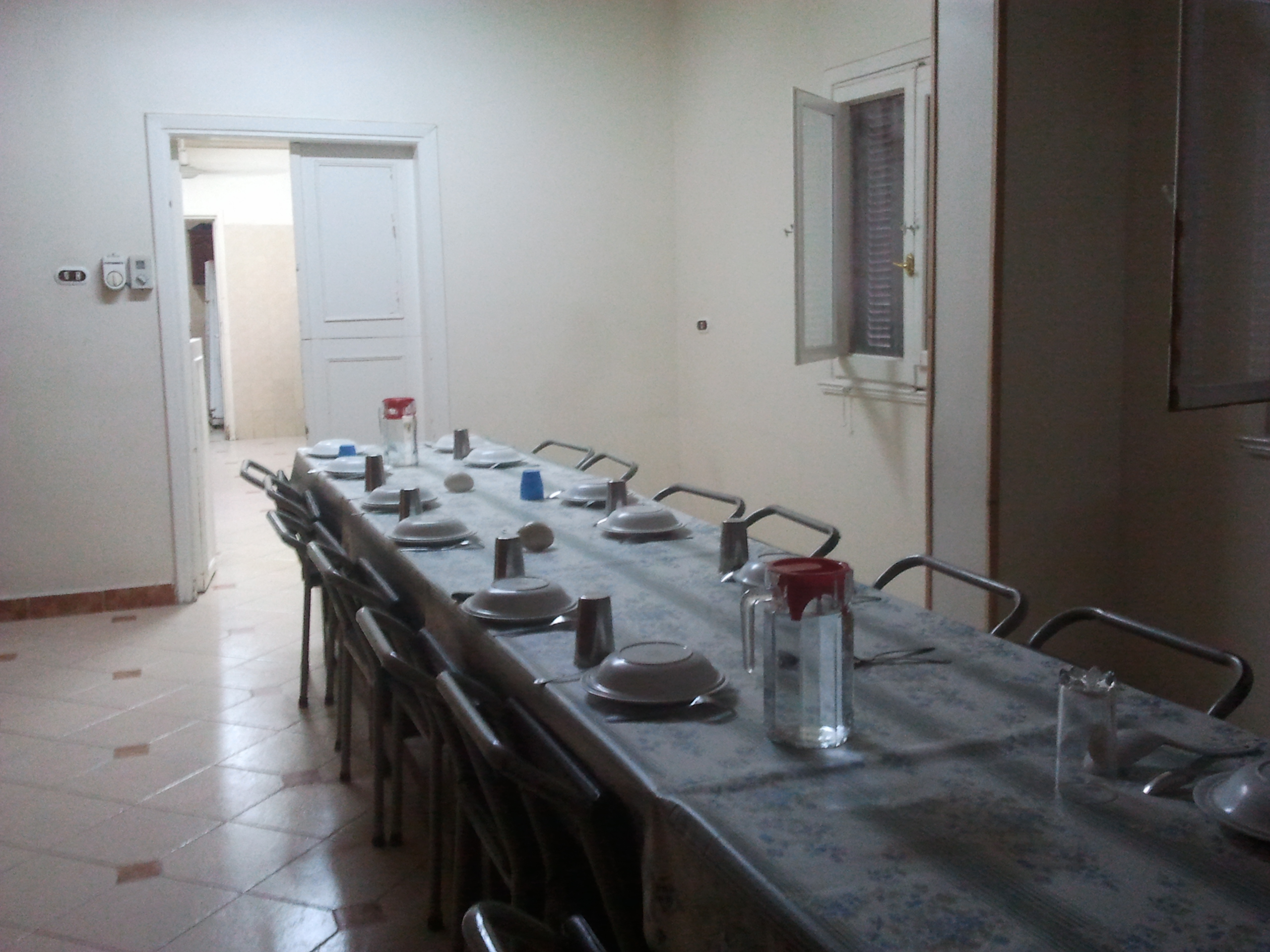
When I’ve had my morning coffee, had my time with God, done my exercises and gotten washed and dress, I head down for breakfast.  Officially, breakfast is served at 8 am, but the time people actually eat varies some.  We eat at a long table, which is covered with a plastic tablecloth.  Sister Maria sits at the far end of the table, since she has the most seniority.  I, the guest, in a position of honor, I suppose, sit across from her.  The sisters seem to sit in rows according to their seniority.  Those with the least seniority sit at the bottom end of the table, nearest the kitchen.

convent dining room

Convent dining room

A normal breakfast is pita bread, a flat bread slightly different from what they sell in Europe and the States, and more tasty, two kinds of cheese, both something like feta, rucola leaves, boiled eggs, and sometimes foul (sounds like fool when you say it), a delicious fava bean stew.  The sisters only drink black tea, which I also drink down in the dining room, but I’m very grateful for my daily cup of coffee in my room.

Then I go off, usually with Rohmy, to the school next to the garbage dump, where I teach my kindergarten group.  Later in the morning I return with Rohmy, whenever he manages to come and pick me up, and I buy water to drink, and then go to my room and write about the morning or the previous day.

Lunch is served at 2 pm in the convent dining room.  We often have chicken for lunch, unless it is a Wednesday or Friday.  These are fast days, and there is no meat.  Most of the sisters fast from breakfast as well on these days.

We’ve had stewed beef once for lunch.  Normally there is some sort of soup with the meat, either the slimy spinachy molokhia, or some sort of vegetable soup like green beans with homemade tomato broth.  There is always delicious rice mixed with vermicelli, and always the flat bread.  Dessert is always fruit – fresh guavas, pomegranates or bananas.

Then I’m free in the afternoon until 5 pm, when I go to teach again.  I usually spend this time in the convent dining room, where there is wifi.  I check and write emails and hang out with whichever sisters happen to be there.  A couple of times they’ve asked to hear the CD I have downloaded into my laptop from the Egyptian Christian group “Better Life”.  I love it when the sisters translate these lyrics for me, and we sometimes have good talks.  Then I go back to my room and prepare my lesson.

At five o’clock I begin teaching with Reda – first the fourth graders for an hour, then the fifth graders and finally the sixth graders.

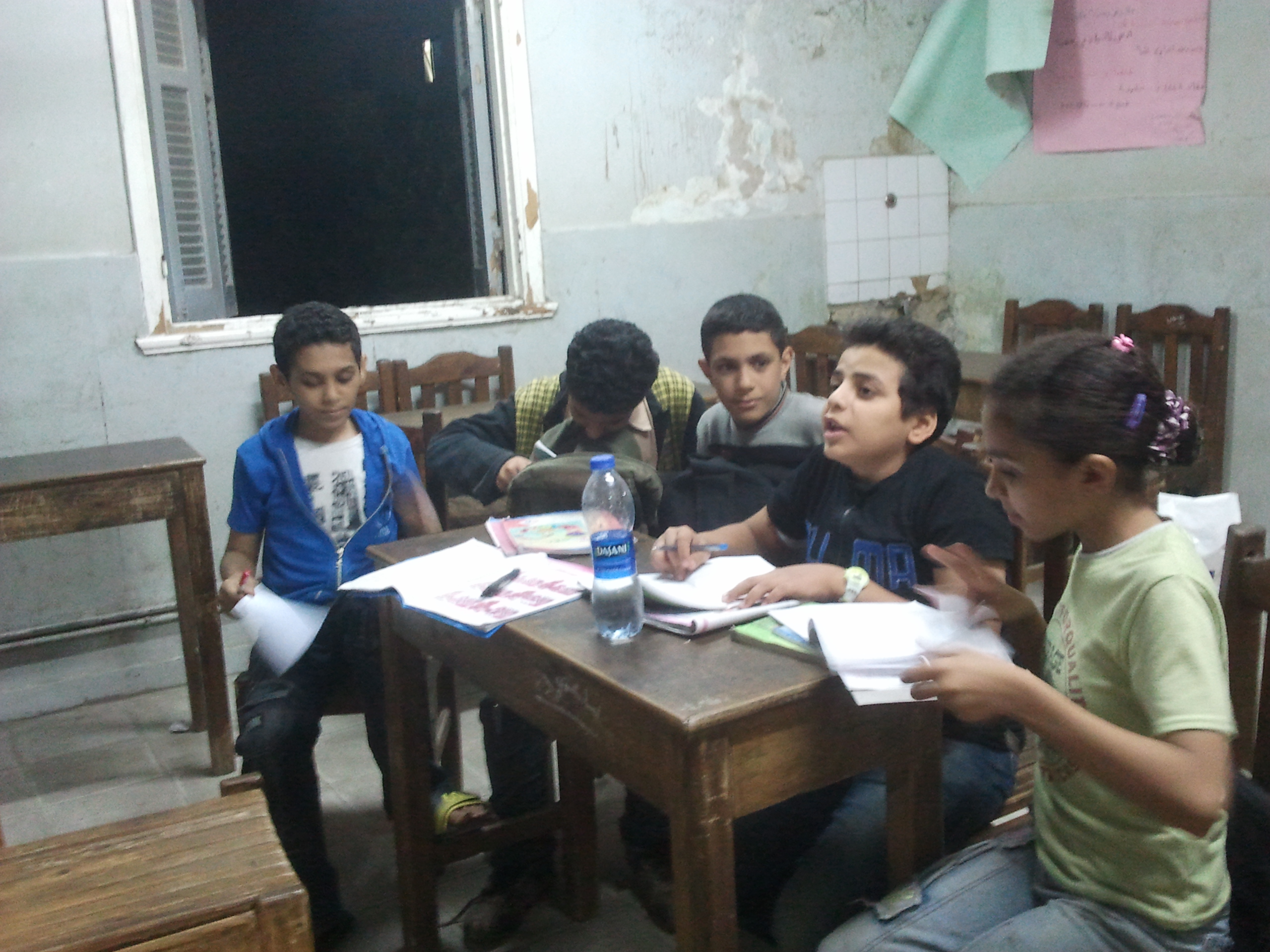
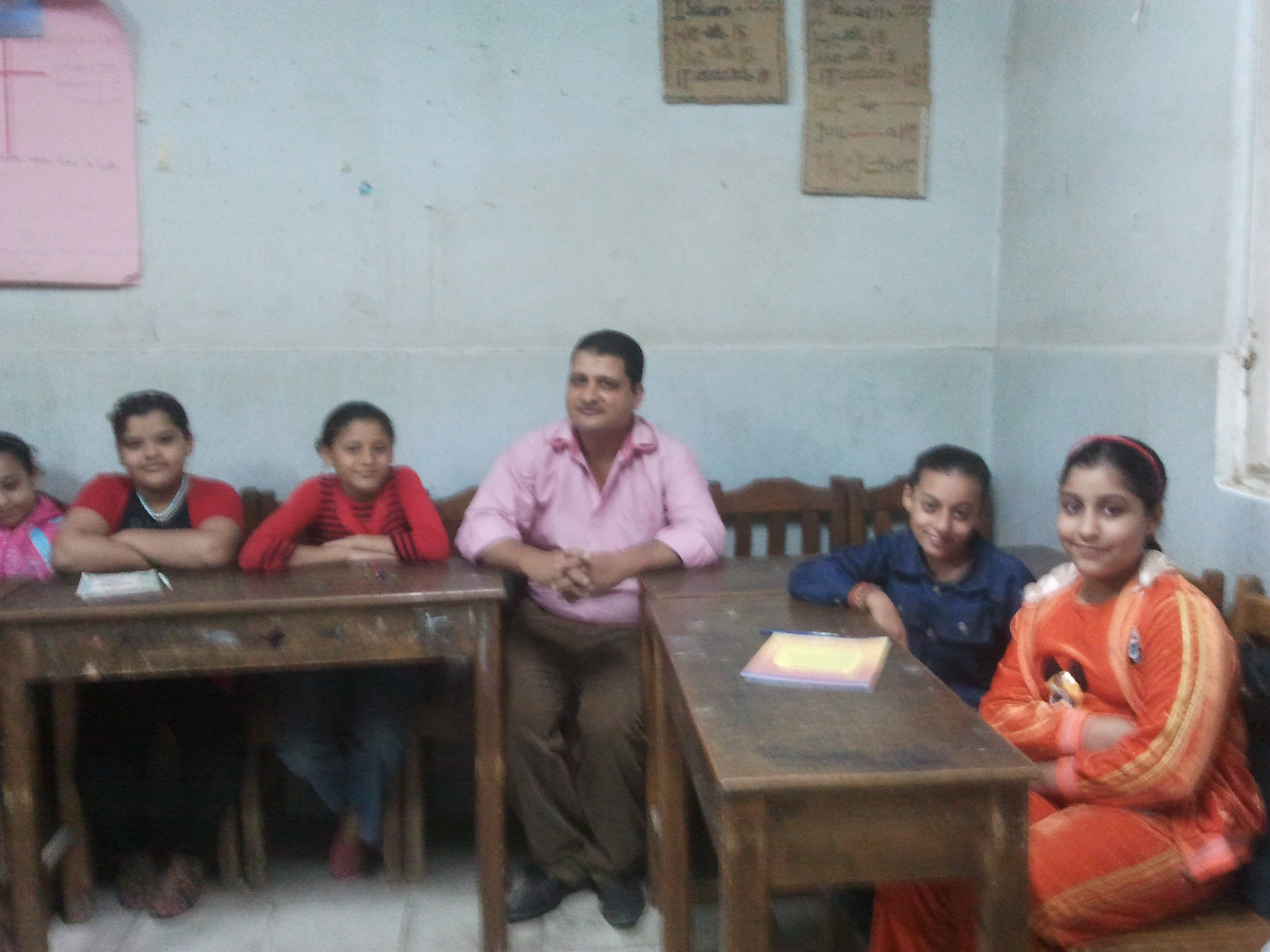
Sixth graders at the Salam Center.

One of my evening classes. These are the sixth graders.

At the very beginning of the evening, we always pray in the classroom.  Reda has taught me to stand facing east with the students, and we make the sign of the cross as we say “In the name of the Father, and the Son, and the Holy Spirit.  One God, Amen.”  The same thing happens with the sixth graders at the end of the evening, at 8 pm.  Then I pray in English, saying whatever I feel like saying, and the children recite after me.  Then Reda and the children recite blessings together.

When the students write from the blackboard, it’s a lot quieter.  But when the fifth graders are there, it is bedlam!  I’ve been wondering why that is.  For one thing, they shout every time you ask them to repeat something.  I’ve started asking them to speak in a normal voice so I can understand what they’re saying, and also to protect my nerves.  One day both Reda and I are tired.  I, because I didn’t sleep well the night before.  This weather change means my body is having to adapt, and that makes me tired.  Reda is tired because he’s come down with a cold.  He wasn’t dressed for the cooler weather.

We pretend to sleep at our desks, showing the students that both teachers are tired.  I count the number of kids in class today – fifteen!  No wonder it’s so noisy in there.  There are only about nine fourth graders who come, and about five sixth graders.

The afternoon program, I learn, isn’t really a school.  The kids all go to some school or other during the day, and come here in the evening for extra help.

Every evening after all the kids have left, Reda and I sit on a bench in the now-school, ex-hospital courtyard and talk about the lessons, or about our lives.  He is such a gentleman, and wants to take care of his “mother”, Noreen.  Every evening he buys me a juice, like mango or guava, and we sit on a bench, drink our juice, and talk.  One evening I ask about the stream of people coming and going from the room next to the courtyard.  The old, worn-out sign says “dental clinic”, but it is obviously no longer a dental clinic.  I see computers in the room – and a constant flow of people.  I also notice that some of those waiting to go into this room listen to us talk.  They seem to understand at least some of what we are talking about.  I ask him what this room is all about.

“These people want to go to America,” he says.  “They’re getting help filling in the required emigration forms.”  So many people want to leave Egypt!  One man, sitting there with his entire family, tells me he has a degree in hotel management and tourism, but he can’t find a job anywhere – there are no tourists.  He thinks he can find work – any work will be fine – in the United States.

I always leave Reda at 8:30 pm to go back to the convent for supper.  There, we normally eat more bread and cheese, and often homemade yoghurt that Sister Ologaya has made.  Once we had a hard macaroni dish, sort of like a pizza.

During one evening at supper, I ask Sr. Maria about those wanting to emigrate.  She says there are large Coptic communities in the States, in New Jersey and California, for instance, that will help these people if they manage to emigrate.

We talk about Coptic lifestyle values.  Reda has told me, for instance, that Copts don’t date.  There is no premarital sex with either the Copts or the Muslims.  Divorce is frowned upon.  Egyptian society is conservative and strict.  I tell her about the mores in Germany and in the States.  This is what these Egyptians will encounter when they land in the States or in Europe somewhere.  “I know, she says.  It will be hard for the children.”

She tells me that among the Muslims, many are turning away from any faith at all.  They had put their hopes in the Muslim Brotherhood, and found through the one-year experience with the Brotherhood that the Muslim Brotherhood were not interested in the common good of all.  They have found the Brotherhoold to be just another corrupt political party.

Somehow the sisters find out that I’ve been cold, ever since the weather changed.  Sister Monika finds a nice warm, clean blanket for me, and I walk back with my blanket to the hospital.  Before I enter the building, however, I am always stopped by a loud “Hello!”  It is Romero, one of the handicapped young men.  As far as I can tell, he is only physicall handicapped, but quite intelligent.  He sells cookies and chips outside to people going into the hospital to visit patients.  He wants me to buy something.  I don’t mind.  I find the suppers boring, and I wouldn’t mind something sweet to eat before I go to bed.  Sometimes I buy an Egyptian form of Oreo cookies.  Or perhaps Twinkies.  I haven’t had Twinkies since I was a kid!  I find that I enjoy this bit of sweetness before I fall into bed.  The night I carry the heavy blanket, I  buy a Twinkie and then go to bed.  I read from a Kindle book in my cell phone until my eyes droop.  I sleep a deep, peaceful sleep.

Rubies in the Rubbish – Day Ten

23 Saturday Nov 2013

Posted by noreennanz in Uncategorized

≈ Leave a comment

Tags

Cairo, Christianity, Copts, Egypt, Pilgrimage, Preschool education, Salam Center, travel

When I used to live in New York City, I learned a saying:  “If you can live in NYC, you can live everywhere.”  I often think of that here at the convent, where life isn’t as comfortable as in my apartment back in Germany.  But so what?  So what if the shower drips all over the bathroom floor and there are also the occasional monster cockroaches?  You stamp on the cockroaches and you mop up the floor after the shower.  No big deal.  I could live here.  Life here is so fascinating, all the senses are stimulated to the max.   I’m not bored for a second.

There’s the sounds, for instance.  Last night I went to sleep to the sound of tuk-tuk and car horns honking, firecrackers (again) and loud music coming from some nearby music.  I liked it – first a woman singing along to some sort of flute-like Arabian instruments, and then a man.  It sounded foreign to my ears, yet nice, even calming.  Rather than read myself to sleep, I let the music do it.  At this moment I hear a man speaking over a loudspeaker.  Is he selling something?  Is he a politician?  Is it someone praying?  No idea.  In the morning I hear the thump-thump-thump of women beating or pounding rugs against the window ledges, getting rid of all the sand from the previous day.  A couple of times a day I hear a loud metallic clang-clang-clang.  I don’t know what it is, but imagine it to be someone riding on cart, pulled by a donkey.  I’ve seen this – huge propane gas canisters used for cooking, loaded onto a cart.  I often hear a saw buzzing.  There’s the perpetual sound of the roosters screeching.  I think they sleep from maybe 9 pm until about 2 am.  And in the daytime, there are children from the school and pre-school downstairs, yelling – uh – reciting their lessons.  There are the birds chirping all day, and the calls to worship, reminding everyone that there is one God and that we are to worship Him.

And the smells?  We’re only a few blocks from the garbage dump, but it doesn’t stink here.  Even the garbage dump doesn’t smell any worse than some of the streets in New York City in the summer’s heat.  I wonder if the air in this part of Cairo isn’t that polluted after all.  There are hardly any cars on the dirt roads, only small craft shops like lumber mills.  What I smelled yesterday, traveling through the quarter by tuk-tuk, was the aroma of bread baking and sometimes the acrid scent of charcoal.  The churches smelled of incense or of rosewater, sprinkled over relics.   Sometimes I smell meat being grilled, or the spicy aroma of meatballs – kofte.  And always, the faint smell of baked dust.

Today I am privileged to attend my first Coptic church service, upstairs in the convent.  It reminds me of a Greek Orthodox service.  For some reason they go up three times for the bread and again three times for the wine.  Later, I find out that there is no particular reason for this, except that the entire loaf of bread has to be used up, as does the wine.  At the end of the service, the priest sprinkles water over everyone, concentrating on me!  And we all share the remaining bread from communion.  There have to be at least three loaves of bread for communion.

As we leave the parking lot to go to school, the guard hands the driver a big chunk of communion bread.  The driver takes it, kisses it, and hands it to me to break off a piece for myself.  Today the driver is Refa’at, instead of Rohmy.  Whereas Rohmy always turns on the radio to pop Arab music, Refa’at listens to what sounds like a Coptic church service.

Refa'at

Refa’at, one of the drivers at the Salam Center

School is wonderful, but tiring.  Wherever I go, children accost me, asking me, “What’s your name?”  At the center, at the school, no matter whether they’re in my class or not.  Today, as we all wait to be picked up, I end up teaching a group of girls my sister, your sister, her sister.  Another girl and I read in her English book, practicing the past tense.

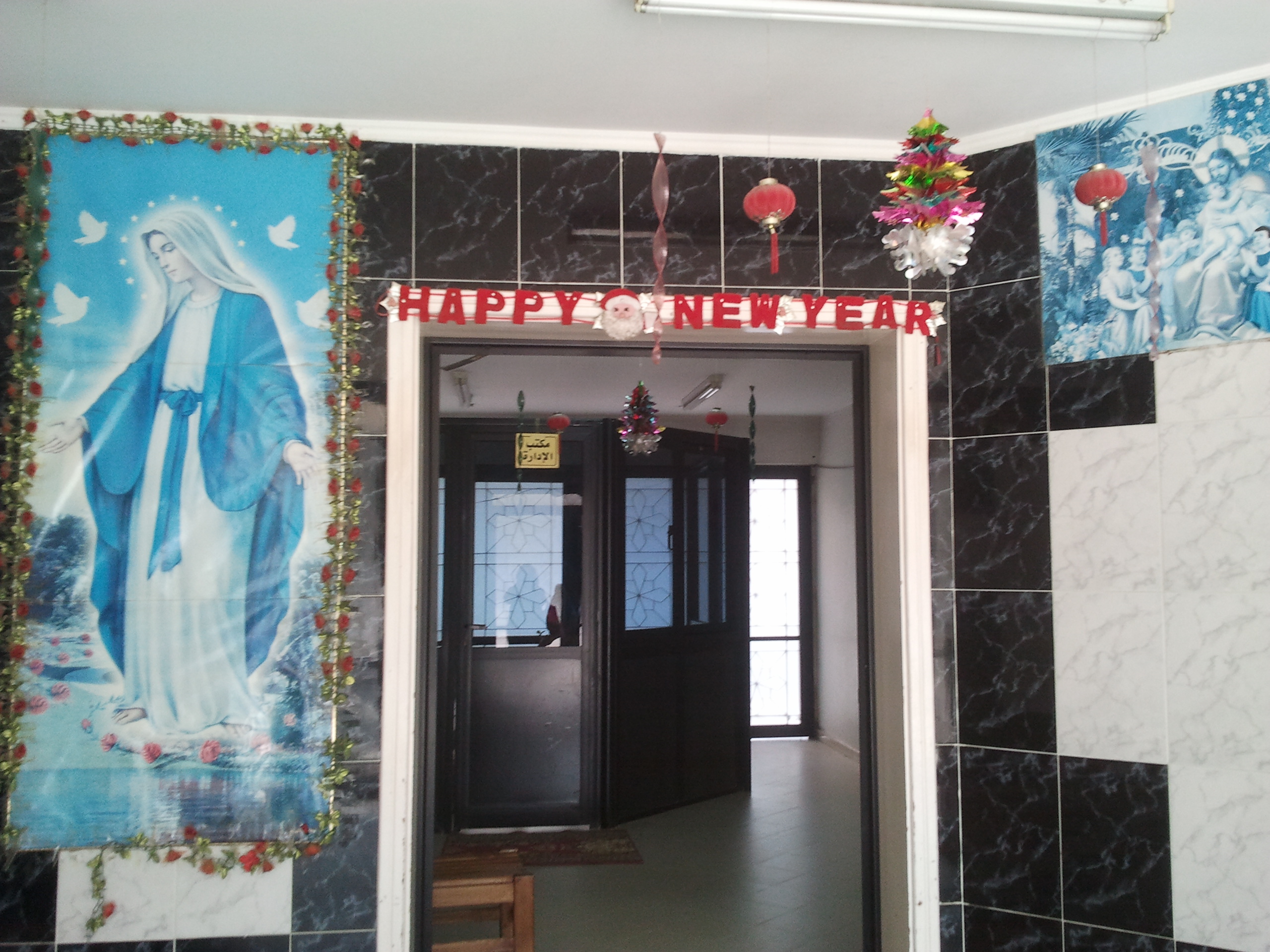
I visit the pre-school program today.  I am struck by the serene beauty of this building.  It must be new.  The walls are straight, the paint shimmers a little, and the floors are clean, with smooth tiles.  Everything is in excellent quality, in its ordered place.  The classrooms have lovely pictures on the wall, and even in the corridor, there are tinsel ornaments hanging from the ceiling.  I know from the tour I had on my first full day here, that the “Happy New Year” sign is there, not because they’ve forgotten to take it down, but because the bright colors of the sign make a cheerful atmosphere.

Kindergarten

Kindergarten

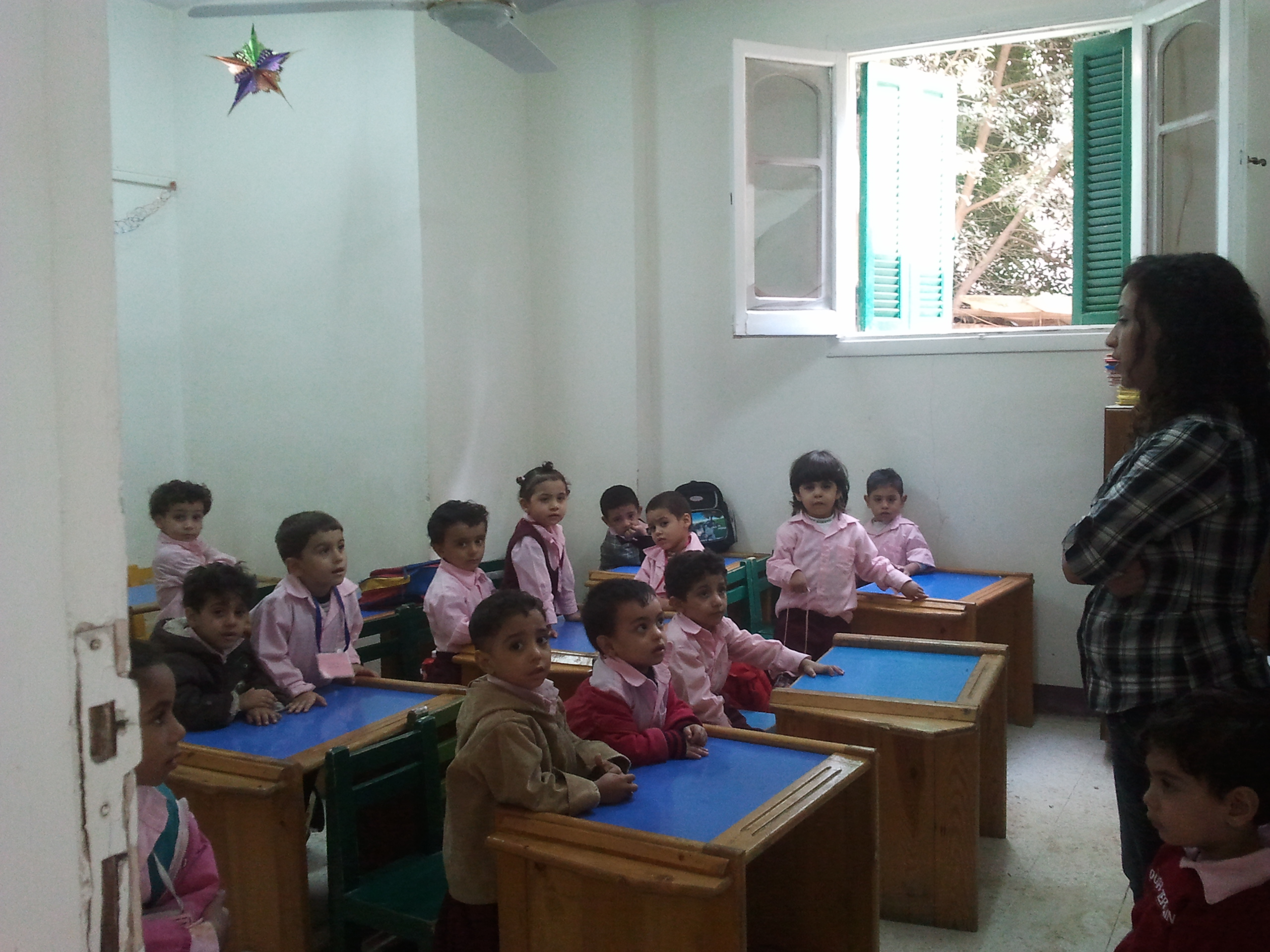
At this pre-school, unlike a German Kindergarten, the children sit at little desks and have to recite things the teacher says.  I see no squirming, apparently no ADS children.

Kindergarten groupo.

Kindergarten group.

As I leave the pre-school, I run into Sister Monika, who is supervising the work on the garden.  Work there is progressing nicely.  Tomorrow they will be able to turn on the fountain.  I ask about the work at the entrance to the convent.  There’s nobody working there today.  “Again, nobody showed up today to work.  Every day it’s the same.  Three days out of five, there’s no one there.  I could kill them!”

I laugh, and then say, “But you’re a Christian.  You can’t kill the workers.”

“Today I’ll kill them.  Tomorrow I’ll be a Christian,” she says, and we both laugh.

Sister Monika

Sister Monika

I want to go to my room, but I need to buy water first.  At the shop, I have to engage in small talk.  On my floor of the hospital I have to first greet all the workers.  I find out that this floor is devoted to training programs.  They all want to talk to me.  Hanel wants my email address.   They are all eating a sandwich, and insist on my eating one with them.  I just want to finally get to my room and escape from all these people.  Besides, I’m afraid to eat the sandwich.  It has cucumber and tomato from the market in it.  My bowels have been acting up a little, since I ate some cucumber the other day.

Heba, Hanel, and me

Heba and Hanel, two of the office workers, and me


I dutifully eat the sandwich.  The cheese is hard and very salty, the same kind of strong cheese I eat every day with the sisters.

“You like?” somebody asks.

“Not very much,” I answer truthfully.  But I finish it, and dash to my room, where I can be free of the press of humans for an hour or so, before I walk downstairs and over to the convent for lunch.  Those few hours in my room are also precious to me.

Rubies in the Rubbish – Day Nine

21 Thursday Nov 2013

Posted by noreennanz in Uncategorized

≈ Leave a comment

Tags

Cairo, Christianity, Copts, Egypt, Pilgrimage, Pope Shenouda, Salam Center, Soeur Emmanuelle, travel

Today’s adventure begins with a simple request at the breakfast table.  I ask Sister Maria if the next time someone goes shopping at the souk (the market) if she could pick up a few things for me.  I’ve got it all written down on a list.  I try to explain to her what I want.  She understands most what I mention, but she has no idea  what coriander is.  “Why don’t you go with Sister Marina to the souk today?  Then you can pick out what you want for yourself.”

Hurray!  This is the only request I have for the entire two weeks, to have someone buy spices and hibiscus tea for me.  To be able to go to the souk myself – a local one at that, is a dream come true.

At eleven in the morning we head out with one of Sister Marina’s friends, Nermeen.
Nermeen

Nermeen

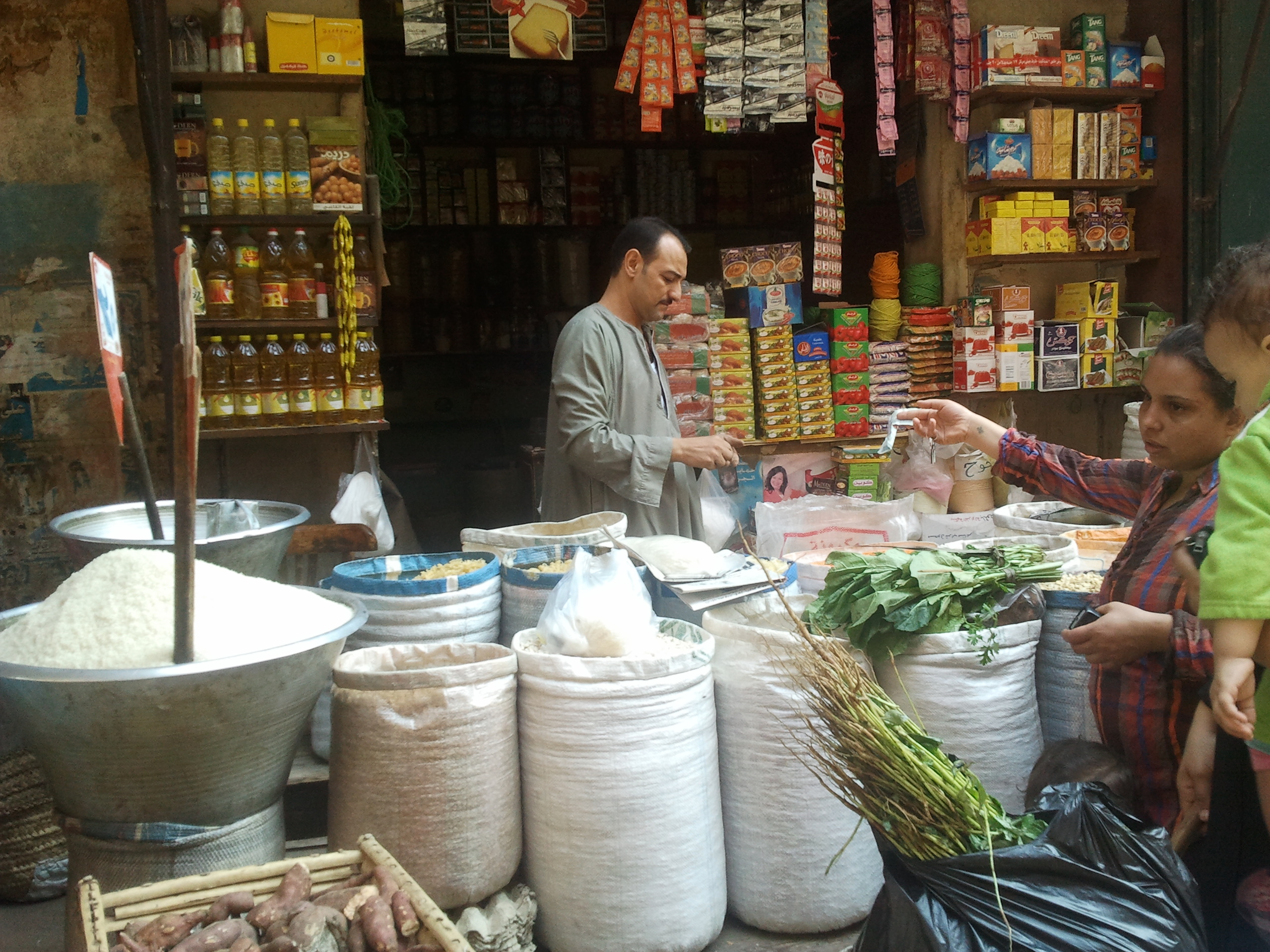
Sister Marina, Nermeen and Noreen are out for an adventure on a Sunday morning.  Much to my surprise, the souk begins right outside the gates of the Salam Center.  Soon after we begin our walk, I spot something that looks like coriander (cilantro) leaves, but they could be flat parsley – it’s hard to tell them apart.  I ask what it is in Arabic.  “Khosbara”, she says.  Sr. Marina leads us down a block or two to a spice, rice and dried beans shop.  She orders everything from the man in the shop.  I walk over to a barrel of what looks to me to be coriander.  What is this in Arabic?  “Khosbara”, she replies.  Bingo!   I order hundred grams, a big bag of kerkaday (hibiscus tea) and a hundred grams of cumin.
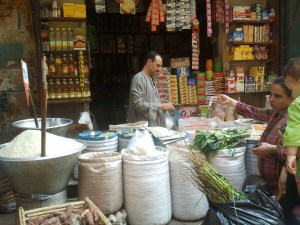
Man selling spices

Man selling spices

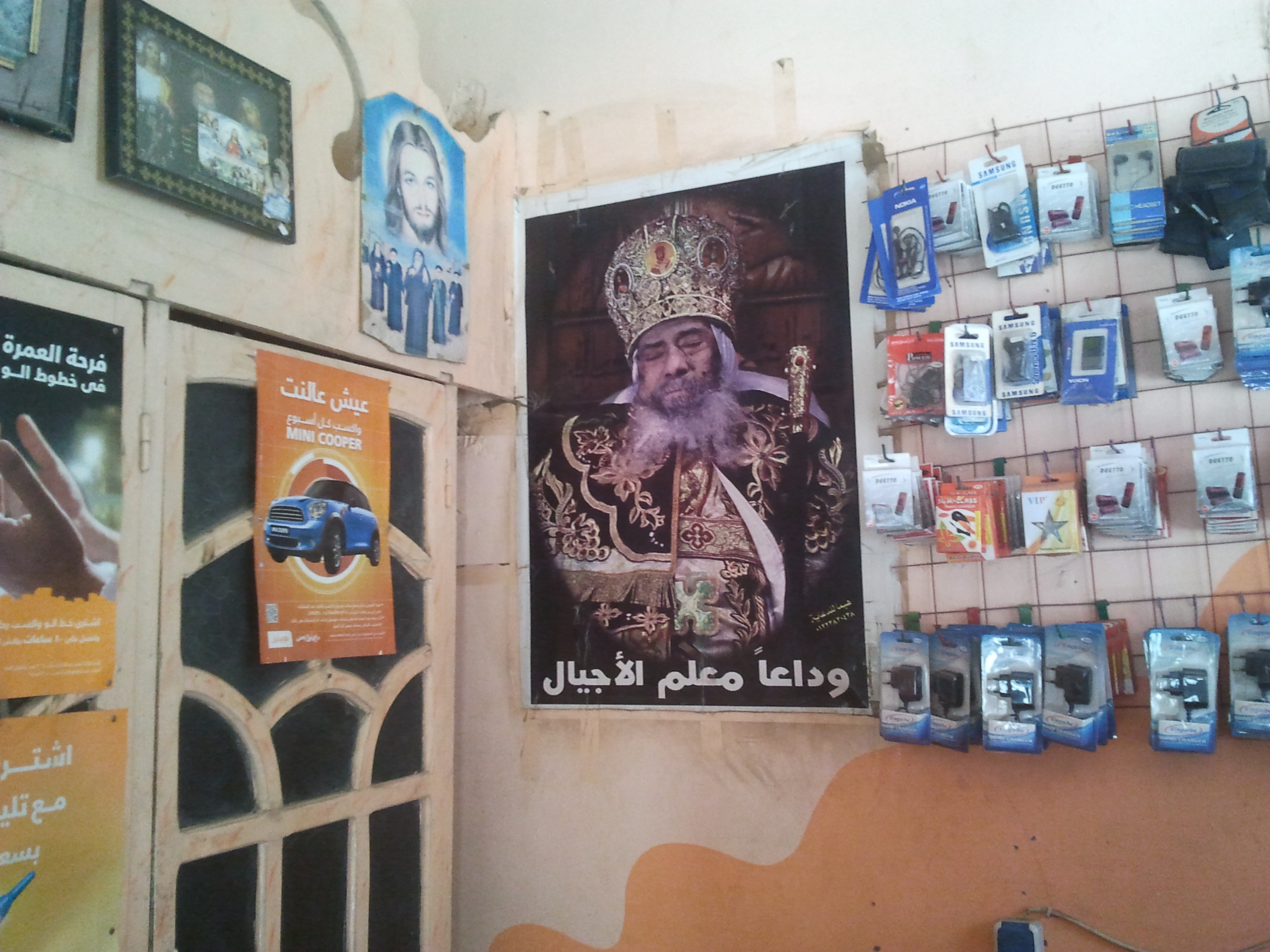
I don’t know how to say “chili pepper” in Arabic, so I use the word “pepper” and then point to my mouth and pant.  Aha!  I leave the shop with fifty grams of chili pepper as well.  All this for fourteen Egyptian pounds, about €1.50, or about $2.00.  Mission accomplished.  We saunter back towards the center.  Sr. Marina stops in a mobile phone shop to ask about something.  In the shop, I notice posters of Pope Shenouda, Jesus, Mary and various saints.  I make a mental note of it.  I’m in a Coptic shop.
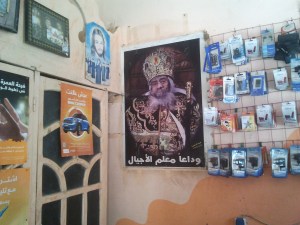
Coptic phone shop

Coptic phone store

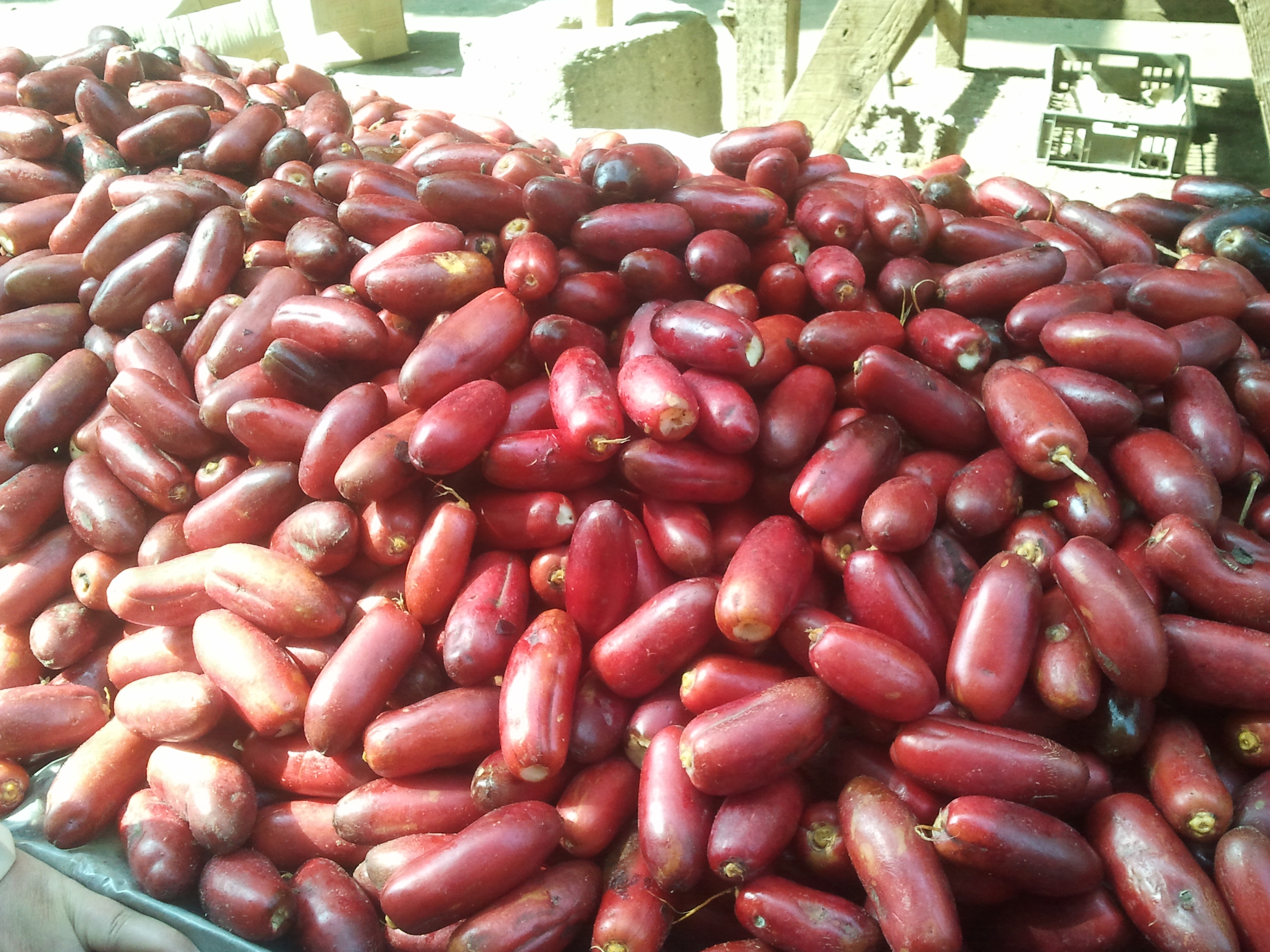
I see a strange-looking red fruit or vegetable.  It turns out to be dates, which come in various colors.  I later learn that red dates are Sister Maria’s favorite fruit.
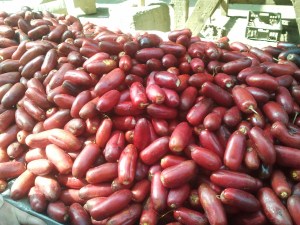
red dates

red dates

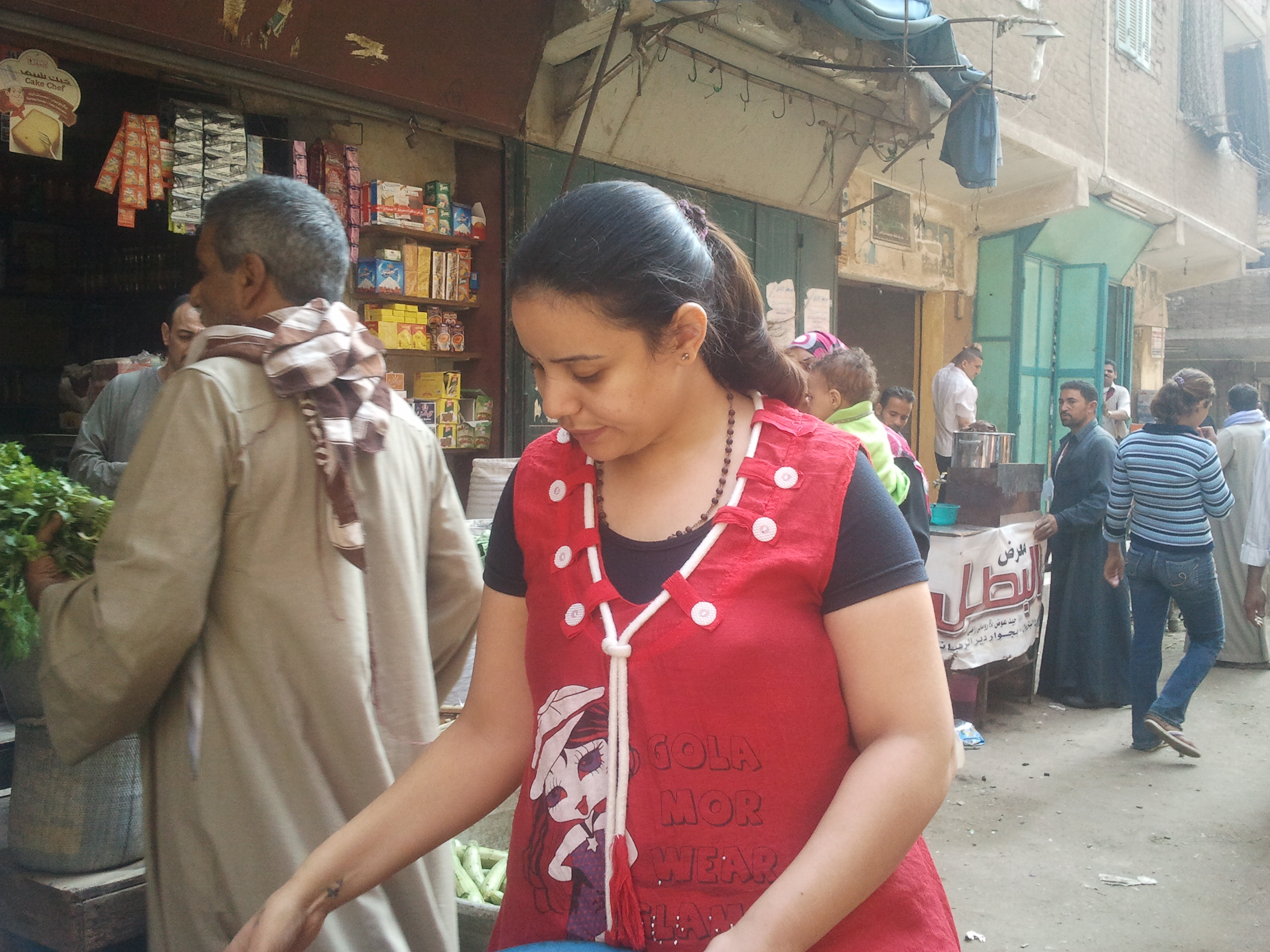
Once outside, as we pass a spice shop much closer to the center, I ask Sister Marina if the shop we bought the spices in is owned by a Copt.  She nods her head.  Just as I’m about to jump to the conclusion that all the Copts mark their shops with their posters, and that the Center only shops with the Copts, she stops at a cucumber stand where Muslim women are shopping.  By now, I think I can tell the difference.  There is a bit of haggling about something, but soon we leave, and Sr. Marina is content.  She’s even purchased some sweet potatoes for me when I mention that I love sweet potatoes.

After we arrive back at the center, Sr. Marina announces that we’re going to visit a church.  We head out onto the street again.  I notice that the building adjacent to the Salam Center has a loudspeaker.  This must be the source of all those deafeningly loud calls to prayer that wake me up at 4:30 in the morning, and sometimes keep me awake.  I ask Sr. Marina where the mosque is.  That’s it – the building next to the center.  “Two mosques,” she says, and points down the street.  That’s what I’ve been thinking – that there are two mosques near the center.

Apparently it is a long walk to the church, because Sister Marina tries to hail down a tuk-tuk.  We struggle inside, three women with generously padded hips, trying to fit onto a seat built for two.  I notice that the driver has a picture of Pope Shenouda on the windshield.  A Coptic tuk-tuk.  Before we even have a chance to get started, two menacing-looking young men accost the driver and Sr. Marina.  I have no idea what the problem is, but Sr. Marina and Nermeen decide this ride is not worth getting into trouble over.  We walk to the church, which is about a half hour away.

This church, Abousefin, says Sister Marina, is the local church, the one the sisters worship at when the priest doesn’t come to the center.

When we first walk into the building I notice a huge lobby.  Its vastness reminds me of the mega-churches in America, with their huge everything.  There is a huge poster of some man hanging on the wall.  In contrast to those of Shenouda and other popes and saints, this man is dressed in a suit and has no beard.

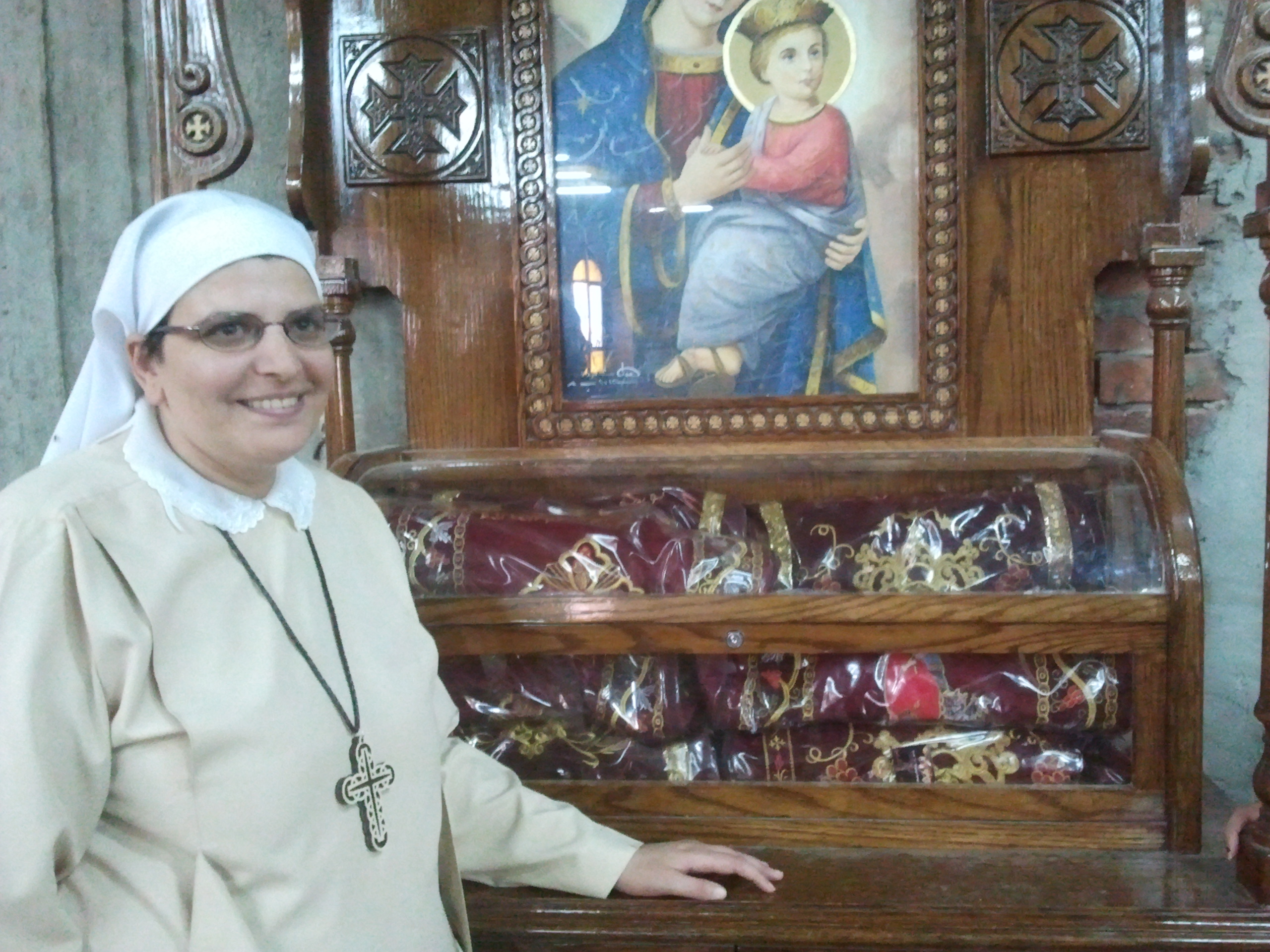
I notice that at the back of each of the three sanctuaries, where there are icons (paintings of saints and various popes), there are also glass cabinets with embossed velvet objects.  Sister Marina stops before one of them and kisses the cabinet.  “Santa Marina,” she says, her eyes dreamy, her voice reverent.  They lead me through the entire church, a seven-story building.  Each of the three is nearly identical except for the saints honored in each one.  Occasionally Sr. Marina and Nermeen touch a picture reverently or kiss a cabinet holding relics of saints they’re particularly fond of.
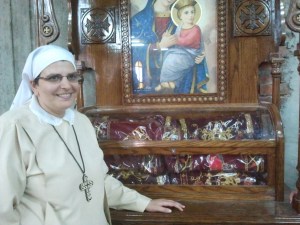
Sister Marina at shrine

Sister Marina with the relics of Saint Marina, her patron saint

The other day when I was walking with Sister Elleria to the hospital, a postcard with a picture of Joan of Arc happened to slip out of a folder and fall to the ground.  She almost jumped to pick it up.  “Who’s that?” she demanded.

“Joan of Arc,” I answered.

“You mean Jeanne d’arc?  I love her!” Her eyes glistened like wet wave-washed sand, sparkling in brilliant sunlight.  “Do you know anything about Jeanne d’arc?”

“A little.”

“Could you tell me what you know of Jeanne d’arc? I love her very much.”

“Here.  Would you like the postcard?”

“Would you really give it up?”

I was only carrying the postcard in case I’d be giving a talk to women.  Then I could possibly have used the card to illustrate Joan of Arc as an example of someone who knew her destiny and had the courage to go “outside the box” to fulfill it.  I’d already given the talk, and hadn’t even used the card, so I handed it to Sister Elleria, who held it reverently.  In her lab, where she analyzes blood samples, we sat and talked.  She has a poster of various saints in her office.  She explained each one to me.

“Do you like the saints?  Do you pray to them?”

“Well, not really.  I’m a Protestant and we believe that talking to God in Jesus’ name suffices.”

She tried to explain to me why studying, thinking about, imagining the faces of, and talking to the saints is such a wonderful thing.  Judging from her beautiful, soft, glowing, cheerful eyes, she must have an advantage over me.

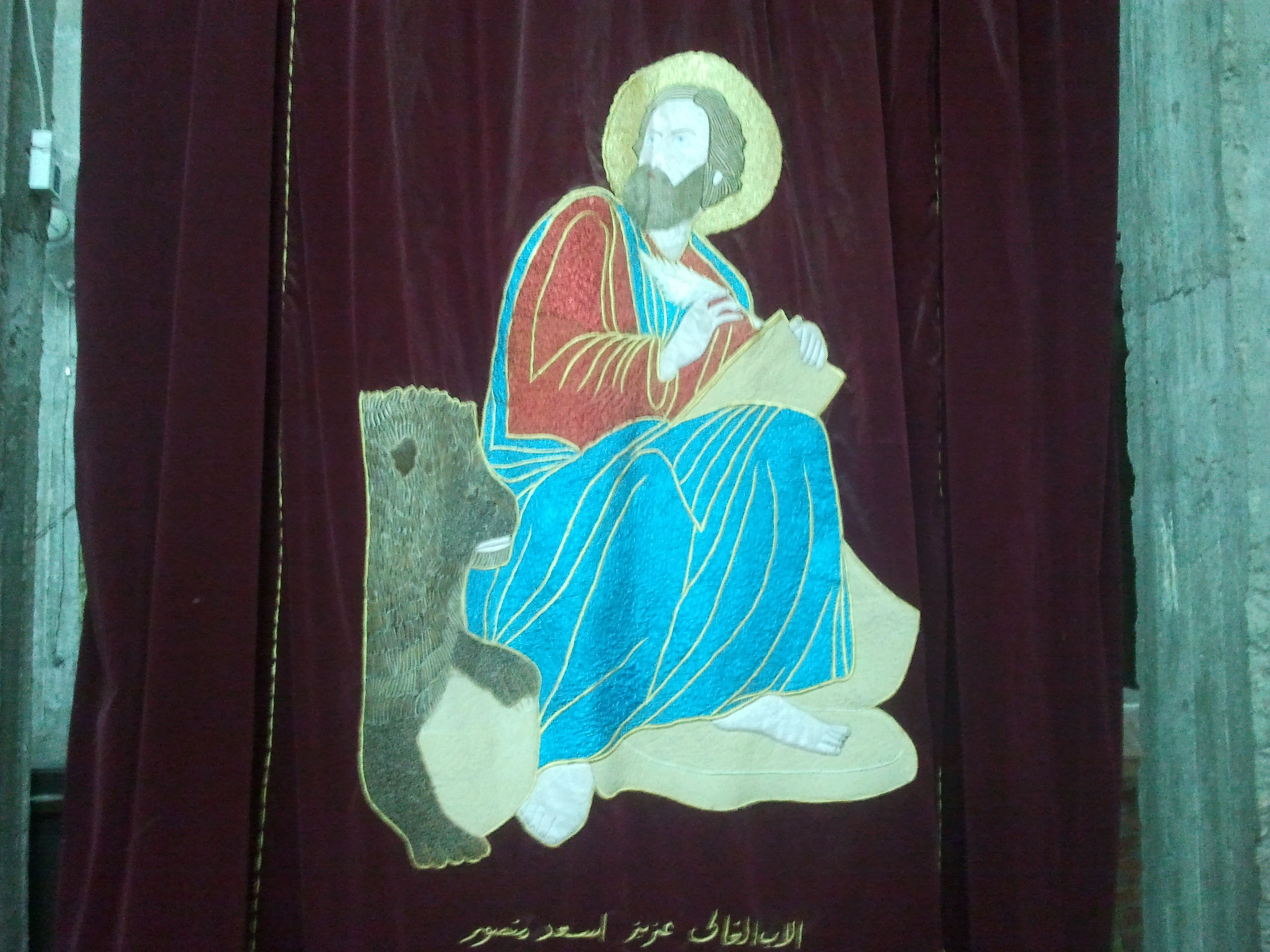
I see this same phenomenon today in Sister Marina and Nermeen, who often look dreamy-eyed as they kiss this cabinet and brush this picture or that.  We come across some red velvet curtains shutting off the altar areas.  Each curtain has beautifully sewn, glittery appliqués depicting St. George and St. Mark.
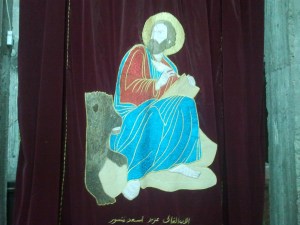
St. Mark, by Sr. Amina

St. Mark as created by Sister Amina

I learn that Sister Amina of the Salam Center has designed and sewn these marvelous pieces.  An elevator attendant takes up seven stories, to the baptistery.  Sr. Marina introduces me to the priest, a man with those same soft eyes I am seeing everywhere I encounter Copts.

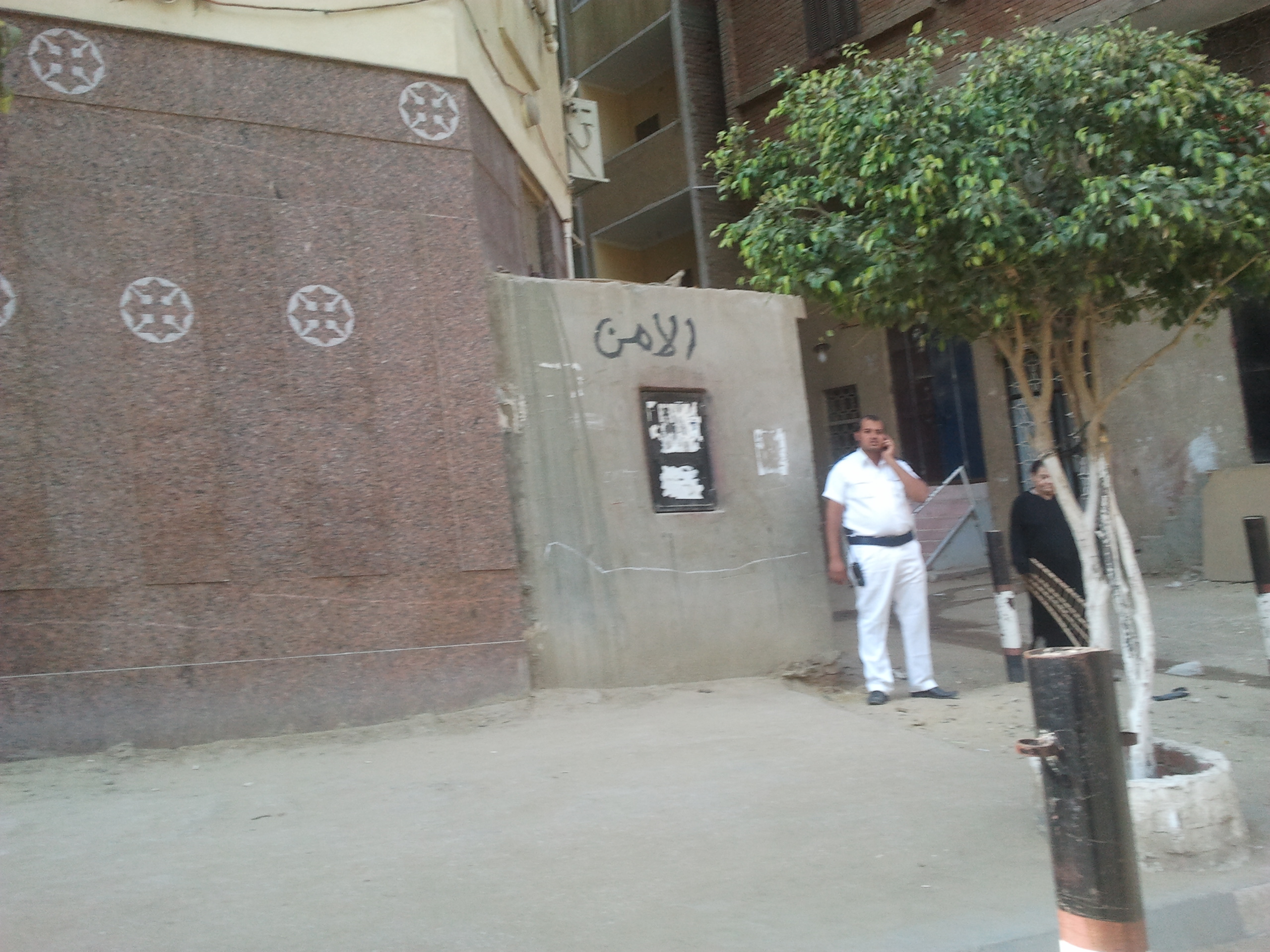
We leave the church.  Outside the church, I spot a soldier, dressed in the white uniform they wear during the summer months.
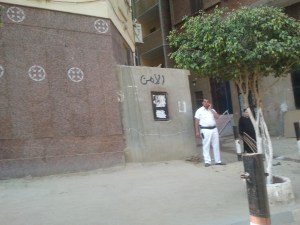
soldier guarding church

Soldier guarding church

Later, after my return to Germany, I learn that this church was attacked by Islamists a few months ago.  When they arrived at the church, a crowd of people, both Muslims and Christians, formed a line in front of the church to protect it.  The Islamists didn’t fire.  They tried a second time, and again people around the church formed a human shield.  This time, though, the Islamists found a man who had a picture of Mary in his workshop.  They killed him.  I wonder if the man whose photo I saw isn’t the man who was killed by the Islamists.

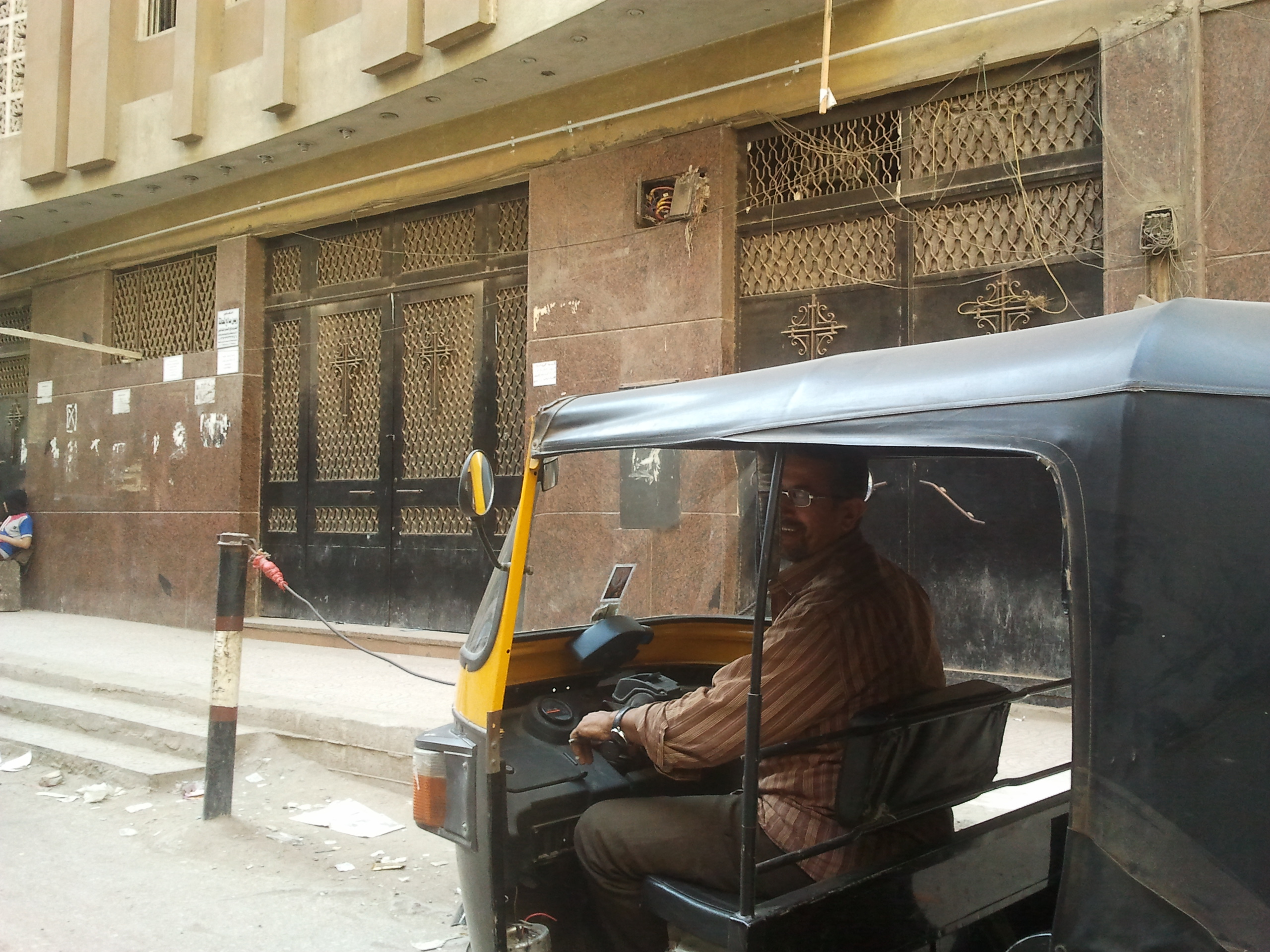
Sr. Marina stops a tuk-tuk driver.  We climb in.  Another Coptic tuk-tuk, but this time we actually get to go somewhere.  We’re off to another church or two.  This is my first tuk-tuk ride ever.  The time I went whitewater rubber rafting a few years ago with my nieces and nephews was not more exciting than this.  Our hips alongside one another are simply too wide to fit into the seat.  Nermeen motions for me to sit on her lap.  I sit there, my head almost bumping the roof, so I lean over the driver and hold on for dear life.  We laugh a lot on our joy ride to the church.
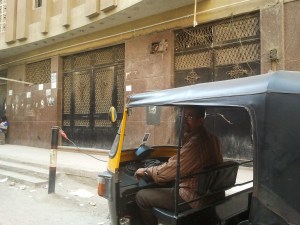
tuk-tuk driver

Coptic tuk-tuk driver in front of the church

The church, the one they call a cathedral is nicknamed Santa Maria by the metro stop (Ezbet El Nakhl).  We’ve been in the same neighborhood as the Salam Center all this time!  The church is actually two churches across the street from one another.  One of the buildings has a bookstore, and Sister Marina shows me a book with Soeur Emmanuelle, the founder of the Salam Center, on the cover.   How I wish I could have met her!  After my return to Germany, I listen to an interview with her in French, and she sounds so lively, so human!  But seeing her photo, I feel I have a connection to the founder of the Salam Center, as well as to those living there now.  Unfortunately, the bookshop is closed.

Again, I notice Sister Marina and Nermeen kissing and touching a lot of pictures.  In one of the churches, again separating the sanctuary from the altar area, there is another beautiful appliquéd curtain.  It’s the Virgin Mary.  I am particularly struck by the beautiful work on Saint Mary, as well as her soft eyes.  Again, the seamstress was Sister Amina.  Sr. Marina, Nermeen, and I reverently touch the curtain.
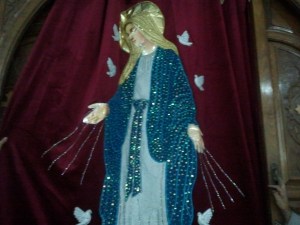
Virgin Mary, by Sister Amina

Virgin Mary, as depicted and sewn by Sister Amina

In the cathedral church of Saint Mary, there is an icon of Saint Marina.  I take a photo of Sister Marina next to her favorite saint.

I ask her who gave Sister Marina her name.  She stops, turns to me, looking at me with soft eyes, and says in a hushed tone, “Father Shenouda”.  It was the Pope himself who blessed her, who gave her her habit, her cross, her name.  Five other sisters at this convent received their names from him at the same time.

We look at the pictures of the twelve apostles at the front of the church.  Unlike the gothic paintings or statues of the various saints I see in Catholic churches throughout northern Europe, these saints all look wonderfully kind, soft, and gentle.  I think the Copts must value kindness and gentleness above everything else.  They study and collect pictures of the lives of these saints like teenagers collect pictures of sports or movie stars.  The difference is, the saints are truly positive role models.  At this moment I wish I had grown up in a Coptic culture rather than in a sober, icon-less Protestant church.

“We don’t worship the saints,” said Sister Elleria.  “We admire them. We honor them.  I hope to be a saint one day, but I don’t hope to die for my faith, like Jeanne d’arc did.”

We look at a large photo hanging on the wall of a man from our time.  He’s a priest, says Sister Martina, who was shot dead by Islamists.  A martyr.

“I fear for you all here,” I tell her.

“No need for fear.  We have Jesus in our hearts.”

Sister Marina’s cell phone rings.  It is Sister Maria.  They talk for a minute or two and then Sr. Marina hangs up.  “I love Mother Maria,” she says in English and again in Arabic.  We’ve been practicing the phrase “I love…”  Nermeen nods her head.  “Me too.”  I agree.  Me too.

It’s time to go back to the convent.  We’re all hungry.  We find another tuk-tuk.  We bump and jerk along dirt streets and avenues until we reach the center.  And then a nasty scene takes place.  The driver is not content with the money Sister Maria has paid him.  Nermeen and I each offer to contribute some money of our own, but Sr. Maria won’t let us.  “He got the same amount as the other driver – five pounds.”  Judging from his face, I’m hoping there won’t be a terrorist attack on the center.  Sister Maria later tells me that he wanted more money because there was a foreigner in the group.  Whenever there are foreigners present, people want more money.

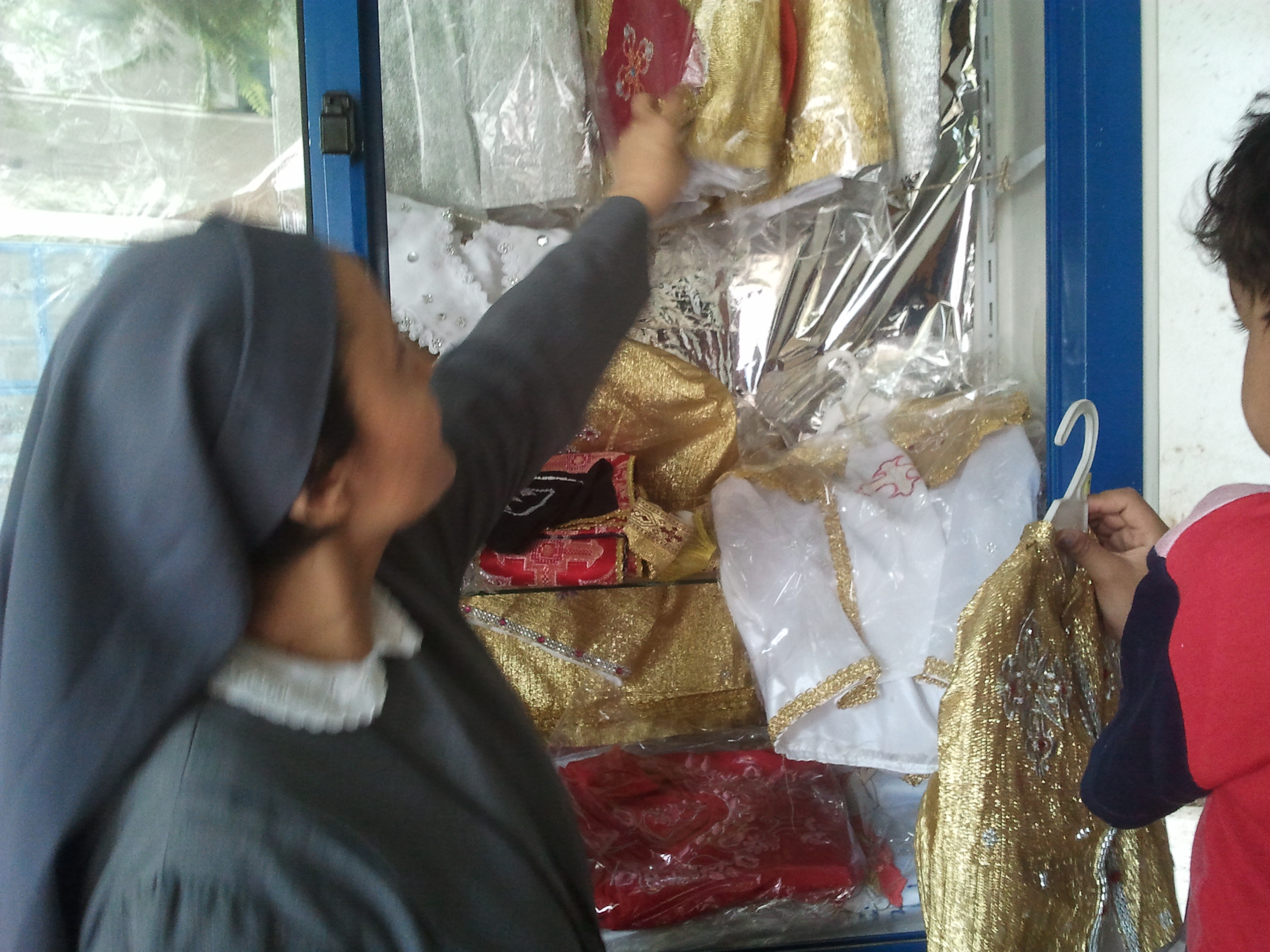
Back at the center, we find Sister Amina still seated at the table, finishing her lunch.  I show her the photograph in my cell phone, her depiction of Saint Mary.  She looks at it, smiles, kisses my cell phone and hands it over to another sister who wants to see the photo.  She also looks, smiles, and kisses it, without a hint of embarrassment or shame.
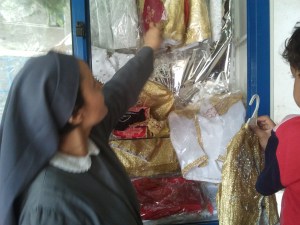
Sister Amina

Sister Amina showing someone baptismal clothes she has sewn

I don’t understand this culture, but I like it.

Rubies in the Rubbish – Day Eight

20 Wednesday Nov 2013

Posted by noreennanz in Uncategorized

≈ Leave a comment

Tags

Alaa Al Aswany, Cairo, Christiaity, Christianity, Copts, Education, Egypt, Garbage Area, Pilgrimage, Spirituality, Spiritualty, travel

It’s 8:30 on a Saturday morning – time to go to school!  I sit inside the passenger seat.  There is no seatbelt for me to fasten.  I’m lucky that the car starts.  Sometimes it seems sluggish.  But it’s always clean.  Rohmy washes all the cars every day.  He sits in the driver’s seat, slams the door shut and hands me the window crank.

Rohmy

Rohmy, my usual driver, and just about everyone else’s.

There’s only one window crank for the whole car, so we have to share it.  I roll down the window and desperately try to see everything there is to see.  There’s so much happening, I feel anxious about missing or forgetting important things.  Oh, well, I’ll just let the impressions simply drop into my mind.  The drive is becoming routine.

I wonder if I could find my way there alone if I ever had to walk.  No, it’s too complicated, despite the grid pattern.  Today another road is blocked off with a huge piece of canvas about three meters high.  A wedding?  Rohmy says they sometimes block the road for special occasions like weddings, so he has to drive around the block.  Even if I could walk to school, I am told it would not be safe for me, a Westerner, to walk alone.  Theresa, the woman who translated for me when I spoke to the ladies last week, walks alone every day to work.  It takes her about an hour each way, when she factors in taking the children to school and picking them up in the afternoon.  She tells me she lives near the closest metro stop, which is about thirty minutes’ walk from here.

Theresa

Theresa, who heads the social work program

I see a giant poster with a photo of Morsi hanging from the wall of an apartment building.  I’ve noticed this poster before, but today I notice that it is only a couple of blocks from the Salam Center.  Copts are telling me that the Muslim Brotherhood are terrorists.  They compare them to Al Qaida.  Since my arrival, I’ve experienced Egypt’s first drive-by shooting that targeted Christians.  I’ve been told that the Muslim Brotherhood condemns this killing.  And yet, this poster makes me a little nervous.  Just what are the intentions of the Muslim Brotherhood?

I see posters of other politicians, presumably, hanging from walls.  I have no idea who these people are, or why their pictures are hanging, but I assume they’re various politicians.

Hanging across many of the streets are giant posters with photos of Shenouda, the late Coptic pope.  I assume these placards identify the neighborhood or street as being Coptic.

I see men in clean, pressed shirts and trousers walking along the dirt roads.  They must be on their way to work.  At shortly before 9 am, I don’t see many men in gallibayas (long robes).  Most of the women, however, whether Copt or Muslim, are dressed in gallibayas.  I think I’m learning to tell the difference in appearance between a Coptic and a Muslim woman when both are in gallibayas.  Their heads may both be covered, but the Coptic woman wears a scarf that may expose some hair, and her gallibaya looks more like a decorative long tunic.  It may be made of cotton or velveteen, and may be brightly colored or with trimming or embroidery.  A Muslim woman, at least in this neighborhood, is dressed in a plain, dark-colored gallibaya, with her head entirely covered.

The Coptic children are dressed western-style.  Many of them are wearing brown/beige uniforms.

There really isn’t that much trash on the roads.  I see someone sweeping bits of paper into a little pile.  Somewhere else a little pile is burning.  Most of the roads are actually pretty trash-free.  I realize that the path I take in Cologne, Germany, when I walk to the supermarket, has more trash strewn along the way than I see on these streets.

I see chickens running freely in the road.  With this number of chickens running around free, it’s no wonder the nights are so noisy!

I arrive at the school.  I don’t notice the smell of garbage anymore.  I’ve had these kids for almost a full week now.  My students, age five, have learned to say the entire Lord’s Prayer in English.  Today they’ve also learned to sing all of “Jesus Loves Me”, and the “ABC song”.

I notice that the classroom is almost twice as full of kids today as it was in previous days.  I ask why.  Because today, Saturday, the public schools are closed, so Marleen, the principal, has invited them to come to the Coptic school on Saturdays.  Imagine kids from Europe or America choosing to go to school on a Saturday!

As far as I can understand it, most Egyptians have Friday, the Muslim Sabbath, and Sunday, the Christian Sabbath, off.  They work Saturdays.  But not those with government jobs.  They have Fridays and Saturdays off.  I wonder what they do on Sundays.

In front of the school

In front of the school

My lesson is finished at 10:30 am.  As I wait for Rohmy to pick me up, a boy, about twelve, walks up to me with a bag of corn puffs and offers me one.  I say “Thank you” in English and eat it.  He responds, “I love you!” and runs back, giggling, to his friends, who all yell at me from back in the corner, “I love you.”  Who wouldn’t want to come back to a country where people tell you every day, “You’re nice,” “I like you,” “You’re beautiful,” “I love you”?

It’s a madhouse when school lets out and everybody, parents and kids alike, are waiting for each other and it’s packed like a school of minnows.  But I love it.  This is when I get to do my informal teaching.  Some days I have the kids write their names, or I show them illustations from magazines and we talk about the words, or I go over an English lesson with someone.  There’s always someone eager to interact with me.  Today my entertainment is filming them interacting!

The other day I was showing Marleen some of the photos in my smartphone, and she came upon one with me playing my piano.  “You play the piano?” she asked me.  Now Marleen has asked me to give the children piano lessons next time I come.  I ask Marleen if there is a piano here in the school.  I can’t imagine there being one.  She says no. Assuming I come again, I’ll have to bring my keyboard.

Others are talking about what I can do next time I come, or telling me that I should stay longer.  I’m having the same thoughts.  In Germany I wouldn’t normally volunteer to teach kindergarten kids English, and giving piano lessons is sometimes tedious.  It’s not a skill I usually offer to teach others.  But here, it is entirely different.  Here, where children volunteer to come to school on Saturdays, I find myself wanting to teach them everything I know.

I’m sitting in my room now, after having taught my morning lesson.  Rohmy has delivered me safely back to the convent.  I’m drinking a lovely cup of black tea with mint from the convent garden, reflecting on my morning.  I, the teacher, have learned a whole sentence today in Arabic:  Ana ashram kubay chai. “I’m drinking a cup of tea.”  I’m so proud of myself!

I find that I’m teaching some of the same kids in the evening program at the convent as I encounter mornings at the school next to the garbage dump.  They too are opting for more lessons.  My heart aches for them to succeed in life.  I’d love to be able to help.  Here, it feels like the work I do is more important than what I do in Germany.

I do wonder about the future of these kids.  Will they spend their adult lives sorting through garbage, like their parents?  There’s one girl I’ve been thinking about – Marina.  She’s very shy, not very good in English, and she’s young – only about nine years old.  She comes to school in a training suit and stiletto half-boots she must have inherited from someone.  They’re way too big for her little feet.  What will happen to her?  Will she ever find a good job?  And then there’s Rosaria, in the sixth grade.  She’s really good, and she always does her homework.  But her pronunciation is terrible!  Sister Maria has told me that Marleen wants to get her best students into the elite private “language” schools, where lessons are taught in English or German.  Sister Maria tells her, forget it.  They’ll never get accepted because they’re from poor families.  This mirrors exactly the fate of one of the characters I read about in The Yacoubian Building, a novel by Alaa Al-Aswany.  In this novel, a boy from a poor family is consistently rejected, even from the police academy, when he’s successfully finished school, because of his background.  He ends up becoming an Islamist terrorist.

Rubies in the Rubbish – Sister Maria

18 Monday Nov 2013

Posted by noreennanz in Uncategorized

≈ Leave a comment

Tags

Cairo, Christianity, Copts, Dorothy Day, Egypt, Pilgrimage, Sister Maria, Sisters of St. Mary, Soeur Emmanuelle, travel

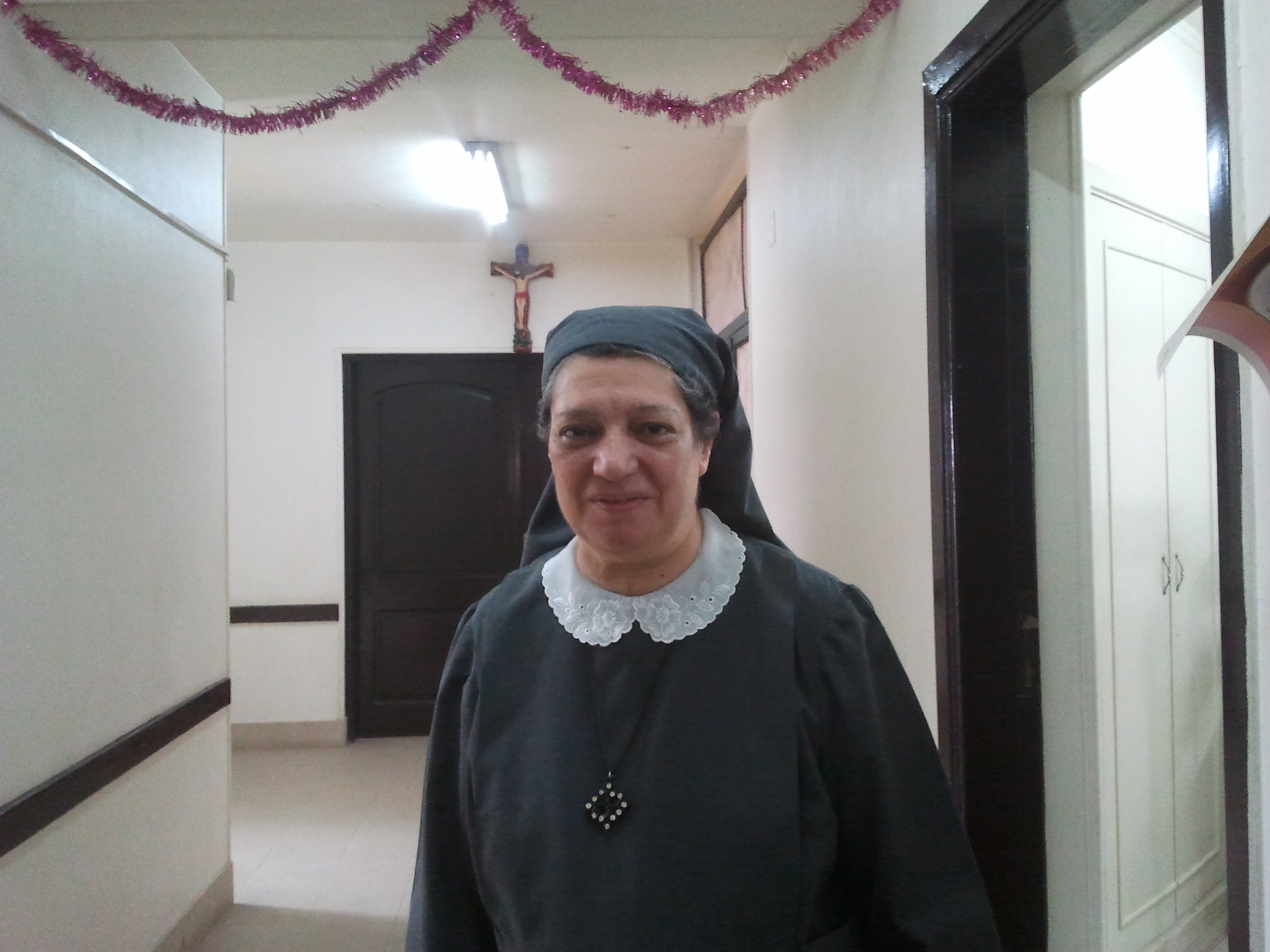
Sister Maria (Tesoni Maria, as they call her in Arabic – Tesoni means “Sister”) is the director of the Salam Center.  She is the one I first came into contact with, the one who, at my request, said, “Please come.”

Sister Maria is a soft-spoken, calm woman with kind, soft, yet perceptive eyes.  Her quiet manner would probably cause her not to shine out in a crowd.  This is partly what makes her a hero to me.  I’ve been watching her for almost a week now.  To me, she’s the Mother Teresa of Cairo.

Sister (Tesoni) Maria

Sister (Tesoni) Maria

When she enters the dining room, all conversation ceases.  Not because the sisters are afraid of her, but because in her presence, they realize that in a convent, mealtimes are meant to spent in contemplative silence.  At least, this is the feeling I get while observing the silence in the dining room.  She can probably read me like a book, but it doesn’t matter.  I have nothing to hide.  Besides, she herself is a fascinating book I’m also trying to read.  Silence does not always reign at the table.  Sometimes there is lively talk, and Sister Maria laughs and shares with the others.

I admire the glints of spiritual intelligence that occasionally sparkle our conversations.  I comment on how many girls have some version or other of the name “Mary”.  I have met many girls and women named “Mariem”.  At least one Mary.  A Marina and a Martina.  There’s Marleen, and a few Maria’s, including the Sister.

“I often think about the qualities of this woman who was chosen to be the mother of Jesus,” she says.  “What an amazing person.  I wonder if it is all that meditating on Mary that makes Sister Maria so soft and gentle, so accepting of what life may hand her, so calm and connected.  Not only is her name Maria, but she also belongs to the order of the Sisters of St. Mary.

I tell her about my first trip to Egypt and the visit to the Philae temple in Aswan, where I first heard the story of Isis and Osiris, and how it excited me.  The parallels to the story of the Virgin Mary giving birth to a son, Jesus, who is to be a savior, are so clear.  I tell her how excited I was to hear of the Pharaoh Akhenaten, who introduced monotheism to Egypt.  I found it exciting to hear of a man outside of the Bible stories – an Egyptian who believed in one invisible God, a spirit God, who created the entire universe.

“Yes,” says Sister Maria.  “Some people say that it is because of preparation like this that made it so easy for the Egyptians to become Christians.”

I have watched her arbitrate disputes.  I hear only the name of one of the sisters, and I know someone is complaining about someone else.  Sister Maria listens calmly and gives her input.  She listens to the arguments of the people complaining.  She is not autocratic, not authoritarian; she’s open for discussion, and I have the feeling that her sisters know that she will deal with them fairly.

I think I heard the sisters discussing some topic with Sister Maria yesterday, perhaps political, or theological.  It was a heated discussion, but each sister was free to state her opinions openly.  Sister Maria was authoritative, yet open to whatever it was they were discussing.

I get the sense that she is used to being around dignitaries who come to visit the center.  Twice this week I’ve seen people whose appearance suggests worldly importance.  At these times she chats with them openly and pleasantly.

I once knew another woman in a similar position whose humility also commanded respect, and who, now deceased, is a candidate for sainthood in the Roman Catholic Church –  Dorothy Day, the founder of the Catholic Worker.  To me, Sister Maria should also be made a saint, but she is already so in God’s eyes, and that’s all that really counts.

In the arrogant inexperience my youth (I was only twenty-two when I met Dorothy Day), I didn’t understand some of the things that I saw and now see happening around Sister Maria.  People defer to her.  When I lived with Dorothy Day, I thought the deference she received was inappropriate.  Now, watching Sister Maria’s calm acceptance of it, I think Dorothy was probably annoyed or perhaps ironically amused by it but, knowing how people are, she graciously put up with it.  Both she and Sister Maria chose to live among the poor instead of seeking worldly success.  And yet, choosing to serve the poor and sticking to it, amazing things happen.  There is success when a person commits her life to improving the lives of those who are weaker, persistently continuing the work, whatever the setbacks.  Projects are successful, new projects start, and people’s lives start to turn around.  This success commands the respect of many of those who have achieved worldly success in terms of acclaim, honor and wealth.

I don’t know if Sister Maria is famous.   Not knowing makes it a lot easier for me to talk to her.  She is approachable (after mealtimes), and always understands what I am trying to tell her.  If she is famous, she seems utterly unfazed by it.  She doesn’t talk about herself, only about the people who serve alongside her, and the people they serve.

“You must see the work in the home for the handicapped children,” she tells me.  These, I think, are the very poorest of the poor.  They have been abandoned by almost everybody.  One of the sisters tells me that in Egypt, people are afraid of mentally handicapped people.  Not Sister Maria.  One of them gets to sit outside the hospital every evening and sell snacks to passers-by.  How wonderful that in this center, they are given a position of dignity.

The Salam Center was founded over thirty years ago as a co-project by Soeur Emmanuelle, a French-Belgian Catholic nun known throughout Europe for her work, and by the Coptic Sisters of St. Mary, the order Sr. Maria belongs to.  Sr. Emmanuelle has since passed on, but Sister Maria, who came to the center over twenty years ago, became her friend and colleague, and is now carrying on her work, adding new projects to what Sr. Emmanuelle began.  She oversees every project of this center.  There are many of them.  There’s the hospital, for starters.  There are free schools for the children of the garbage workers.  There are kindergartens, a children’s health clinic, where children are treated and parents instructed in hygiene, nutrition and health hazards.  The clinic educates parents on the harmfulness of female genital mutilation.  There’s the center for the handicapped, a home for the elderly, a team that visits and cares for the elderly who live in their homes.  There is a women’s program, where parents are educated in topics such as gender equality, civil rights, drug prevention, and prevention of female genital mutilation.  Social workers go and visit the homes, helping parents obtain important things they need, whether it be documentation or funding.  The women’s center has seamstresses who teach sewing, so that women can have an income.  There are training programs for young people, where they can learn things like mechanics, computer operating and repair, and hairdressing.

“Everybody I meet is so warm and kind!” I say to Sister Maria.  “Everybody I meet seems to talk about a deep love for Jesus, but it isn’t just talk.  They all seem to show the love I think characterized Jesus.”  She nods her head.  I ask, “Do you interview all the people who come to work here?”  She says yes.  “Are you looking people with open hearts more than the right theology?”  Again she nods her head and says, the one quality she and everyone else involved in the hiring process is looking for is hearts that honor, that want to love and serve the poor.

This is what makes her, to me, a saint.  Because everything this woman is, is about following and serving Jesus Christ.

Rubies in the Rubbish – Day Seven

18 Monday Nov 2013

Posted by noreennanz in Uncategorized

≈ Leave a comment

Tags

Cairo, Christianity, Copts, Egypt, Pilgrimage, Spirituality, the Better Life group, the Better Life team, travel

I am so happy, my heart is so full, I can’t sit still.  I can’t concentrate.  I can’t believe I’m doing the very things I have been longing to do – in Egypt.  My gifts are being used, just like the broken parts of the wheelchairs I see piled up in the parking lot.  And I’m learning to value them.  In Germany I have often thought being an English teacher to be beneath my level of intelligence.  Not only is my life as an English teacher reductive, I keep getting the lowest level students, reducing my vocabulary still further!  My once vast vocabulary has been reduced to a few hundred words.  When I speak to native speakers of English, I think I must sound like a simpleton, my English has become so basic.  But here in Egypt, that is exactly what they need.

This morning, a new thought emerges.  It is so beautiful and new, I think it is God speaking to me:  “These are my beloved children.  I am so pleased that you are open to them, I am opening your heart up, just as you have asked me to do.”  It is as though my openness to the poorest of the poor opens me.  As I close myself to the weakest, the most broken, my heart closes in direct proportion.  What an amazing principle.  I have asked God to open me up more and more to God’s love.  And it is happening.  I tingle.  My heart burns.  The condition for receiving this love is to be open to all of God’s creation.

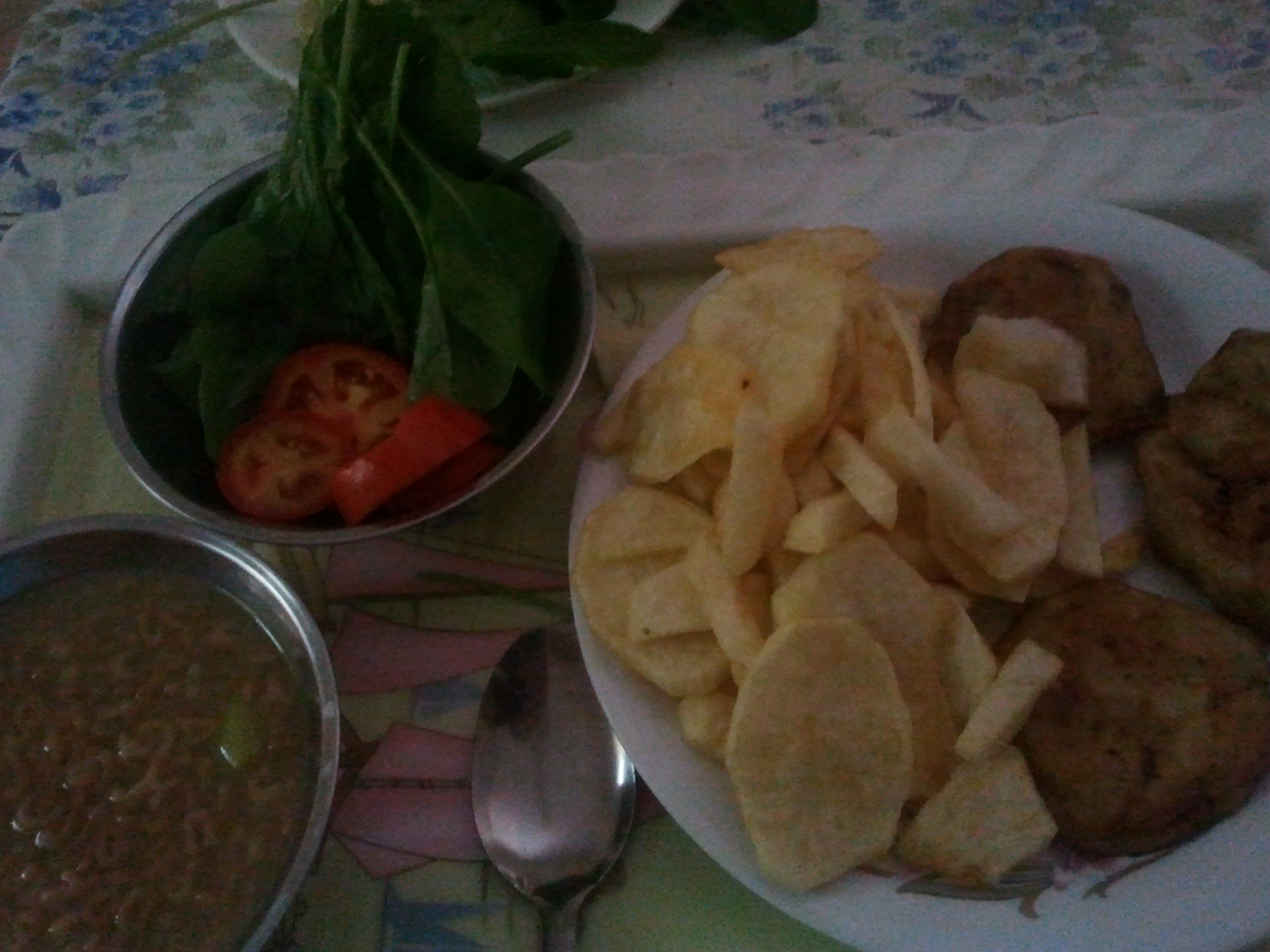
Today is Friday, the Sabbath of the Muslims, and everything is closed.  Most of the sisters are fasting, and there are no activities scheduled for today.  All I can report of this day thus far is that Sister Mariem has prepared a magnificent breakfast for me – breaded fried eggplant, French fries, noodle soup, tomato slices with rucola, and bread with molasses.

Egyptian breakfast

An Egyptian breakfast, made just for me

Sister Ologaya sits across from me, eating foul – cooked fava beans and pita bread, her favorite breakfast.

Each day I am more impressed with these sisters and their work.  I recall a Bible passage about the worth of a woman.  In Proverbs 31:10 it says, “A wife of noble character who can find?  She is worth far more than rubies.”  These women are celibate, but I believe that in the Catholic Church, when a nun makes her vows, she becomes a bride of Christ.  So, these Sisters are also, in a way, wives.  They are beautiful gems, and I find them models of what I admire in a woman.  I find myself calling them rubies – rubies who have chosen to live in the rubble near the rubbish heap.

Sometimes I wander into the dining room and discover a sister or two working in the kitchen.  They’re often humming pretty songs, which I assume are Egyptian songs worshipping God.

One day when I was in the dining room I showed them that I had Egyptian worship music in my computer – music from a group called “Better Life“.  “Oh, I know that group!” they all exclaimed.  Since then, when I come into the dining room to check and write emails, they ask to hear the music, and then translate the lyrics for me.  Sister Marina even owns the same CD as I, and Sister Elleria sings a song for me.  What a beautiful voice she has, and how lovely these songs are.

Each day they overturn assumptions I had made the day before.  Now I know that the entry to the convent is filled with sand piles because they need the sand for laying the terracotta tiles.  There are plans to turn the garden I thought was so messy into a little paradise.  Parts that look as though they are randomly lying around, are actually there for a reason.

The washing machine I thought had been discarded into and defacing the garden was placed there because it is next to where the handicapped children live.  These children are helping to load trucks with things like the washing machine, as well as the wheel chairs now sitting in the parking lot, for repairs.  They are helping load lumber and furniture onto trucks for delivery to a new school/dormitory the Salam center is opening.  Nothing is wasted here – not the gifts of the handicapped children, and not the leftovers from the meals.  Sister Mariem’s dog gets all the chicken bones.  I thought dogs couldn’t eat chicken bones, but this dog does, and is not harmed.

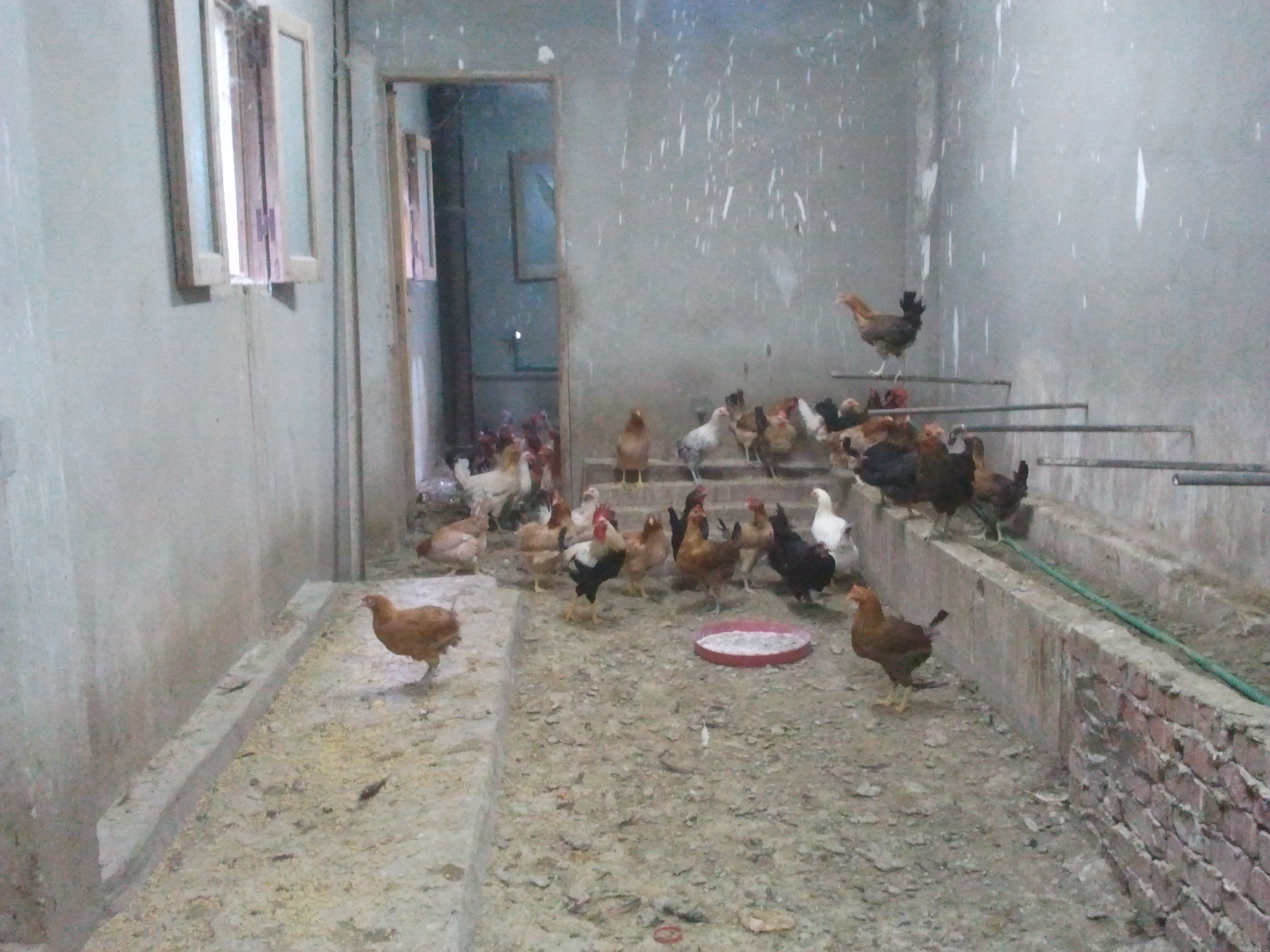
It seems I am not harmed from the food either.  I tried a little rucola the other day, and my stools were fine afterward, so I’ve been increasing my intake of raw vegetables.  I’m still in the best of health.  At breakfast I look at all the food in the garbage and ask if this is for compost.  No, it’s for the chickens.  You have chickens here? I ask.  Oh, yes, they’re Sister Mariem’s chickens.  I ask to see them.

Sister Mariem's chickens

Sister Mariem’s chickens

I am ushered outside to a dilapidated building, where the chickens are kept.  We have delicious eggs nearly every day here.  Turns out these eggs are from Sister Mariem’s chickens.  So I ask Sister Mariem, whose English is the best of anyone’s here, if the garden is organic.  “Oh, yes,” she answers.  “We don’t use any chemical fertilizer on the garden.”  I found out that the tap water is safe, just unpalatable.  So the food here is also safe for Westerners to eat.

Sister Mariem

Sister Mariem

One day Sister Ologaya shows me the garden.  We discuss the names for herbs and vegetables.  Sometimes her English fails her, and she resorts to French.  Either way, I’m learning so many new words for these things, I can’t keep track of them all, although I write down and practice new words every day.  Green beans, fava beans, lettuce, cabbage, rucola, molokhaya (the vegetable that tastes like slimy spinach), mint, sage, onions, mango, date and orange trees, and more.  She leads me to a stall, where I discover a beautiful young cow and a goat.  They plan to inseminate them so that next year they can have their own fresh milk.  Knowing the sisters, they’ll probably find a nice male cow somewhere and put the two cows together.  The cats have the run of the garden.  My first day I discovered a cat resting on one of the chairs in the dining room.

Sister Ologaya

Sister Ologaya

I love this place that converts old apartments into chicken stalls, old hospitals into schools, and lets cats run around the dining room.  I find myself, for the first time, wholeheartedly accepting a Christian community.  I feel like I belong here, and that I want to belong to these women who are so full of love and joy.

Rubies in the Rubbish – Day Six

17 Sunday Nov 2013

Posted by noreennanz in Uncategorized

≈ Leave a comment

Tags

Cairo, Christianity, Education, Egypt, Garbage Area, Pilgrimage, travel

Time is flying and, as the McDonald’s ad says, I’m lovin‘ it!  I am so happy here.  Everywhere I go, people greet me with a smile, and I have to smile.  Maybe I smile first and they smile back.  I don’t know, but I end up smiling all day, and then the people here think I always smile.  It’s not true, sadly.  But inside of me there is a joyful woman, and she comes out here; full of life, love and joy.  She is in love with these people.  I’m not sure I would want to live forever under these material conditions, but for now, I can’t imagine a place I would rather be.  These are the people I want to be with, at least for now.

Today I am bold – I wear my black flowered flip-flop sandals to the garbage dump.  Everybody else wears sandals; I want to risk it too.  The only problem is, just before the school, the road is blocked because of a building under construction, so Rohmy and I have to walk over a pile of gravel and another sand pile.  My sandals and feet are full of sand by the time I reach the school.

I go back to the same kindergarten class I had two days ago.  The same child is sleeping, but he wakes up for the lesson today.  Marleen, the school principal, wants me to teach these children to say the Lord’s Prayer in English.  Five-year-old children who don’t speak any English.  I look at her for a second, doubtfully, but she assures me that these kids know it in Arabic and that it will be good for them to know this prayer in King James English.  Okay…

“Our Father”…I interrupt myself.  “That means ‘Papa”.  They all know the word “Papa”.  “Our Father”…and they all repeat after me a few times.  “Who art”… They repeat this.  “In Heaven.”  They repeat.  How to explain what Heaven is?  I point to the sky and all around me.  We get as far as “Hallowed be Thy Name”, repeating many times, when I decide that’s enough for today.  We have several more days to learn this prayer.

Marleen comes back into the classroom and says to the children, “I love Jesus!”  They all repeat after her, making motions for each word.   This reminds me of the song I learned in Sunday school, decades ago, “Jesus loves me.”  I once heard a sermon about this song that I will never forget.  The preacher said that this song contains some of the best theology in existence, and it says it all.  He said it is a song that says all we need to know.  I would agree, except my prayer for myself is that I will love Jesus more and more, with all the love I have.

I ask Marleen if she knows this song.  No, she’s never heard it.  I sing it to her, and she is amazed.  She finds this song incredibly beautiful.  So I begin to teach it to the children, using the same motions she used, but in reverse, and adding a few others.  Then we continue to the lesson we had two days ago, writing the letters of the alphabet.

Suddenly I am called out of the classroom.  Sister Maria has called the school and told them that I am to visit another school.  She has already told me she wants me to have a look at all the programs this center provides, so I’m not surprised by this sudden change of schedule.

Another woman and I walk a block or two, past people sorting through garbage, past shops, past donkeys carting garbage and goods for sale, to another school.

rubbish processing center

a rubbish processing center

As soon as I enter the school, I see that someone has taken pains to beautify it.  The walls are clean and freshly painted in lovely contrasting shades of pink and maroon.  I glimpse a sign in English, “Literacy Program”, and we enter a classroom with children about eleven years of age.  The teacher, Mariem, invites me to sit down.  I wonder what I am supposed to do here.  She seems to have no idea, so I ask if I can see what the children are doing.  Yes, certainly.  These kids are writing words like “dog”, “cat”, “fish” and “apple” over and over again, each word on one page of a notebook.  Sometimes their method is unorthodox.  Some of the children start from the right side of the page, or the word, and work left, or write only the “a” of apple, for example, all down the page, then get to “p” and so on.  I try and help them see that they need to go from left to right.  They already know this, at least in theory.  And then I help them write an entire word before going on to the next.  I am impressed that these children haven’t given up.  They are proud that they can write these words.

kids in the literacy program

kids in the literacy program

There is also a computer in the classroom.

computer in the literacy program classrom

computer in the literacy program classroom

One of the girls in the class gets to play a computer game when she’s finished writing her words.  Mariem comes every day to teach these children math, Arabic and English.  Perhaps more too.  Her English isn’t very good, but it is adequate to teach these children all they need to know.  Some of my students in Germany could come here and teach these kids to speak English.  Mariem is living out a principle I started learning a few years ago.  Give back what you have received.  Don’t wait for it to be perfect.  It is good enough if you know just a little more than your students.  And this applies to anything in life.  Give back what you know.  Don’t wait to be perfect.

Mariem

Mariem, the teacher in the literacy program

It’s time to leave.  As my escort walks me down the stairs, I look out the window.  Just behind the school walls, I see the garbage dump.  But the courtyard before it is magnificent!  Someone has made a basketball court/soccer field, and painted the walls sky blue with pictures of people playing sports.  As yesterday, I am struck by how much love, care and attention is given to these children, most of whom are garbage pickers themselves.

beautiful gym behind garbage dump

A beautiful gym right behind the garbage dump

On the ride back, as we pass shop after shop, I look – just for fun – to see how many apples I can find.  Usually I see oranges, guavas, bananas, pomegranates, peppers, even potatoes for sale, but rarely apples.  Finally, we pass a shop that sells both golden and red delicious apples.  Now I know these kids aren’t writing “apple” in vain.  They do eat apples in Egypt.

Rubies in the Rubbish – Day Five

15 Friday Nov 2013

Posted by noreennanz in Uncategorized

≈ Leave a comment

Tags

Cairo, Cairo Education, Christianity, Copts, Education, Egypt, Pilgrimage, travel

Isn’t day five the day you always get frustrated?  I remember this from my zen days, doing week-long meditations.  Day five was always the day when I was in a bad mood.  Day five, when you’re on vacation, and everything starts to become routine, and you notice the things that aren’t right.

The first thing I notice today is that Sr. Maria is nowhere to be seen, and I need a driver to take me to the school.  There is nobody today in the convent dining room who speaks English.  Marsa has her few words, like “I like you”, and “You are beautiful,” and “We are happy to meet you.”  But I want to know where Sister Maria is, and whether I can get a ride to the madrassa.  They’re waiting for me, after all.  Marleen said I could come every day.  They’ll be asking what happened to me.

I reach into my pocket for the phrases I’ve written down on a piece of paper.  Ah, yes, there it is.  “Where is…”  Where is Sr. Maria? I ask Nagette.  She points upstairs and mimics “sleeping” with her hands.  Sr. Maria asleep at 8:30 am?  I can’t believe it.  I decide to go outside and look for Rohmy.  I just saw him on my way to the convent!  But now he is nowhere to be seen.

I walk into the ornamental garden, looking for Rohmy.  From my room, looking down, the garden looks beautiful.  From inside, it is a mess.  There is dirt and dust everywhere, the fountain seems to be broken, and there are little bits of garbage lying around.  There is only one chair in the garden, and it appears to be filthy – and broken.  There is an abandoned washing machine in the middle of the path.  Why doesn’t anybody maintain or fix the things that are broken?

I ask Magdy, the elevator operator, “Feyn Tesoni Maria?”  Today my new word seems to be “where is…?”  He rattles off something in Arabic, and says something in English about two o’clock.  When I ask about Sr. Maria, he says, “Nine or ten o’clock.”  I don’t know how to ask politely in simple English, so I ask, sounding like a commander, “Could you tell Sr. Maria that I would like to see her?”

One of the things I notice here is that there is a lot of sitting around.  Women sit on benches outside the hospital and wait for someone.  The steps of each floor of the hospital are so crowded with people sitting, sometimes I can hardly wriggle through them to walk downstairs.  Why don’t they sit on the chairs in the waiting room?

And it’s not that much different with the workers.  They seem to have plenty of time on their hands.  The other day, a doctor in the ER had enough time to show me the entire complex.  Yesterday, Aowny told me that life is hard in Egypt; people have to work twenty-hour days to support their families.  He told me he has to work from 9 am until 10 pm every day.  Yes, he was on duty.  But he also had a few hours to sit and chat with Sr. Elleria and me.

On my second day here, the lock on the door to my floor of the hospital broke completely.  The door is metal, and the lock as well.  Some of the metal on both the door and the lock appears to be rusty, and screws are loose on both sides of the lock.  I was unable to lock the door.  Behind the door there are offices with valuable office equipment.  It took me two days of asking Sr. Maria before someone actually repaired the lock, and then only from one side.  I have found that if I use the key to pull on the door, I can get in and out once I’ve unlocked it.  But why doesn’t someone repair the entire lock?

I know that new stairs for the convent are being built, but why is there sand everywhere?  Why don’t they pave the parking lot instead of leaving the sand there and letting it blow over everything?

On my floor I can’t turn on the light in the bathroom that doesn’t stink because the light bulb is broken.  There are chairs in the lobby of my dormitory with broken rungs on the back rests or missing seats.  The convent kitchen has cupboard doors missing and knobs broken off.  The knobs on one of the stoves are missing.  But people make do.  As Dr. Boussar said, “You see, it works!”

This morning, since neither Sr. Maria nor Rohmy is anywhere to be found, I have plenty of time on my hands.  How to fill this time?  I decide to clean my room.   But I don’t know how.  There are no buckets anywhere, no mops, no dustpans, although I have found a broom.  I don’t know how they clean rugs here, and my rug is full of sand.  The floor is coated with a film of sandy dust after having lived here for five days.  I ask a girl in the office for someone to help me clean my room.  I find a girl in one of the offices.  It turns out we have already met.  I should remember her, because her name is similar to mine – Shereen.  Almost sounds like Noreen.  But I have met so many people, I can’t remember her well.  Marleen, Sabreen, now Shereen.  I apologize.  She smiles and says it’s okay, and that she will send the cleaning lady in a few minutes.

Soon the cleaning lady arrives.  I show her the bathroom with the broken light bulb.  I tell her the other bathroom stinks, but even I can’t smell it any more.  Have I gotten accustomed to the smell, or is it truly better, after I have poured at least two liters of water down the drain?  I don’t know.  But the cleaning lady won’t let me do a thing.  I learn that there is no vacuum cleaner here, so the cleaning lady simply replaces my rug with one in another room.  She cleans the floor, the toilet, the shower, the sinks.  There are two things that will not happen.  She will not let me clean my room myself, and the light bulb will almost certainly not be replaced.

As I stand around, watching her work, I feel like a bossy colonialist.  I am embarrassed.  But after decades of sacrificing my needs to others, and years of working on myself, I have learned that I need to take care of myself and my needs, and that self-consciousness will lead to only more inhibition.

As I write, I think I sound like a spoiled, petulant Westerner who thinks her culture is superior to this one.  True, there is a strong perfectionist streak in me.  One thing about learning to express my wishes and needs is that I think I have gotten bossier and more dominant than I was when I was compliant and submissive.  So be it.  I have also learned that God loves me as I am, and that I am allowed to be a bit bossy if that is the only way I can find to have my needs met.  As long as I think I’m being reasonable, it should be fine.  I wish the Egyptians would let me clean my room myself.  I wish they could see and wish to replace broken light bulbs and fix smelly drains.  I think they see, and yet they don’t see.  Germans love the friendliness of Americans, but I doubt Germans will ever be known for their friendliness.  I know the Egyptians long for a country that works better, but they don’t seem to know that they have be on the look-out for what needs fixing, and then somehow get working on it.  But maybe this is too much to expect in a country, in a continent, that is known for being laid back.

On my way to lunch, I pass a truck with two very old, dilapidated wheelchairs on a sort of platform in the back of the truck.  A man sitting on a wheelchair is sitting inside the belly of the truck, and two men are trying to repair two wheelchairs that look beyond repair.  I remember something Mohammed, Peter’s and my tour guide on our last trips to Egypt, said:  “Egyptians will salvage anything.”  Maybe the washing machine in the garden is also awaiting repair.  Who am I to judge?

I also learn that Sister Maria was indeed not sleeping.  She left the convent at 6 am today, and was relying on another sister to bring me to my work.  The other sister and I never met up.  No matter, Sister Maria has found work for me in the school here in the compound for this afternoon and evening.

*

I’ve just spent three hours working with the children, and it is wonderful!  They are so friendly, so eager, so polite.  Their teacher, Reda, allows me to do most of the work teaching the class.  He’s unbelievably humble, asking me how he’s doing as a teacher.  What I see is a really loving man who loves his kids.  Love is what comes across to me the most in this entire center.  I see love wherever I go, whether in the hospital, the schools, or in the convent itself.

I find myself standing in the same classrooms that looked so incredibly filthy and decrepit on Sunday.  Filled with kids, they are filled to the brim with life and joy.  In Reda’s class, every time a student gets an answer right, everyone claps.  Reda tells me that these kids are weak students.  Their books are meant for private school students at the same level, with role plays like someone calling the operator at the Egyptian Museum, asking when the opening hours are.  These kids will probably never know enough English to be able to call the Egyptian Museum.  I wonder if they’ve ever been to that part of Cairo and seen the mummies.  I live in Germany, but I’ve seen the mummies in the Egyptian Museum.  (They have been there, I later learn.)Image

I teach one of the classes the present continuous form of the verb “to drive”.  I’m driving a car.  This is supposed to be review.  Then we get to the past tense.  I start asking the children, “Did your father drive the car yesterday?”  Child after child answers, “No, he didn’t.”  I look at Reda.  He tells me, “These kids are poor.  They don’t have cars.”    So he and I adapt the question to, “Did your father sit in a bus yesterday?”

Reda tells me that even though these kids are weak, he doesn’t hit or punch them.  The fact that he is telling me this makes me wonder how many teachers in this country hit their pupils.  “These kids are my brothers and sisters,” he says.  I never had a teacher who called us students his or her brothers and sisters.

Reda's (and my) fifth graders

Reda’s (and my) fifth graders

I have to revise what I said about Egyptians not working very hard.  It is nearly 8 pm and Reda is still teaching.  He got up at 4 am today to teach in another school, taught there all day and then came to this school to teach in the evening program.  He’s there every evening, five days a week.  He has to take three buses to get to this school, and he often gives private lessons as well.  Sometimes he only gets four or five hours of sleep because he has to work so hard.  “I’d come here, though, even if they didn’t pay me.”  What would make a person miss out on three hours of sleep, just to be able to work there?  This must be a very special place.

← Older posts
Newer posts →

Subscribe

  • Entries (RSS)
  • Comments (RSS)

Archives

  • August 2023
  • August 2022
  • February 2022
  • January 2022
  • December 2021
  • January 2021
  • April 2020
  • March 2020
  • February 2020
  • November 2019
  • October 2019
  • September 2019
  • August 2019
  • July 2019
  • June 2019
  • May 2019
  • April 2019
  • March 2019
  • July 2018
  • April 2018
  • February 2017
  • February 2016
  • July 2015
  • May 2015
  • March 2015
  • December 2013
  • November 2013

Categories

  • Uncategorized

Meta

  • Create account
  • Log in

Create a free website or blog at WordPress.com.

Privacy & Cookies: This site uses cookies. By continuing to use this website, you agree to their use.
To find out more, including how to control cookies, see here: Cookie Policy
  • Subscribe Subscribed
    • Mileage Plus Pilgrim
    • Join 94 other subscribers
    • Already have a WordPress.com account? Log in now.
    • Mileage Plus Pilgrim
    • Subscribe Subscribed
    • Sign up
    • Log in
    • Report this content
    • View site in Reader
    • Manage subscriptions
    • Collapse this bar
 

Loading Comments...