• About
  • Creative Writing
  • Recipes

Mileage Plus Pilgrim

~ Flying through Life

Mileage Plus Pilgrim

Tag Archives: Christianity

No Way Outa Here – 5

03 Wednesday Feb 2016

Posted by noreennanz in Uncategorized

≈ Leave a comment

Tags

Christianity, faith, Healing, Life-Changing Experiences, Recovery, Spirituality, Stroke, Suffering

If possible, I think the next phase was even more frightening and lonely than the two weeks I had just been through.  After all, just days before, Michael had finally woken up and started to talk to us.  I had found hope that he could recover.  But when he started having violent tremors, combined with a very high fever, sky-high blood pressure, high blood sugar as well, and pneumonia, I felt on the verge of despair.

As soon as I complained about Michael being on a normal ward, the doctor decided to put Michael into the intensive care unit.  I came to know this unit very well, because day after day, Michael just wouldn’t wake up.  At one point, they put him in an artificial coma to see if that would lower his blood pressure and stop the tremors.  It did, but they couldn’t keep him like this.  In addition, he wasn’t swallowing well, and the doctor feared that the breathing tube going from his lung through his mouth, the same thing he had had in the previous hospital, could be causing the pneumonia.  Having my husband in an induced coma was also no fun, but it was better than having him sleeping day and night, when he should have been awake.

The picture the doctors were forming of my husband didn’t help,either.  The tremors turned out to be epilepsy, at least some of the time.  How much new damage had occurred?  In addition to all the other monitors, he now needed regular EEGs.  One doctor said to me, “Your husband is a very sick man.  He has an awful lot of fronts to fight on – the stroke, pneumonia, high fever, high blood pressure, epilepsy, and diabetes.”  Another doctor told me not to expect linear healing.  “Healing with stroke victims occurs in waves,” he said.  “Look for patterns, tendencies, but remember that waves always go down before they come up again.”  This was helpful advice, but with each trough I would tend to panic.  Was Michael going to experience any recovery at all?  Was he going to survive this?  He wasn’t getting any better – in fact, some days the nurses would despair of finding ways to lower Michael’s fever, or for the blood sugar count to come down.  They kept trying new anti-epileptic drugs to stop the tremors, but these drugs may have also contributed to his being asleep all the time.  The “astronaut” tube food he was being fed was not good for his diabetes.

One day a nurse came to me and asked me if the living will we had said anything about resuscitation after heart failure.  I had no idea.  The wife of another patient in the ICU told me her husband had received resuscitation, and that was their mistake – now he was alive, but brain dead.

I went home and woke up the next morning thinking about the living will.  Technically, from what it said in the will, I reasoned, we should be letting Michael die.  It said he should be receiving no life-prolonging measures.  That meant no oxygen and no tube feeding.  What was I going to do?  I didn’t want my husband to die!  But they might make me do it because I’d signed that in the will!

I panicked.  I was at home, all by myself, and started to scream and cry uncontrollably.  I don’t remember the details clearly, but I must have called a friend to help me, because I knew I couldn’t be alone.  She came right over, and I also  called another friend who could spend more time with me.  Together, my friends managed to calm me down, and one of them took me to the hospital to talk to the doctor.

The doctor told me not to worry, that they would do nothing without my permission, and that at this stage, when Michael’s life was at stake, he needed all the things he was receiving.  This was not the time to think about pulling the plug, he assured me.  I was tremendously relieved.

I kept writing emails every evening to all my family and friends, both in English and in German.  It was always a struggle to write in German, knowing I would make many mistakes, and it was more difficult to express myself in German than in English.  But the responses I got made it all worth it.  “We’re praying for you,” was the tenor of most of the emails I got back.  Sometimes I got emails from people I barely knew.  People were passing my emails onto other people, onto strangers.  Churches I had never heard of were praying for Michael.  I made a rough estimate of all the people I had heard were praying.  I came up with about a thousand people!  My husband is well-known in the Christian circles where we live in Germany, and all the pastors he knows asked to be on my email list, and they forwarded my emails onto other people.

It was comforting to know that so many people were praying for Michael.  But the prayers weren’t helping to wake him up.  Day after day, I would go to the hospital to visit him, who remained day after day in the ICU.  No change.  The tremors were still there, and he was still out, dead to the world.  Where was God?  Why hadn’t God heard our prayers, given so sincerely before Michael went in for surgery, for protection?  Even Michael, normally so fearful of doctors and hospitals, had gone into the hospital, trusting that all would be well.  Was there a God at all?

It is very difficult to bear the pain of watching someone in what looked for all the world like a coma, wondering if this person would ever wake up.  His face looked peaceful, and that was a mercy.  But it was too much for my heart to take in, watching him.  I longed for the days when life with him was so difficult.  At least I had him, back then!  If only I had appreciated him more.  There was so much goodness in him that I couldn’t see because I had been so focussed on his glaring faults.  Now I knew that I had no idea in those days how deep despair could go.

The emails I was receiving were mostly encouraging, but not only.  Sometimes I felt the pressure of the spiritual expectations of my friends.  “I pray that you receive a word from the Lord for each day,” one person wrote.  A word from the Lord?  I was wondering how the Lord could be so unkind as to let the worst imaginable thing happen.  What could be worse than living in a coma for the rest of your life?  Other people wrote, “I pray that you will feel God carrying you.”  Some reminded me of the piece about the footprints in the sand.  I thought of that myself nearly every day, but I certainly didn’t feel carried.  I had never felt so alone before, even though I was being carried by friends, who kept bringing me food and offering to help in any way they could.  That helped.  But God carrying me?  God felt far away.  “I pray for strength for you to endure,” some said.  I could relate to that prayer.  I was somehow enduring.  I prayed every day for strength to endure, and somehow I did.  I couldn’t feel or sense where the strength was coming from, but I was enduring.

I decided to read the book of Job at this time.  I found it comforting to read that he also felt alone in his misery.  He also wondered where God was, and how God could allow this to happen.  He knew that he was a righteous man, and so his fate could not be seen as punishment for his sins, as his friends so wrongly interpreted.  I knew that Michael had many unresolved issues in his life, issues making life impossible for himself and for me, but I didn’t think any of his weaknesses warranted this calamity that had befallen him – and me.  I was bereft, more than ever before.

But I kept looking for God – all day, every day, even when I couldn’t find any traces.  One evening, though, while out walking the dog, I suddently remembered a line from a gospel song we used to sing in church when I was a teenager.  “I don’t know what the future holds, but I know Who holds the future.”  This was a thought that had come out of the blue.  God had spoken to me!

I also remembered the strange thing that had happened to me on my wedding night.  Just as I was getting ready to go to bed with my new husband, I heard these words, not audibly, but clearly just the same:  “Married life won’t always be easy for you, but I will always be with you.”  At that time, I had never “heard” God, and I was surprised by the message I heard, because I was looking forward at that time to a lifetime of “happy ever after”!  What a comfort those words have been to me over the years, as I’ve discovered that life isn’t necessarily as happy as we would wish it to be

I endeavored to accept the situation, however disastrous I considered it to be, as it was just to let it be.  Every day I prayed the prayer those of us in twelve-step programs say:  “God, grant me the serenity to accept the things I cannot change, courage t change the things I can, and wisdom to know the difference.”  I put all my energy and will into accepting this horrible thing that had thrown us off our feet.   Actually, knowing there was no way to get out of this desolate place was a help.  This was the place I had to live in now, and there was no running away.  No more agony of too much choice.  Now there was nowhere to run to, except into God.

*

Writing this blog is proving to be a very difficult thing to do.  The feelings of months ago come rushing back to me and I feel the pain and horror of those days, coloring whatever my present days bring me.  I still often wish I could run away somewhere.

In my past, leaving difficult situations was my typical solution, albeit after long, long deliberation.  I left Minnesota, where the winters were cold and desolate, and where I felt little warm approval from my strict father and passive mother.  I hated Minnesota, with its strong cool Scandinavian influence.  I escaped to sizzling hot New York City, where people are so expressive, they talk with their hands.  But there, I fled an unhappy love affair, returning to Minnesota, only to leave it again, still dissatisfied with the environment I had grown up in.  A brief stint in Boston, then back to New York, where I started to find myself in God, but then the opportunity to leave New York for Germany.  I soon found Germany to be cool in temperament, and had the opportunity to leave with my husband for Brussels, where I lived in semi-contentment until our posting there ended and we were forced to come back to Germany.  It took a broken elbow and a wrist that won’t quite let me hold my fork to my mouth in the German style, for me to come to terms with living permanently in this country.  When things got too bad with my husband, I left him.  But now I know there is nowhere to run to, and this is where God can catch me.

Sunday I was driving home from visiting Michael, listening to a folk music program on the radio, when they played a woman from Norway.  Her voice stunned me so much, I almost drove to the side of the rode, just to listen to her music.  Her voice captured the solitary state, the loneliness I so often feel in my soul.  There was deep longing in her voice, but also warmth, as if she had also found hope, or even possibly fulfillment in the midst of her longing.  That was exactly the state I found myself in.  I thought, either this woman is longing for what Jesus can give her, or she is singing about Jesus.  Suddenly I heard the word, “Jesus”, the only word I could understand, and I knew.

No Way Outa Here – 4

18 Saturday Jul 2015

Posted by noreennanz in Uncategorized

≈ Leave a comment

Tags

Christianity, Healing, Life-Changing Experiences, Recovery, Spirituality, Stroke, Suffering

That evening, October 22,  we heard the diagnosis confirmed.  Michael had suffered a stroke on both sides of the thalmus.  What the doctors knew so far was that he had lost the ability to stay awake and alert.  So now, we knew the reason he had been asleep for nearly a week!  Hearing this news was still like a hammer shattering the walls of my heart, but by now I’d had a day to take it in.

In the meanwhile, Michael was talking a blue streak in his new surroundings – the stroke unit of the university hospital.  I hardly understood anything he said, so I asked him, “Are you trying to tell me the story of what happened?”  He said yes.

Chris mentioned to him, “Oh, Papa, I can hardly imagine what you’ve been through in the past week.”

Michael answered, “You have no idea,” waving his hand in the air for emphasis.  But he also told us something that we found very encouraging.  “I managed through the whole of last week, and I will manage the rest.”  This was very different from the Michael I was used to dealing with, fearful of so many things I couldn’t count them.  His blood pressure would shoot to the stars every time it was measured by a doctor, simply because he was afraid of the results.  And now he’s saying, “I’ll manage the rest?!”  Incredible.  God must have been speaking to him during that week.

It was a huge relief to be able to talk to Michael, even if we couldn’t understand most of what he said.  The following day we witnessed him talking to one of the nurses, who was from Portugal.  “Hola!” he said to him, when Michael learned that the nurse was Portuguese.  Michael can speak nine languages fluently, and a smattering of a few others.  Portuguese is one of those with a smattering.

By that Saturday, October 26, Michael was talking a lot more clearly, but was telling the speech therapist things that were patently untrue, such as that he had lived in England for three years, and that was why his English was so good.  Michael has never lived in an English-speaking country.

He was also trying to pull out the catheter, and joking about it.  “Yes, I know, the cat,” he said.  Apparently “cat” is an abbreviation Germans use for “catheter”, which is pronounced without the “h” – “cat’EH-ter”.  He tried to operate the remote control, used to turn the light on or off, or call the nurse.  He was having difficulty pushing the right buttons.  “I’m stupid!” he complained.  Michael is possibly the most intelligent person I have ever met.  It was upsetting to hear him say this.

By now, realizing that we were in for a long haul of recovery and therapy, I tried to mobilize my resources.  I had started writing emails to all my family and friends, even before he went into the hospital for surgery, asking them to pray for Michael.  I’m not nearly as eager to communicate in languages other than English as Michael, but I decided I’d have to grin and bear all the mistakes I’d make writing in German.  I started an email prayer list in German as well as in English.

Before long, I was receiving all sorts of offers for help, something Chris and I truly needed.  I had told the language schools where I was teaching English what had happened, and they found substitute teachers for me, which was a relief, but I was in no position to cook.  I was far too upset.  People started bringing food over.  One friend gave me a massage.

“We’ll get through this,” Chris and I told each other.  But on Sunday he had to fly back to Korea, where he was finishing a master’s degree.  I would miss his presence and support.  Now I would be on my own, dealing with the aftermath of Michael’s stroke.

We went to church on Sunday.  It was so good to be among the support of fellow Christians!  They crowded around us and offered support and prayers.  Then we went on to the hospital, so Chris could say good-bye to his dad before leaving for the airport.

We had difficulty finding him at first.  “Oh, we’ve moved him!” said a nurse. “He was doing so much better, so we moved him off the stroke unit into a regular unit.” As soon as we entered the room, we saw something was very wrong with Michael,   and he wasn’t hooked up to any monitors.  No one was witniessing what was happening to my husband.  He was gone to the world, in a deep sleep or some sort of unconscious state, and his right shoulder and head were in constant tremors.    This was the state Chris had to leave his papa in.

After Chris had left, I went back to the hospital that evening.  Michael was still unconscious, and still having tremors.  “Is this epilepsy?” I asked the doctor.

“No, I don’t think so,” she said.  “I think it’s just his high fever.”

I went home to bed, lonely and scared, praying like I never had before, but less sure than ever that the God I was praying to heard my prayers.

*

This blog series is about the process I have been going through in my thinking, my emotions, and especially how my relationship with God is changing, so I don’t want to give it all away.  I want to share the process with you.  But I do want to share a bit of today with you.

A lot of what I’ve been going through has been challenges.  I am confronted with what I see every day, and also the question:  Where is God in all of this?  Is God there?  Am I going to trust God anyway?  So, I often make flat decisions to trust, no matter what I see or feel.  I read my Bible every day, I pray almost automatically, without ceasing, bringing it all to God, even if I feel horrible, I meditate, waiting for God to speak to me, even though I am often left without an answer I am aware of.  There must be at least a thousand people praying for Michael and me – I have asked everyone I know to pray, and they have asked people I don’t know.  I meet regularly with some friends in a prayer/support group, where we pray regularly for each other.  And I go to church every Sunday.

Tomorrow I’m going to give a testimony in church about how going to church has helped me.  Today I read in Hebrews 10:24-25 – “And let us consider how we may spur one another on toward love and good deeds, not giving up meeting together, as some are in the habit of doing, but encouraging one another.”

This church supported Michael and me all during our separation.  I never told the members exactly why we had separated because Michael didn’t feel ready to talk about his issues with them.  But they supported each of us, just the same, never criticizing or judging us.  After Michael suffered the stroke, they would come up to me each week and ask how I was doing, how Michael is doing.  They pray regularly for him, and also for me.

I have been a Christian for so many years, and I am a critical listener.  Usually, the sermons don’t touch me that much, but I am learning to listen to the heart of the speaker, and this is helping my critical mind to be more open.  So I am changing, even in this respect.  Sometimes the sermons even touch my heart!

The sermons may or may not reach me, but the worhsip never fails to touch me.  Every Sunday there is some song we sing that stays with me, speaking to me all week.  I often find that even by Wednesday or Thursday after Sunday, that song is still ministering to my heart, building my faith.

Years ago, I felt obligated to go to church every Sunday.  Michael had decided to be a pastor, and so I had no choice but to join him, I thought.  He said that God had called him into the ministry. I couldn’t see it, though, and I resented the feeling of being expected to minister to others, whether I liked it or not.  On warm summer Sunday mornings, I would see couples out for a stroll, people out walking the dog, families gliding past our car on bikes.  I wished I could join them.  I felt roped into going to church.

Now I wouldn’t miss it!  Both Michael and I have a lot more support than anyone else I’ve encountered outside the Church.  And every Sunday, I am ministered to, as well as sharing in the ministry myself.

This Community that Jesus dreamed of, when it is drawing from Christ, is a beautiful, wonderful life-giving thing, a living, breathing organism, and I am now so thankful to be part of this body of Christ.

No Way Outa Here – 3

15 Wednesday Jul 2015

Posted by noreennanz in Uncategorized

≈ 1 Comment

Tags

Christianity, Healing, Life-Changing Experiences, Recovery, Spiritualty, Suffering

Mama sitting on her eggs

Hm-m-m.  How to structure this series so that there is some connection between what happened way back in October, which normally feels like decades ago, and today?  I feel the need  to tell you readers how I responded to the earthquake that shattered my life, and somehow connect that with today.  When I read over my notes and emails of what happened eight months ago, the feelings, which had long since faded into the background, rush back, and I have that to deal with too.  But I hope this blog will be a means of comfort – for myself, as well as for you, the reader.  I also want to share honestly how I’ve been dealing with what happened, hopefully to connect with some readers who may be experiencing, or may have experienced, something similar.  Or maybe you simply wonder how one deals with something like what happened to me, and want to read my blog for this reason.

The day I heard the news that Michael had suffered a stroke, I was in the doctor’s office, trying to get help for a sinus infection, so as hopefully not to infect Michael.  From the doctor’s office, in the waiting room, I made a routine call to the hospital, something I’d been doing every morning since his surgery on October 15.  Now it was October 22.  I had visited him the evening before, when Michael was finally starting to wake up!  The doctor quickly removed his breathing tube, and Michael started talking non-stop to our son Chris, who had flown back home to be with his dad, and me.  Most of it wasn’t making any sense, but we attributed that to his exhaustion and weakness from the high fever and constant rocket-level blood pressure.  He did mention the word “stroke” to me, and “crazy situation”, but I assured him what the doctors had told me, that there had been no stroke.

So, when I phoned the hospital that morning, I was completely floored to hear the doctor now announce to me, over the phone, in the ENT doctor’s office, that my husband had had a stroke.  I screamed, right in the waiting room, and started wailing so loudly, a nurse came in to see what was wrong.  She put her arm around me and took me off to somewhere I could wait and cry with her to comfort me.  I saw my doctor, who examined me while I sobbed.  He sympathized with me and told me I could get something to calm my nerves in the pharmacy downstairs, and offered to call a cab for me.  But I, ever the one needing to prove  how strong I am, declined.  I went to the pharmacy, got some lavender capsules which were supposed to steady my nerves, swallowed one, took the tram home, delivered the tragic news to Chris, and we fell into each other’s arms and wept.

The news was bad enough, but we had no idea of the implications.  Thalmus – what is that, we wondered.  We were told that Michael had been affected on both sides of the brain, in the thalmus region.  He would have full use of all his senses, and his intellect was not impaired either.  What was affected was his ability to organize all the sensory input that came his way.  His ability to regulate sleep and awake time was also affected.

That day he was transferred to the university hospital, where he finally had a neurological exam, complete with MRI.

*

As I visit that horrible day from so many months past, the feeling of devastation, of having my world suddenly lurched upside-down, comes back, almost as if I had heard the news just yesterday.  I have tears in my eyes today, as I write.  This seems to be something you just can’t get used to.  Yes, you can get into a routine of some sort each day, but even this morning, as I anticipated writing this, I noticed my queasy stomach, and a feeling of generalized fear, or perhaps vague anxiety.  I live with these feelings every day.  They are my constant companions, but they’re normally somewhere in the background.  Other things, little gifts, also come my way.

I have decided to believe that these gifts are God’s way of showing me that all is not lost.  My faith in a good God, or in any God at all, has been put through the wringer.  More about that in other posts.  Today, I simply want to say that I have also received many gifts since Michael’s stroke.

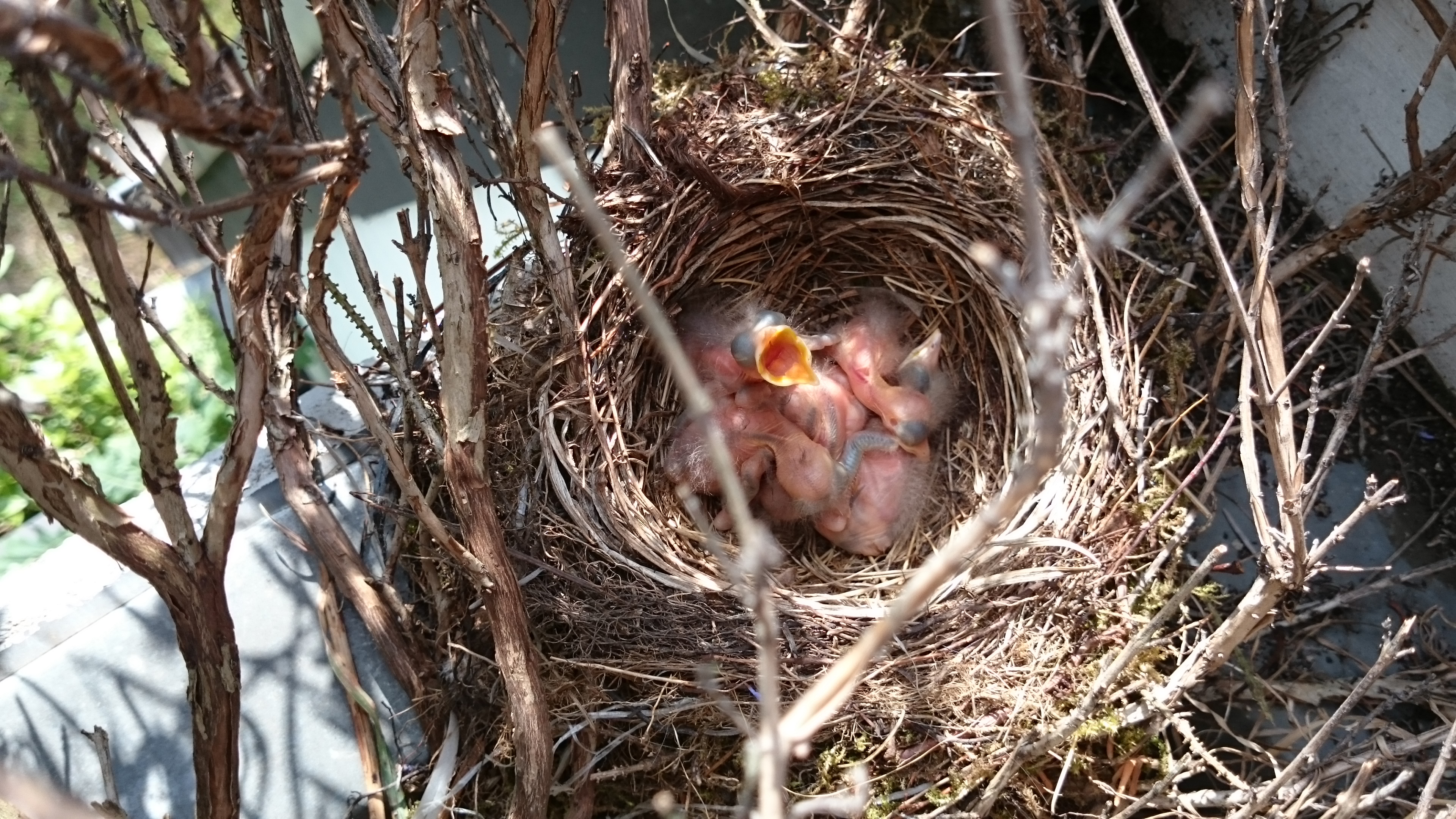
The latest gifts have to do with birds.  On our terrace there is a lovely lavender bush, in full bloom right now.  This spring a blackbird decided to build a nest in our bush.  Since May, I have been privileged to observe blackbird eggs, which are much smaller than chicken eggs, a beautiful soft shade of green, and spotted.  Blackbird eggs

I have seen one clutch hatch five birds, and watched their development all the way to their flight out of the nest.  And now, the mama has layed her second clutch, and I get to watch four more birds develop.  I see how the mama sits on her nest, day after day, warming the eggs, preparing them her unborn babies for birth, and then after the eggs hatch, she sits again, day after day, protecting her fragile, helpless young.  I see both parents feed their young, taking turns.  I have read that blackbirds are monogamous, and that they normally remain partners for life.

These birds inspire me with their faithful care of their babies.  I am awed to see the helplessness of newborn baby birds, who are born blind and without feathers. Blackbirds 2 days old and hungry!

I am reminded of Jesus’s words, “Are not two sparrows sold for a penny?  Yet not one of them will fall to the ground outside your Father’s care.  Don’t be afraid; you are worth more than many sparrows.”  These blackbirds, whose song I have always dearly loved, show me tender caring love, and they are cared for.  They show me that I am being cared for too.

On Sunday a guest choir sang in our church.  One of the songs they sang was the old gospel song, “His Eye is on the Sparrow”.  They sang this song just for me.  Today is Wednesday, and I’m still singing their song.  Today I watched a video of the Statler Brothers singing it, and I let the words massage my heart.  I feel peace as I sing this song and watch my birds, day after day.  I feel my anxiety being steadied, and I smile and marvel at the hope that flutters in my heart.  Yes.  God’s eye is on the blackbird, “and I know He watches me.”

No Way Outa Here – 2

05 Tuesday May 2015

Posted by noreennanz in Uncategorized

≈ Leave a comment

Tags

Christianity, Healing, Life-Changing Experiences, Recovery, Spiritualty, Suffering

On the Saturday before Michael went in for surgery, we went to Düsseldorf for brunch.  We wanted a nice weekend together before the big event, to be in the city of Michael’s childhood, the city I first lived in after arriving in Germany, the city where we first met.  We have many ties to Düsseldorf, most of them pleasant.  We ate at a nice cafè near the poshest market I have ever seen – anywhere.  After breakfast we walked through the market.  Well, I walked and Michael hobbled, hardly able to move at all, he was in such pain.  He went to get the car, picked me up, and we drove to the Japanese part of the city to buy some porcelain tea cups.  It was a lovely day.

The night before going into the hospital, I made us tacos, the same meal I had cooked for him the first time I ever cooked for him.  Since that time, thirty-three years ago, tacos have always been one of his favorite meals.  Back then, tacos were unheard of in Germany.

Michael was very positive about surgery, unusual for him.  He trusted his doctor, we had prayed for everything surrounding the surgery, the entire church had prayed for him.  He went into surgery relaxed and hopeful about a release from his excruciating pain, looking forward to a new lease on life.

I phoned Michael that morning to wish him all the best for his surgery.  “See you on the other side!” I said merrily and went to work.  I was a bit uneasy while teaching.  After all, the operation was no picnic.  It would take over four hours.  I took my unease in stride.  This was major surgery, after all, and Michael hadn’t been operated on since he was a toddler.  He’ll be fine, I told myself.

Late that afternoon the doctor who had performed the surgery phoned me, saying there had been a complication during surgery.  The extra vein in his neck that they had intubated for administering fluids had collapsed during surgery.  That meant that almost the entire infusion had dripped into his face and neck.  They couldn’t remove the breathing tube with the amount of fluids that had accumulated in his face and neck.  They gave him more anesthesia to give his the swelling time to reduce.  Nothing to worry about, but he was in the ICU for now and would remain unconscious until the following day.

The following day, he failed to wake up.  I began to be nervous.  He looked horrible, with his face so fat.  And so vulnerable.  The day after that, Michael still did not wake up.  I started to feel alarm rise up in me.  The head doctor or ICU came into Michael’s room to talk to me.

“We did a CT scan,” he said.  “Nothing to be alarmed about.  We did find some abnormalities in the brain in the thalmus area, but the shadows look old.  It could be some old neurological damage that was never identified.”  It wasn’t a stroke, he said.  Another doctor came to me and told me she had tried to order a neurological exam for that day, but the neurologist they used was unable to come to the hospital on that day.

With this news, I became alarmed.  I was very worried.  But it was the weekend; nothing happens in German hospitals on the weekend.  I spent hours that weekend talking to my family in America and to doctors, trying to find a way to have my husband examined neurologically.  But the hospital would not budge.

“This isn’t like in America, where you can just call a neurologist and have him come in,” said one doctor to me.  The head of ICU came into the hospital on Saturday morning, just to tell me it was far too dangerous to transport Michael to another hospital, where he could have an MRI.  I had called a neurologist I knew, and he told me Michael needed an EEG and an MRI.  The hospital he was in didn’t even have a neurologist, so no neurological exam, no MRI over the weekend.

It went on and on like this, even after the weekend, when Michael still didn’t wake up.  By now he had dangerously high blood pressure, a high fever they just couldn’t get down, and indications of pneumonia.

And by now I was writing every evening to my friends and family, one email in English and another in German, asking them to pray for Michael.  I asked those without faith to send their good thoughts his way.  And the prayers and good wishes came in.  But they weren’t waking Michael up.

I told the hospital on Monday that I wanted Michael transferred, danger or no, to a teaching hospital where they could examine him properly.  On the morning of his transfer, I had to see a doctor myself.  I seemed to have a cold, and I wanted it treated before I made my husband’s condition worse.

While in the doctor’s office, I phoned the hospital to see how Michael was doing.  A doctor I had never spoken to answered the phone and told me, “Your husband has suffered a stroke.”

With that news, my entire life turned upside down, and I knew that nothing would ever be the same.    The news took about five seconds to deliver, but the consequences would mean that my entire lifestyle would have to change.  Would my husband even survive all this?  That very evening, in the university hospital, after studying the results of the MRI exam they game Michael, the neurologist confirmed that he had suffered a stroke on both sides of the thalmus.  “Your husband is a very sick man,” he told me.

No Way Outa Here – 1

19 Thursday Mar 2015

Posted by noreennanz in Uncategorized

≈ Leave a comment

Tags

Christianity, Healing, Recovery, Spirituality, Stroke

There is a fact that I did not disclose when I wrote “Rubies in the Rubbish” – my separation.  I had separated from my husband a few months before going to Egypt.  We have known each other for over thirty years and had been married for almost thirty years when I decided I needed to live elsewhere for a while.  There were some issues in my husband’s life he was unwilling or unable to deal with, and they were getting worse.  The worse his condition got, the more I sank into anxiety, fear, anger and frustration.  I was unable, no matter how hard I tried, to just detach and let him be.  His problems had begun to spill over into our married life and into the space of my life with him to the point where I simply could not let go.  So I left.  I found a way out of my misery.

In this series I’m going to change the name of all the characters to protect their real identity.  Those of you reading this who know me will know who I’m referring to.  In these posts, I’ll call my husband “Michael”.

I told Michael that I would come back after he had gotten some help with his problems and I could see that he was working on them.  I went into therapy and continued with the self-help group I had already been going to.

It felt good to finally be away, to find my own space, to find a life of my own.  Being with Michael had felt like carrying a huge load of bricks.  Now, the weight was lifted.  I hoped with all my heart for recovery for both of us, but in the meantime, life on my own was much easier.

We continued to see each other, and sometimes Michael would cook for me, or I for him.  Cooking was one of our mutual passions, and talking together while eating another one.  Actually, Michael and I are ideal partners.  We love so many of the same things, and we love discussing all the things of life we encounter.  We love discussing ideas, politics, current events, literature, music, religion, psychology, and of course analyzing other people.  I loved listening to him uncover historical details about the places we traveled to.  We are at our best, perhaps, during our travels.  We had already traveled twice together to Egypt, and Michael was involved in my plans to stay with the Coptic Sisters long before I separated from him.

But now here we were, separated physically, emotionally and spiritually.  I stopped going to the church he was pastoring, needing to also be separate from his spiritual energy.

We lived separately for about a year.  Going to Egypt on my own, living in my own apartment, making my own decisions, I felt like I had been let out of a pressure cooker, with the simple push of a button.

During this time, some things started to get resolved and dealt with.  Michael went into a clinic where he could get help with some of the things troubling him.  He changed some things about his lifestyle, and I could see that he was serious about making these changes.  There other things I could see that lay beneath the suraface, things that would need a lot of work.  Michael was beset with a miserable sense of self-worth, especially since I had actually left him.  And shame, mixed with overwhelming anger at his mother, the cause of most of his problems, but dead for ten years already, invaded our home.  Shame, self-hatred and anger lived in our house, like ghosts who refused to leave.  I was still trying to change Michael, still caught up in a mothering role I had developed over the years.  We had lots still to work on.

Michael had a lot more than emotional and spiritual things to work on.  His back, always a bit sensitive, began emitting excruciating pains in the back itself and also in his legs.  He tried osteopathic treatments, physiotherapy, exercise.  Nothing helped.  His orthopedist finally recommended surgery.

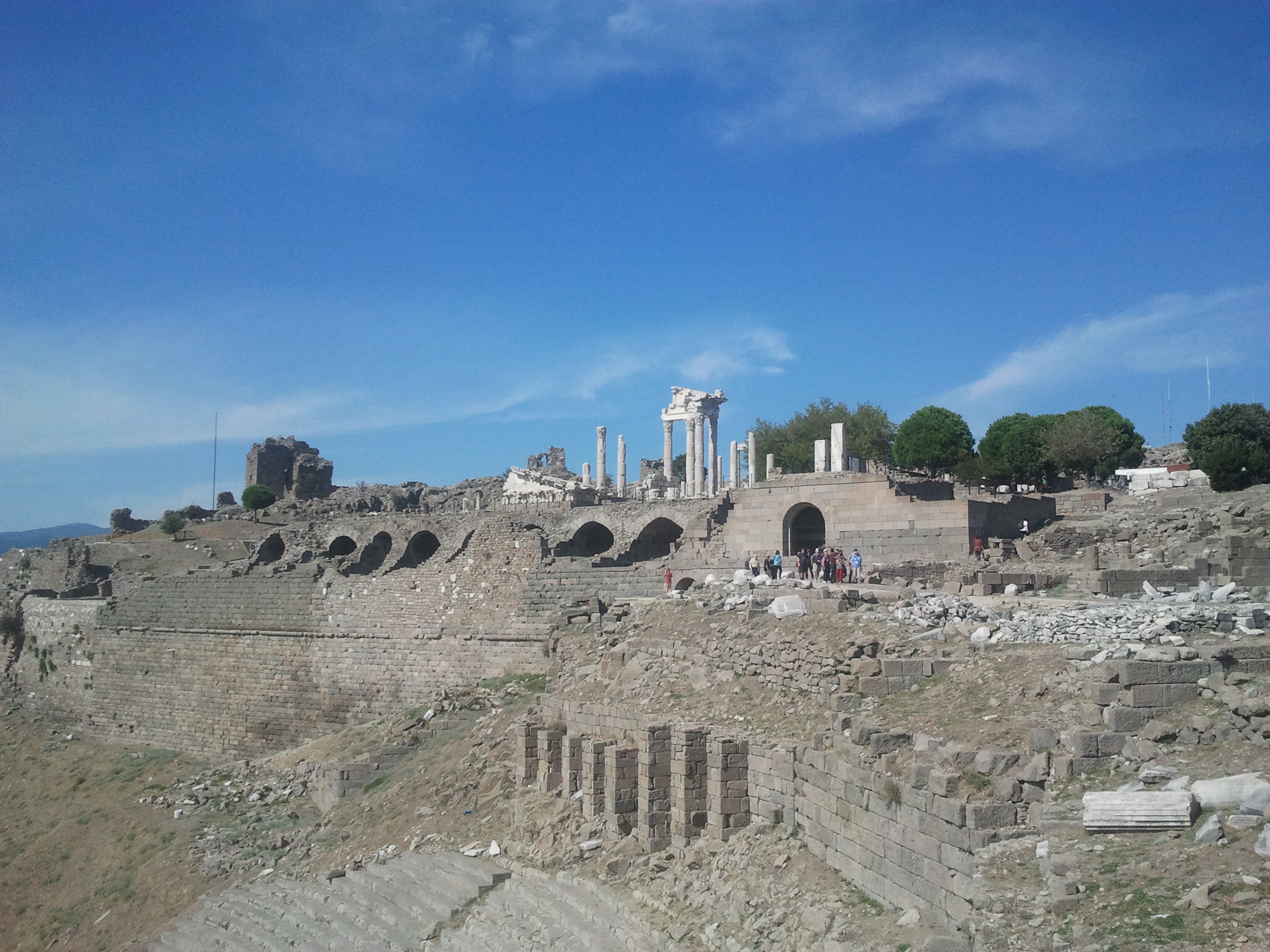
In September, 2014, we went on a trip to Turkey together.  Michael lumbered heavily through archeological sites in Ephesus, Miletus, Pergamon and other places, determined to see it all, despite excruciating pain.  He would have surgery in October, and he wanted to see it all beforehand, just in case anything went wrong, rendering him unable to walk over these sites.  It was a lifelong dream of his to see these sites.  Michael has always loved history, especially from the Greco-Roman period.

Reunited, we had a wonderful two weeks together in Turkey, cooking up a storm in the evenings we ate in our apartment, feeding the cats who came to visit us, traveling in the daytime to archeological sites, swimming before dinner, shopping.  I was grateful for the release I had enjoyed during our separation, and now tranquil in the hope of a future together of mutual healing.   There was lots to work on, but we could do it.  After all, we had God helping us!

SAMSUNG

Pergamon. What a peaceful place to be, high above all the stress of life down at the bottom of the hill! In Pergamon we felt as though lifted up by an eagle into space.

Then Michael went in for surgery, and things went horribly wrong.

Rubies in the Rubbish – Conclusion

14 Saturday Dec 2013

Posted by noreennanz in Uncategorized

≈ Leave a comment

Tags

Cairo, Christianity, Copts, Egypt, personal change, Pilgrimage, Salam Center

It’s about ten days before Christmas as I write this, and I’m in the middle of Christmas parties, baking, shopping and all the usual pre-Christmas rush.  And yet, my thoughts are still in Egypt, as I reflect on what this trip, finished more than a month ago, means to me.  I’m still hearing from Reda and Hanel through Facebook, and I read whatever news I come upon that pertains to Egypt.

I sit in my bed every morning, as before, read the Bible and devotional books and pray, but I’ve added a new element to my prayer time.  Sometimes I look at the pictures of Jesus and Mary that Reda gave me.  I think about Mary and what an open, compassionate woman she must have been to agree to mother the most compassionate of human beings there ever was.  I see myself as a woman like her in some ways, certainly with the same capacities.  If she was compassionate, I can grow in compassion.  So I pray for more compassion in myself.  I look at the picture of Jesus, imagining the depths of love, compassion and power contained in this man.  He is, after all, resurrected from the dead, and has the power to resurrect all that is dead in me.  I reflect on the verse in Colossians, “For you died, and your life is now hidden with Christ in God.” (Colossians 3:3)  Surely this is the secret the sisters possess in order to live in such peace and joy.  They live, not caring that much whether they live or die, because they know they have eternal new lives, hidden and protected in Christ Jesus.  They consider their old lives to be rubbish.  The sentence St. Paul wrote to the Philippians has taken on a deeper meaning:  “I consider everything a loss because of the surpassing worth of knowing Christ Jesus my Lord, for whose sake I have lost all things.  I consider them garbage, that I may gain Christ and be found in him, not having a righteousness of my own that comes from the law, but that which is through faith in Christ.”  Philippians 3:  8-9.  Paul goes on to describe more of the life I have seen in these sisters:  “I want to know Christ – yes, to know the power of his resurrection and participation in his sufferings, becoming like him in his death, and so, somehow, attaining to the resurrection from the dead.”  Philippians 3:  10-11.

I feel some embarrassment writing this, but I am unsure where my embarrassment comes from.  Is it something within me, or am I reflecting an embarrassment burdening our modern Western society?  These words sound so old-fashioned, so far from the way we in the West live our lives.  But it is precisely because this way of living has become so rare that my time with the sisters and their friends is so precious to me.  They have influenced my thinking and my approach to God.  The time I spent there continues to influence how I prepare for Christmas.

Being there was good for me in so many ways.

I had the chance to live around Christians whose very lives depend upon their faith.  They rely on God for everything.  They will not give up their faith, even if it costs them their lives.  Not only that, they refuse to open themselves to hatred or revenge.  They will continue to love and serve other Egyptians, even if some Egyptians hate them enough to kill them.  They remain open, loving and tolerant of differences.

It’s not only the sisters who live such courageous lives.  It’s also people like Reda and Marleen who refuse to join the western, materialistic mindset, even Mary in the gift shop at the airport.  Copts don’t date, they don’t have sex before marriage, and they don’t divorce.  I can imagine many people I know who feel trapped in their lives.  They long for a better partner and they recoil at the thought of a lifestyle that they consider restrictive.  They might consider this Egyptian mentality rigid and reactionary.  But I don’t see the people I met as trapped.  To the contrary, I think they’re onto a secret of happiness – sticking with relationships, even when they’re difficult.  I saw sisters complaining about other people to Sister Maria.  But they try again the next day.  At the Salam Center, they don’t teach putting up with abusive behavior either.  That’s not it.  There, they teach people how to live constructively in relationship.

Living with radiant, cheerful Christians who are true to their faith, to their principles, and who love, showed me that there are groups of Christians who are really good examples of the faith..  They truly live in, for, and love Christ.  This has opened me up to looking for more of the same positive faith here in Germany, where so many people focus on the weaknesses of Christians.  That’s what makes it in the newspapers and on the internet, and that’s what people talk about.  They talk about bishops who build lavish homes instead of humble Christians who live generous, joyous lives.

At the Salam Center I had a positive experience of life in community.  Sister Maria runs the center with a steady, yet gentle hand, and not as an autocrat.  She listens to the complaints and arguments of others, and they state their opinions and grievances openly.  It felt good to be around her and the other people I encountered, day after day.  It felt good not to run away into ever new people and experiences.

I valued my own good qualities because I saw them as valued by those I encountered there.  For instance, people there kept talking about my kindness.  This is something I’ve never particularly valued.  I’ve valued competitiveness more, because that’s what our society values.  But seeing my kindness as something they treasure helped me to treasure it too, and to work towards developing more kindness and dropping the competition.

In the same way, I valued my profession as a teacher of English as a second language, because I could see that my teaching skills were openly valued there.  People could see and hear what I did in the classroom and they expressed approval and sometimes even admiration.  This helped me stop taking what I do in the classroom in Germany for granted.   In Germany, I think native speakers of English who teach their language are seen as people who do this for lack of having found anything more lucrative to do.  I remember reading an interview with the American crime novelist Donna Leon, who lives and sets her novels in Venice.  She said that in the beginning of her time in Venice she was forced into (horrors!) teaching English in language schools.  It took doing it in Cairo and seeing how much the Egyptians value this to place a high value on what I do.  These days, I’m looking at teaching as a wonderful career, and I see the logic and the great sense of purpose I can find in being a teacher.

I loved the openness and candor of the Egyptians I met.  I have found this each time I’ve been in Egypt.  When I meet warm people, there is a synergetic effect – I warm up!  These Egyptians are unafraid of eye contact or of showing who they really are, even if it is their softer, more vulnerable side.  Their heroes are godly people from the past and present, not rock, movie or sports stars.  The people I met are unafraid of admiring the character qualities they find in people, and they even want to emulate this!

Sometimes they would walk right up to me and say things like, “You have beautiful eyes.”  “You have kind eyes.”  “You’re beautiful.”  “I like you.”  I responded to their openness, and it opened me up.  I smiled and related to everyone from my heart, because that’s how they related to me.  I’ve tried bringing this back to Germany.  I recently said to a casual friend of mine as I said good-bye, “You’re so sweet!” He smiled and seemed delighted with what I said.  I hope he was.  In Germany people don’t go around telling each other that they’re sweet.  At a Christmas party I smiled long at another woman, looking directly into her eyes.  I don’t know her terribly well, but I like and respect her very much.  She smiled back at me.  We weren’t making passes at one another.  I wouldn’t have smiled at her like that if I hadn’t experienced the same thing in Egypt.

At the Salam Center, I saw the distractions we have in the West as simply that – distractions.  They do not improve our lives.  I have a deeper desire to concentrate on the essentials, on the important things like love, and to let the other things drop.  Living in that environment helped me to see which activities are distractions and which are life-bringing.

I have rarely felt such supreme happiness as I felt while at the Salam Center.  Sharing my gifts and my self with people who valued this made my days!  And I shared my happiness with God, talking about this in my moments alone with God.  I didn’t care about all the deficits at the Salam Center, things like broken doorknobs and wading through sand to get into the convent, feeling that joy, that happiness.  That is an essential.  That is something worth more than gold.  Well, you can find it at the Salam Center.

At the Salam Center, I felt like I belonged to a group, and that this was a group I wanted to belong to.  I respected their values and even shared most of them.  Those I didn’t share, like the kissing of icons, I could at least understand.  In this community I felt completely accepted, desired, and valued.  What can be better than that!

And so, here I am now, living again in Germany, profiting from the treasures – from the rubies I discovered in a center near a rubbish heap.  These treasures have the ability to enrich my daily life.  They also create a hunger in me for more.  Insha-Allah, Lord willing, I will return to the Salam Center, not only to share more of myself, but also to receive more of what these marvelous people have to share with me.


Rubies in the Rubbish – Day Thirteen

09 Monday Dec 2013

Posted by noreennanz in Uncategorized

≈ Leave a comment

Tags

Breakthrough at Caron, Cairo, Christianity, Coptic wedding, Egypt, intellectually disabled, Josh Groban, Pilgrimage, Salam Center, travel, You Raise Me Up

Remember the chicken I saw in the sink, about to be killed?  It turns out they had to kill it because it had broken its leg.  Mariem said there was no way they could have saved it.  I feel better about eating this poor chicken now.

It hasn’t taken long for the chicken to become a topic of friendly joking.  They laugh about my sadness, but they also understand.   Sister Maria says she wouldn’t like to watch a chicken being killed either.  Today we will eat it, in gratitude that it gave its life for us.  And we will give our lives for others – we probably won’t die today, but we will have given our lives, which is also a sacrifice.

Today is party day.  My last day, for tomorrow I fly back to Germany.  I hand my clothes, now washed and dry, over to Marleen, and work one last day with the kindergarten kids.  Bolla’s still hyperactive, his breath smelling smelling of Doritos, but Jameena has finally learned which direction to draw the half-circle in for the “d”.

Marleen’s daughter Alvera is visiting the school today, so I get to meet her, and we walk back together to the Salam Center.

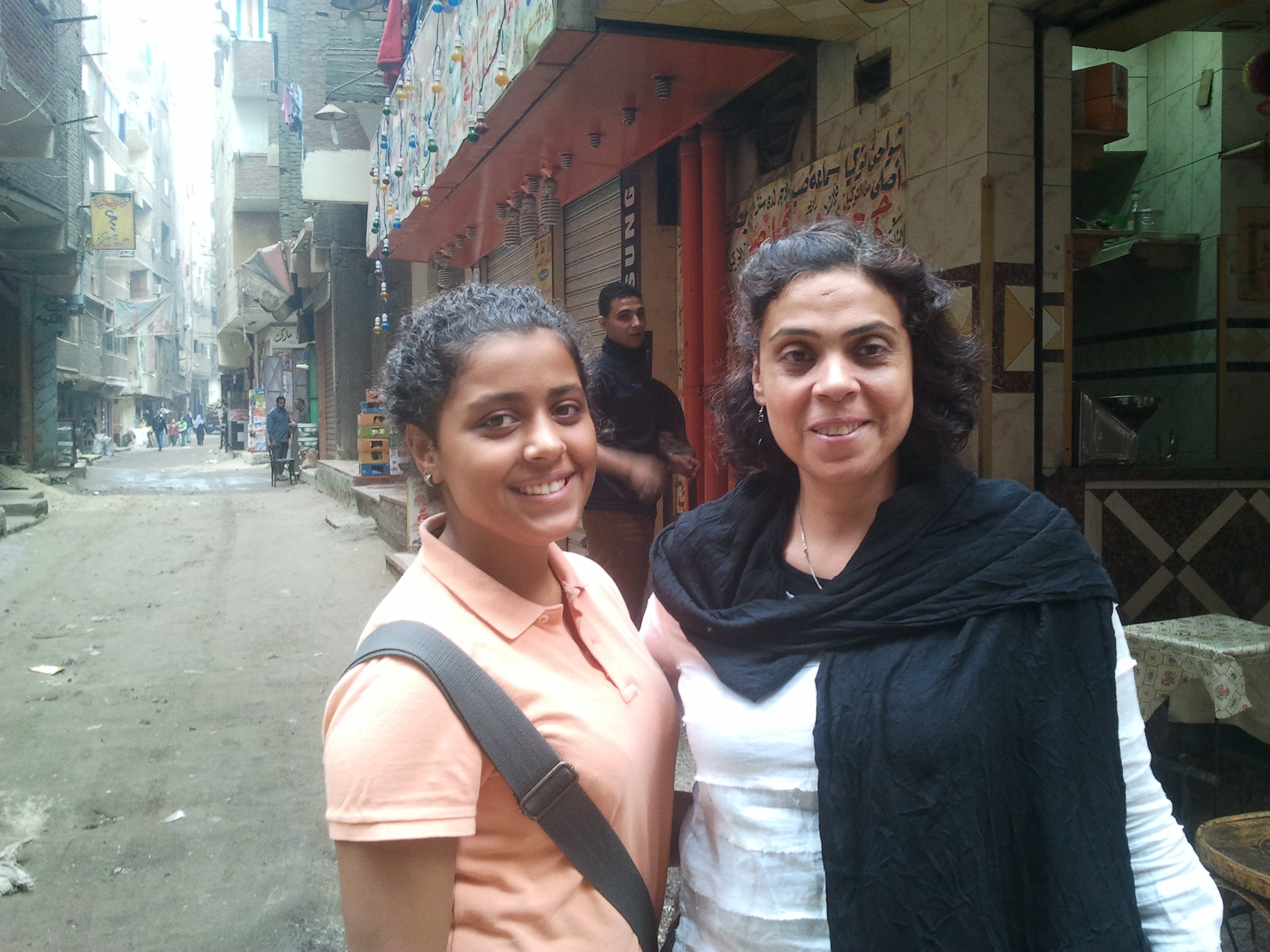
Marleen and Alvera

Marleen and her daughter Alvera

I love walking back because I can see so much more than in the car, but this is only the second time I’ve been able to do that.

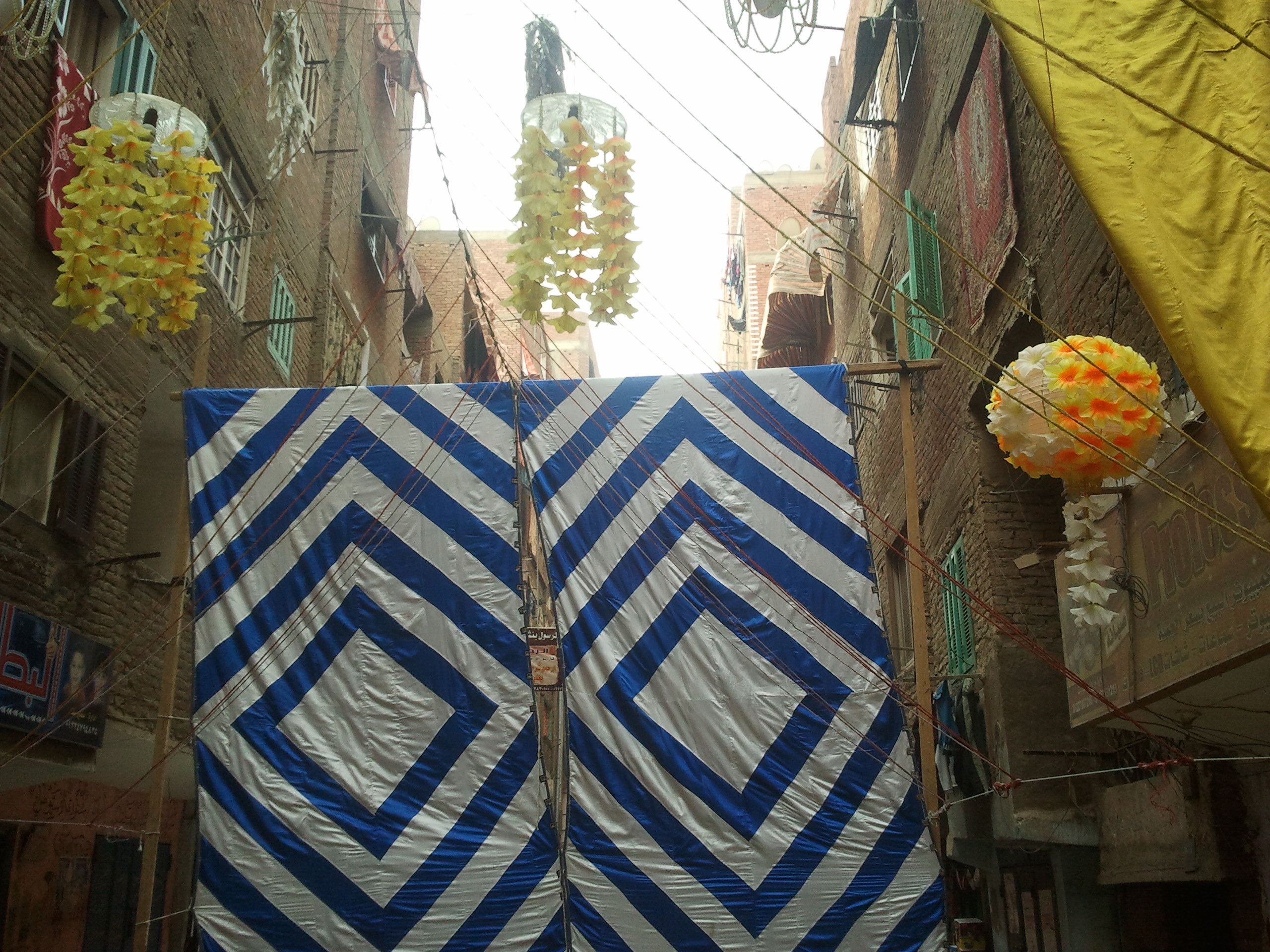
banner/street barricade

A street barricade/banner for a street wedding reception

This time we come to one of those cloth barricades in the road.  On foot, we can walk through it and see why it is closing off the street.  On the other side, the barricade is a festive banner, and the street is full of garlands and lampions.  It’s a wedding, Marleen says.  I take pictures.  Someone sitting at the edge of the road, supervising the decoration, says “Welcome” to me.  What a wonderful country this is!

A lot of meat is being sold today.  Marleen tells me that poorer people have one or, if they can afford it, two meat days a week – Thursday and Sunday.  Today is Thursday.

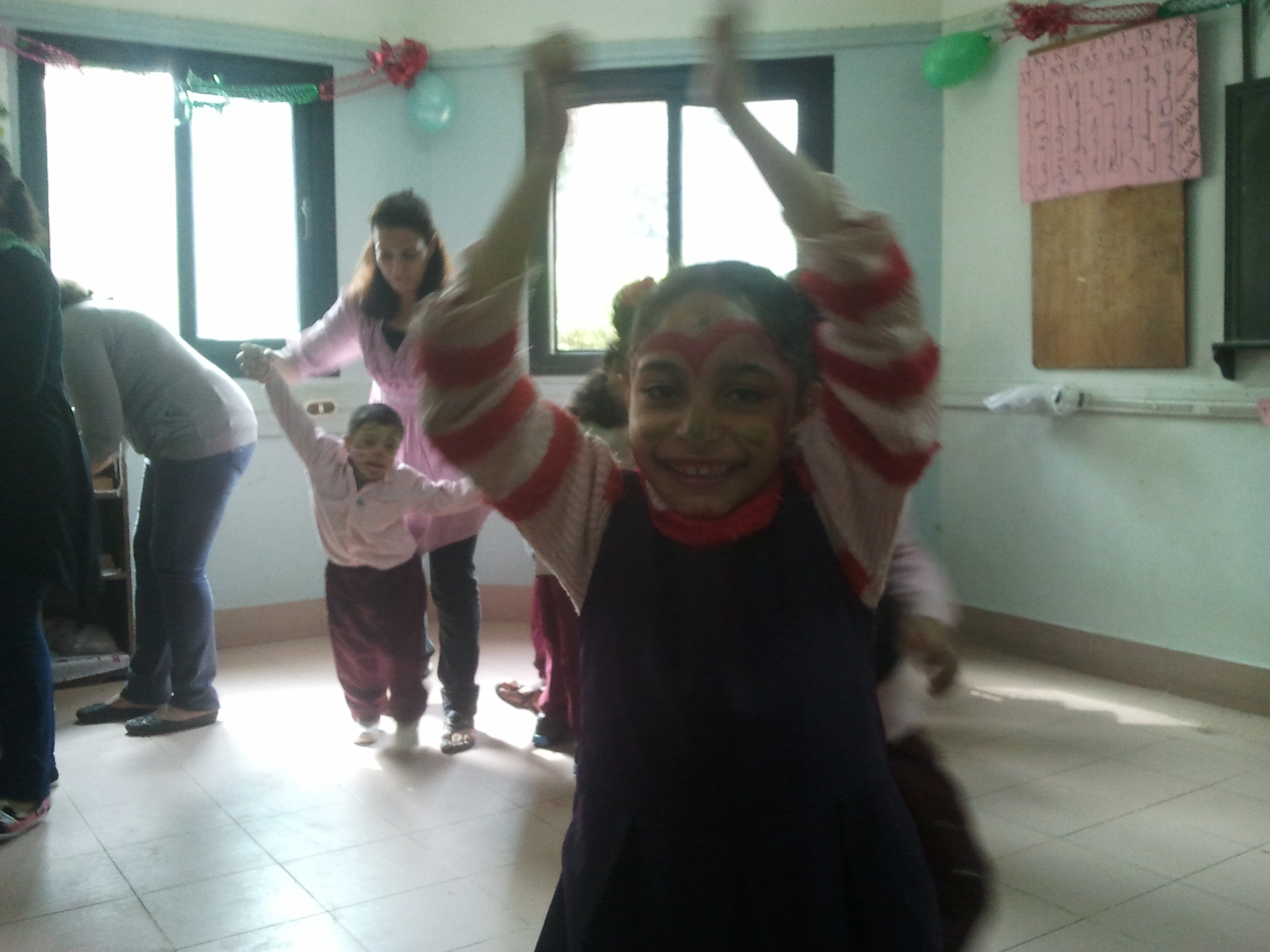
Today I’m back in plenty of time to visit the center for the intellectually disabled today.  I walk into the center, unannounced, and find that not one of the workers here speaks English.  When I say the name “Tesoni Maria”, though, it’s my entry ticket, and they offer me a chair.  I sit down in a room of happy bedlam – two children today are celebrating their birthdays.  Most of the children are sitting in chairs or wheelchairs along the edges of the room.  I was once a social worker who worked with intellectually disabled children.  I have never seen such a high staff/client ratio as what I see today.  The room is swarming with women.  It seems they’re waiting for something to start happening.  Then I hear it – “Happy birthday to you…” in English, with an Arabic rhythm.  Everyone starts clapping.  At first the kids are pretty quiet, with only a few clapping.  Someone walks around the room, painting faces.  Before long, aides are twirling kids around in pirhouettes, dancing in line, holding kids and dancing with them.  What happy havoc!

Intellectually disabled children's center.

It’s party time! At Seeds of Hope, the intellectually disabled children’s center in the Salam Center hospital

I leave the room and explore the center a little.  I hear more music, the kind adults might listen to.  I find a room of teenagers who are also intellectually handicapped.  One boy is dancing frenetically to Arab pop music.  Some of the staff are also dancing.

One of the highlights of my first trip to Egypt was an evening dancing with the staff (male) of the ship on our Nile cruise.  Today I get to dance with the women and kids.  It’s wild, and I love it, even though I’m a bit embarrassed.  I don’t really know how to dance at all.  The women dance very sensually with each other.  This time I’m dancing with Coptic women.  They dance exactly the same way the Muslim men danced with me.  Last night Reda, one of the teachers I work with, said to me, “The Egyptians are all one.  And we have 4,000 years of unity.”

I love the unembarrassed sensuality of this dancing, but its overtness makes me, who was born with Baptist legalism in her blood, feel uneasy, as though I were transgressing some moral code.  In the evening Sister Maria, Sister Malaka and I chat about the day, and I talk about the dancing.  “It’s like at a wedding,” Sister Maria explains.  And this physical expression is very important for the handicapped children.  They need this outlet.”  I ask if men and women in Egypt dance this way together.   They look shocked at my question.  “No, Coptic men and women never dance together.  Muslims usually don’t either, but a few do.”

It’s party time for my classes with Reda, too.  He has allowed me to plan the lessons for the day, and I’ve planned a song, “You Raise Me Up,” sung by Josh Groban.  This song has a strong personal meaning for me.  It was chosen and played for me when I was at a Breakthrough workshop in January this year, working through a personal crisis.  My therapy group listened to this song with me, and laid their hands on my shoulders, head, and arms.  I felt then, for the first time that I can remember, a truly cherished part of a group.  It was an important time on my healing journey.

But, I quickly see that this song will not work for the fourth-graders.   It’s much too difficult for them.  No problem, I have another song in my smart phone, “I Will Love You Monday (365)”, by Aura Dione.  I’ve used this song with my German students to teach them the days of the week.  The fourth grade class here is now learning the days of the week.  But an unanticipated emergency occurs.  Faida, one of the kids, has cut his hand badly and needs medical treatment.  Reda leaves with him for the pharmacy, and I am left alone with the classroom.  I, who speak next to no Arabic.  I can’t even say, “I don’t speak Arabic.”  But I write the days of the week on the blackboard, and words like today, tomorrow, and yesterday.  We get through it all just fine.  One kid, Ibram, one of the brightest kids in the class, keeps asking me something I don’t understand.  Finally, he simply walks over to the board and writes the words in Arabic with blue chalk.

Thankfully, Reda and Faida return, and we can go into the fun part of the lesson.  But as soon as I play the music, the lesson threatens to disintegrate as the boys start dancing.  “They’re acting like they’re at a wedding,” Reda says.   But I play the song and point to the words on the board as they’re being sung.

I play “You Raise Me Up” for the fifth and sixth graders.  I am amazed that my unruly fifth grade class sits quietly and listens to the song.  One boy mimics playing the violin as Josh Groban sings the refrain and another acts like a schmaltz singer, but generally, the kids are amazingly receptive to the song.  “Good, good,” they say afterwards.  Nessma, the girl who is most disruptive, asks, “How old is Josh Groban?”  I say, “Thirty-seven.”  I’ve no idea if that is true, but Reda is thirty-seven, and I want her to get an idea of the age difference.  “I hope he will wait for me to grow up, because I want to marry him,” she says.

The same thing happens with the sixth graders.  They love the song.  They are open to its emotionality.  And that is precisely what I love about Egyptians.  They are not afraid of their soft feelings.  For them, saying, “I love you,” and “You’re beautiful” are as natural as saying, “I’m hungry.”  I need this frank openness, this candor.  Their openness opens me up, and they respond.  The Egyptians seem to love me, and then I respond with love them, then they love me because I love them.  I love these kids.

I add a game to the sixth grade song activity.  I’ve cut out phrases from the song, and lay them out randomly on the table.  They are to walk single-file around the table as the song is played, picking up the phrases they hear.  The one who picks up the most pieces will get a prize.  But they cheat!  They pick up phrases out of turn, or grab them away from each other.  Soon, it’s a wild free-for-all, with mad grabbing and ripping of papers.   But I’m happy, because they loved the lesson.

Rubies in the Rubbish – The Faith of the Sisters

08 Sunday Dec 2013

Posted by noreennanz in Uncategorized

≈ Leave a comment

Tags

Cairo, Christianity, Copts, Egypt, Mary of Zeitun, miracles, Pilgrimage, travel, Virgin Mary

The sisters seem to be absolutely serious about their faith, but I’ve never seen such a merry group of women. This confirms what I’ve always thought, that believers should, by nature, be cheerful.

The other day, when we’d had Sister Ologaya’s favorite dish, molokhaya, plus roast chicken and rice, she told me she was stuffed. She’d had molokhaya, two servings of rice, two pieces of pita bread and two bananas. “I’m getting fat!” she wailed, smiling.

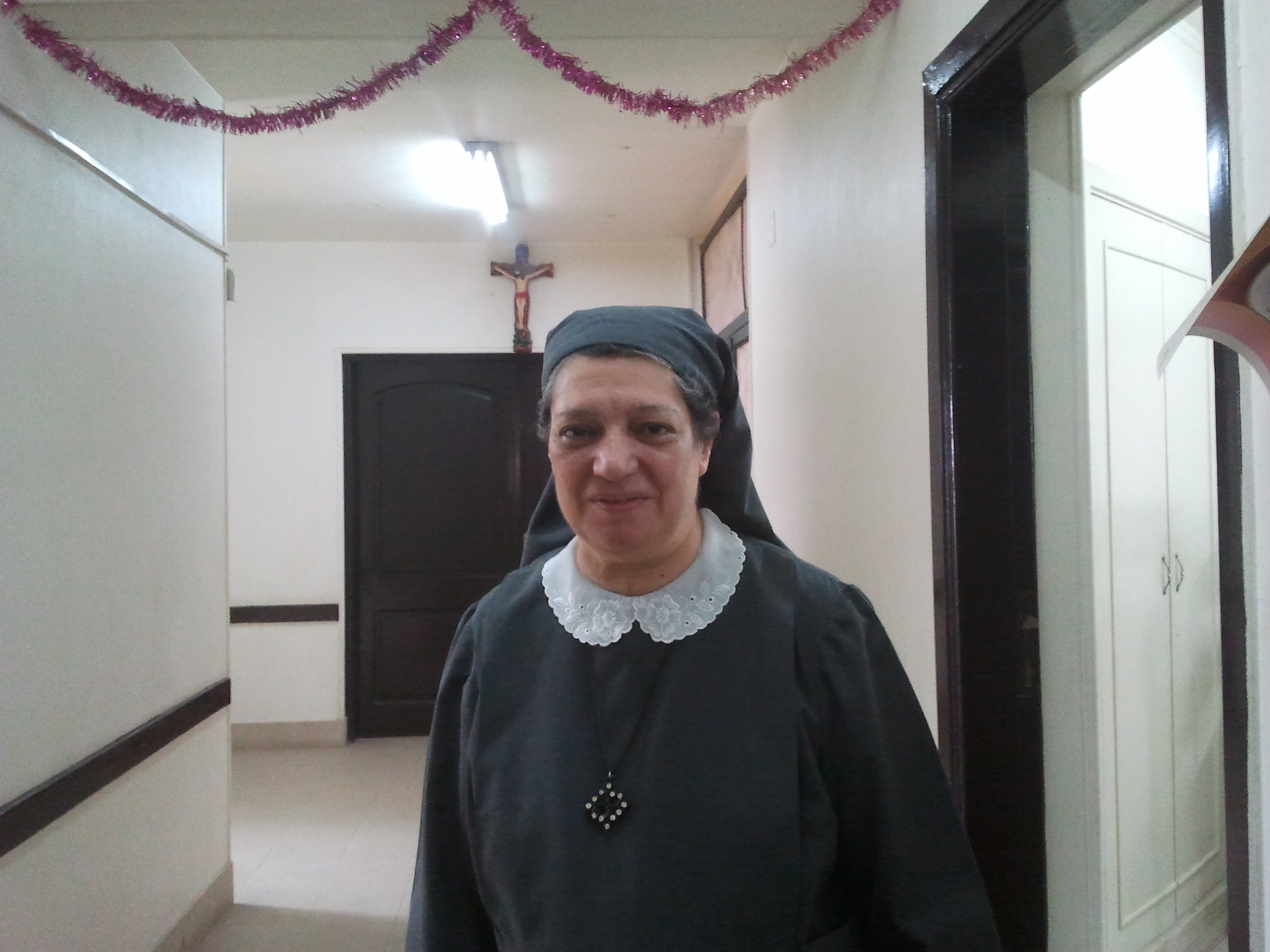
Sister Ologaya

Sister Ologaya

“Do sisters worry about things like their looks?” I asked.

“Not usually. Sometimes there is a sister who is truly beautiful in the eyes of the world, but what we concentrate on is having Christ’s beauty grow in us. Then we are truly beautiful.”

She told me a couple of stories.

“A Muslim person was complaining to someone else about the luck of the Christians. ‘Why is it that it’s always the Christians who are the most beautiful – and also so rich?’ this person asked.” I supplied the answer.

“Because Jesus blesses His children. There is blessing in following Jesus.” She nodded her head, and went on to tell another story.

“Someone went to a wise man and asked him what the best religion is. The wise man answered, ‘I won’t tell you, but you go and find the people who are the kindest, the most loving, the most forgiving, the most honest, the most generous, the most cheerful, and the most patient of all those you meet. Find out what religion they are, and you will have your answer.’

“The man went and followed the wise man’s advice. Then he went to the wise man and said, ‘It is Christians who are the kindest, the most loving, the most forgiving, the most honest, the most generous, the most cheerful, and the most patient of all.’ ‘There you have your answer’, the wise man said.”

These are the qualities I find in the sisters here. I think I lack many of these qualities myself, but these are the qualities I want the most in the world. What a wonderful world this would be if we were all kind, loving, forgive, honest, generous, cheerful and patient. That’s why it is such a joy to find this group of Christians who really seem to live Christ-like lives. At least they strive to do that, just as I do, and I see many cheerful faces here.

There are aspects to their faith that I, a Protestant, find bewildering, but also intriguing. I’m incredibly attracted to their combination of joy and gentleness. The sisters and also the staff here all have warm, loving eyes. They have no difficulty looking long and lovingly into mine. That’s nice, but also a little embarrassing. Embarrassment about such things, though, is a feeling I would like to overcome. I wonder how much of this gazing into one’s eyes comes from their gazing into the eyes of the icons of their favorite saints. Sister Elleria is overjoyed to have a picture post card from me of Joan of Arc – so that she can look long and lovingly at her picture, receiving strength and inspiration from it.

Sister Maria tells me one day in an off-hand comment that she often thinks about what it was in Mary, the mother of Jesus that inspired God to choose her, of all women, to be Jesus’ mother. She thinks about Mary’s personal characteristics a lot.

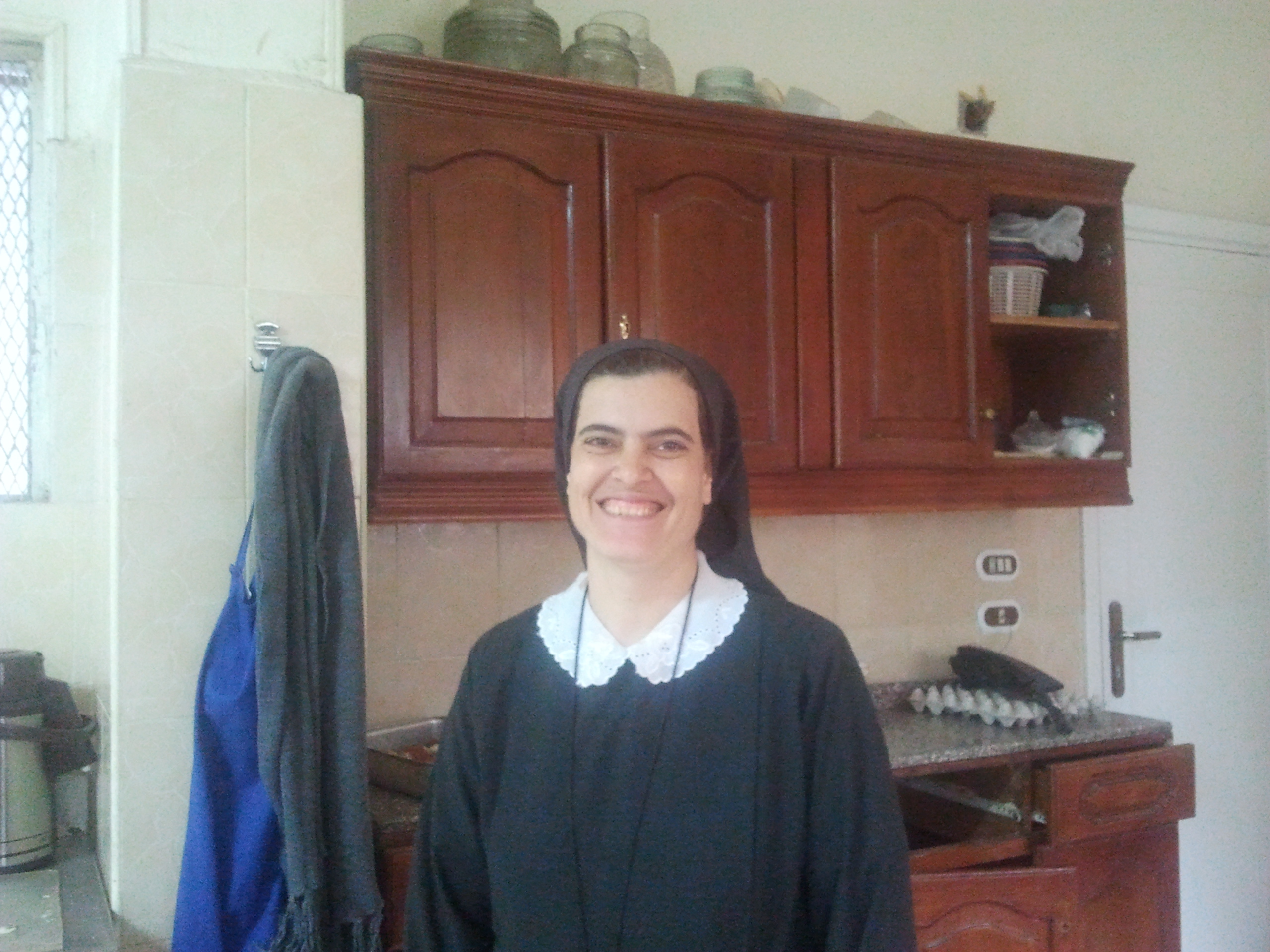
Sister (Tesoni) Maria

Sister (Tesoni) Maria

But then, she’s named after Mary. Come to think of it, so am I. Marie is my middle name. Something for me to think about.

On my last day with the sisters, we look at the photos I’ve taken. We discuss a picture of Mary, and I ask her if the church I took this photo in is the church of St. Maria of Satoun. I show her a picture Reda has given me. “Yes”, she says, “this is St. Maria of Satoun, but that is not where you were. St. Maria of Satoun is the church where the holy Mother has appeared.”

“What do you mean?” I ask.

“She appeared to many, many people, many, many times. Even General Nasser saw her. Both Muslims and Christians saw her. She appeared especially often during the year before Mubarek was deposed. She looked like a real woman, standing on the roof of the church, with her arms outstretched, like you see in this picture. She looked so real, people climbed up onto the roof to tell her not to jump off, but then they found out that it was St. Maria.

“Many miracles happened through her. People were healed of diseases. She was very good for Egypt. We were all blessed by her appearances.”

“Did you see her?” I ask.

“Yes, but not there,” she replies.

I am dumbfounded. Sister Maria is a woman with her feet on the ground. She is not crazy, she’s not a dreamer, and she would not lie to me. But this is confounding some of the foundations of Protestant beliefs. Protestants have always criticized what they call excessive devotion, or even worship of Mary.

“You know, she also appeared here at the Center. About a year later. Not like at St. Maria of Satoun, but she appeared here many times too. Here she appeared as light, in the sky, above the Center. She had her arms outstretched, as she did in Satoun. I saw her, as did many others. People, Muslims too, would come to the Center looking for her, thinking she was staying here. She left a scent, a perfume like none other you have smelled. People thought it might be something from relics – you know, they perfume the relics.”

I had noticed that on the day Sister Marina showed me the relics of Santa Marina.

“We had a volunteer here at the time, a French woman. She was skeptical about all of this, so she was unable to see Mary, but she did smell the perfume.”

I wonder if I’d be able to see Mary if she appeared.

These revelations intrigue and puzzle me, but they don’t discomfit me. They leave me marveling. Now I understand why Reda gave me this picture, and also a lovely picture of Jesus. He obviously meant for me to contemplate them. That seems to be what Copts do. I will hang them on the wall near my bed and gaze at them, allowing the thoughts to come. I will not let embarrassment or judgmental thoughts about the taste of the artist stop me from it. I will welcome what comes.

Rubies in the Rubbish – Day Twelve

06 Friday Dec 2013

Posted by noreennanz in Uncategorized

≈ Leave a comment

Tags

ADHD, Cairo, Christianity, Copts, Egypt, Pilgrimage, Spirituality

Today is not my day.  Do things go in cycles, or what?  Day Five was also difficult.  Day Ten wasn’t so easy because I was tired.  Funny, you never know at the beginning of the day what your day will bring.  It could be glorious, or in more and more places in the world, there could even be a bomb.

I read today in my devotional, “I am with you.  I am with you.  I am with you.”

The day starts out well enough.  I’ve had a lovely time of reading, prayer and meditation with my delicious cup of coffee, I am calm inside; I’m ready for a new day.

I walk over to the convent, and someone lets me in.  But when I get inside, the table isn’t set for breakfast, and there’s only one sister in the dining room.  “Fasting day,” she says.  “Wednesday.”  I didn’t know that they fast on Wednesdays.  “But only breakfast.  One eat lunch.”  I see a pot of beans boiling.  I get to eat a sumptuous breakfast on this morning when practically everyone else is fasting.  The foul is there, all of it for just Nagette and me.

As I prepare to leave for the school, I see Marsa, the cook, with a live chicken in the sink.  The chicken is squirming, but silent.  I can tell what’s coming, though.  Protest wells up inside me.  This must be one of Sister Mariem’s chickens!  I’ve already asked Mariem if we’ve been eating her chickens, and she has assured me, her chickens are only used for the eggs.  Just to make sure, I ask Marsa if this is one of Sr. Mariem’s chickens.  It is.

I haven’t seen one killed since I was a little girl.  My grandfather killed a chicken every time we came for a visit, and that really upset me.   I almost didn’t eat the chickens, but the smell was always too tantalizing for me to resist, no matter how sorry I felt for the poor chicken.

I leave the kitchen quickly and go to the bathroom.  From the kitchen, I hear loud squawking.  And then silence.  By the time I return to the kitchen, the chicken is dead.  Even as I write this, it brings tears to my eyes.  That poor chicken didn’t want to die.  It protested for all it was worth.  But it had to give its life for our sakes.  Possibly for my sake.  I have no idea if this chicken will be cooked just for me, since today’s a day of fasting.  Did that chicken have to die?  We eat chicken and meat heedlessly every day, amidst laughter and jokes.  We may even compliment the cook, but we give no thought to the life that was spent on our behalf.  A life that didn’t choose to be given.  We humans have tremendous authority over the animal kingdom, and we rarely even think about it.

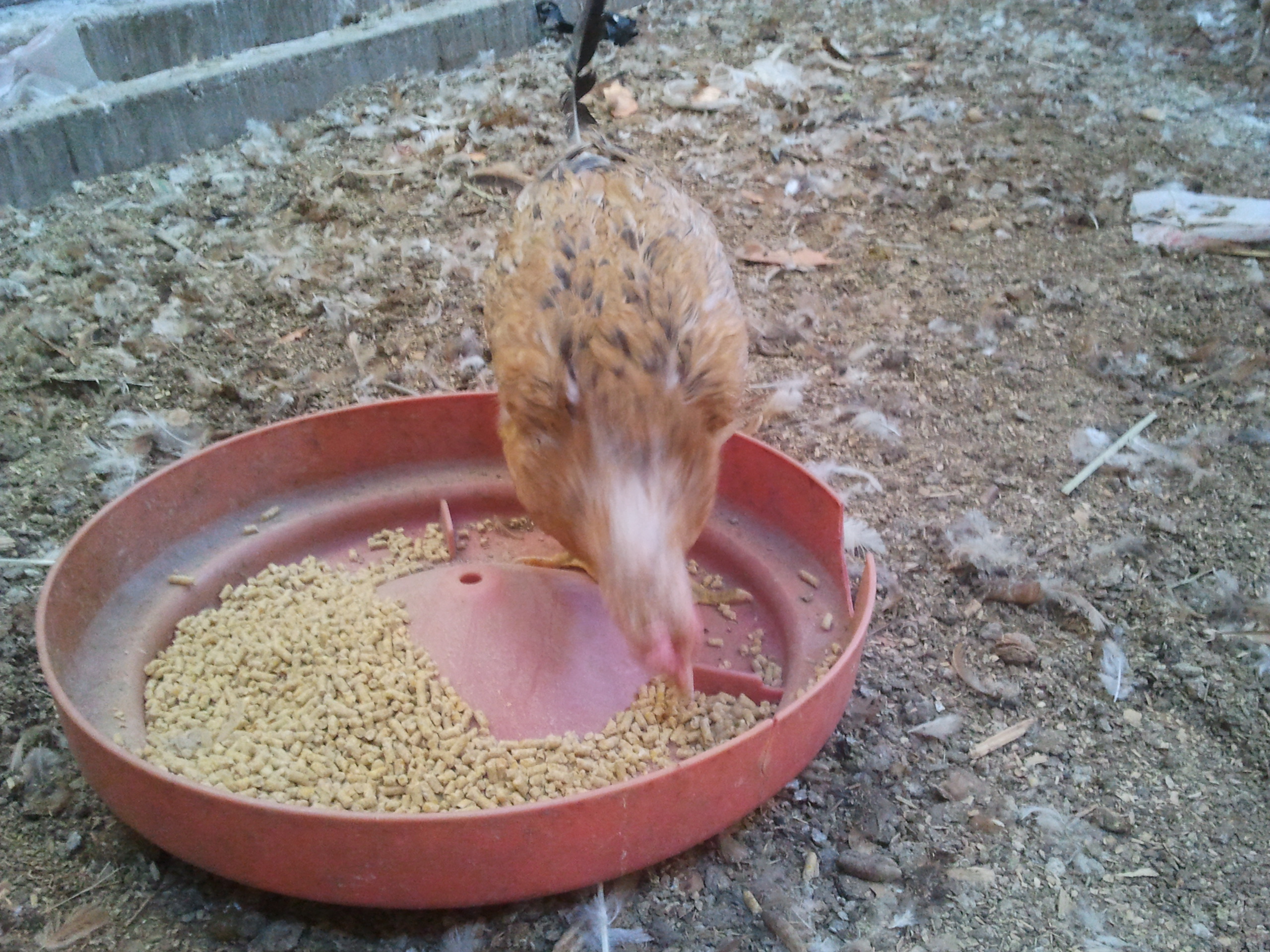
One of Mariem's chickens

One of Mariem’s chickens

That chicken could have been someone’s pet.  I know a little girl in Germany, Leah, who had a pet chicken she taught tricks to, like riding down the slide.

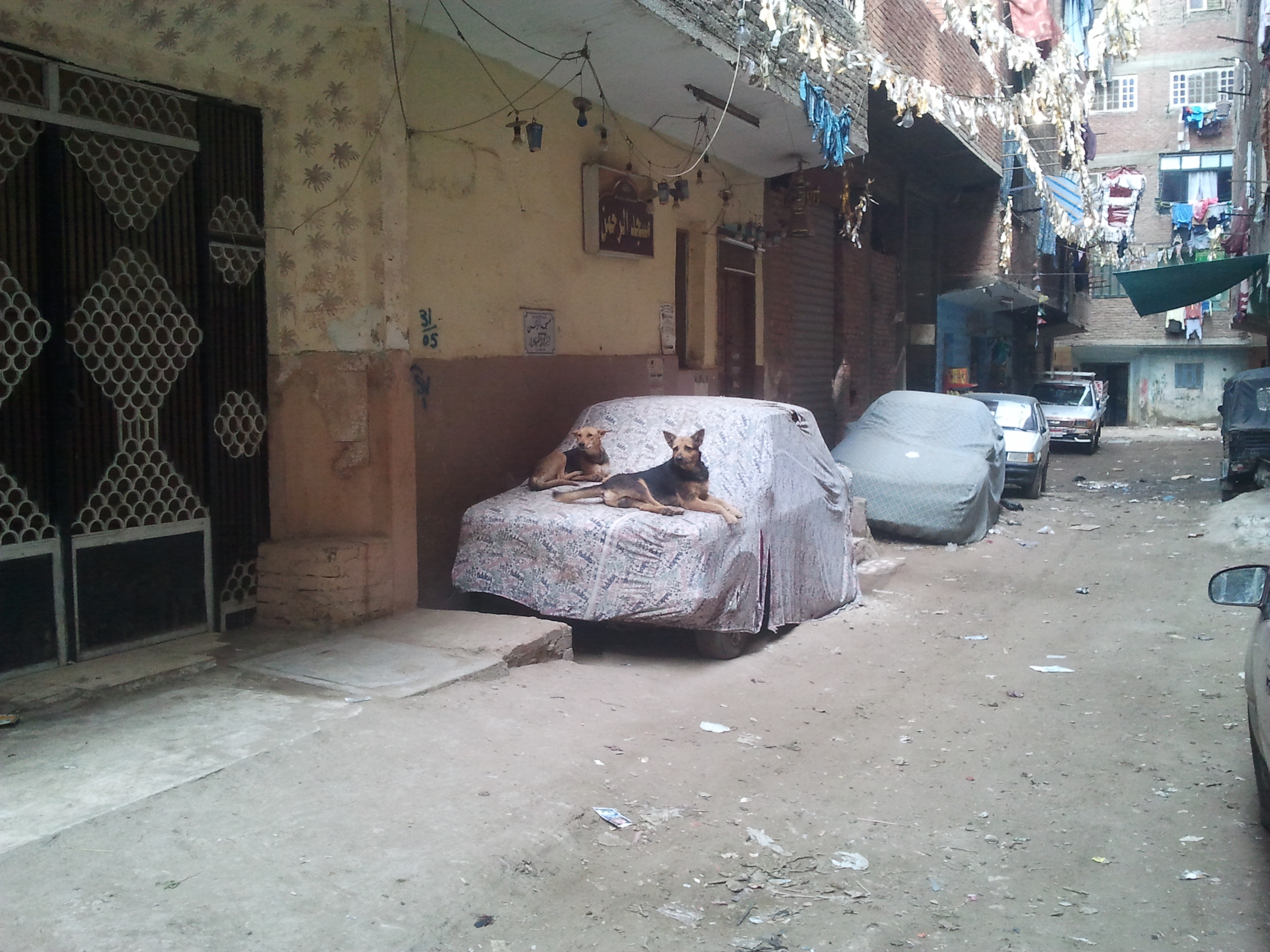
I have a pet dog , Toffee, whom I pet and kiss every day.  I’ve just been reading an email from my husband about how Toffee is doing.  Toffee is almost like a person to me.  Here, dogs run wild in the street and no one pays any attention to them.  They look mangy and unkempt.  You wouldn’t even want to pet them.

Two dogs

Two dogs have found a resting place on the hood of a car.

The same thing goes for the cats.  And chickens, apparently.

If I could, I’d refuse to eat this chicken, but that won’t do any good.  I’m a guest here.  I have to eat what’s served.  Besides, it’s already dead.  It’s also organic, free of antibiotics and hormones.  But it had to give its life for us humans.  I consider going back to being a vegetarian.  But I do love chicken, and I know I won’t give it up, sad as I am today.  I will treasure and be thankful for the chickens I eat in the future, though.

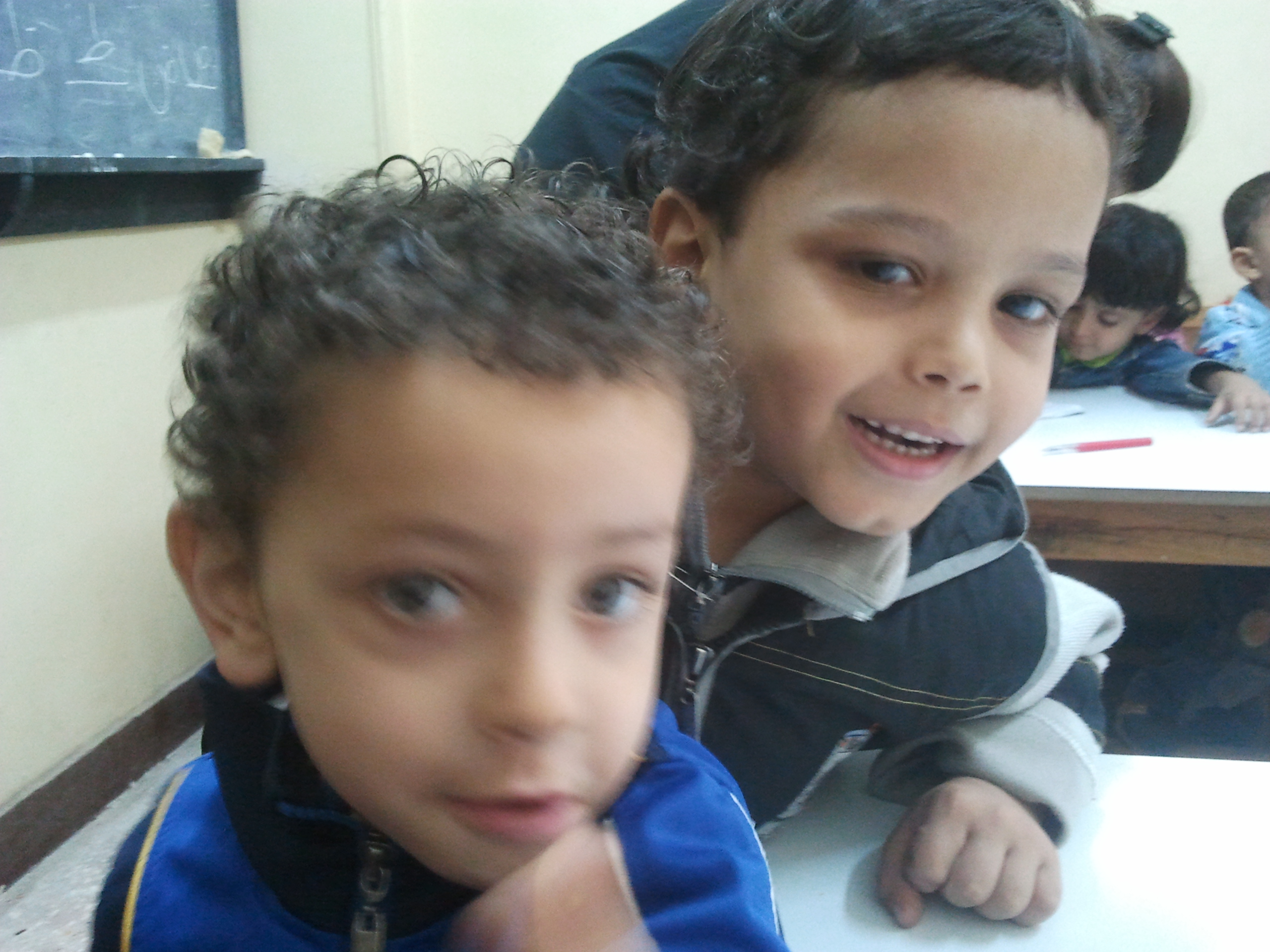
I arrive punctually at school, and basically everything goes fine except that one kid, Bolla, a wild little clown, continually interrupts the lessons, dancing like someone on MTV, and he’s only five.

Bolla

Bolla, who never sits still, not even for a picture

You just can’t get him to sit still.  He has a bag of Doritos he shares with Mahaariel, who also turns into a jitterbug.  She even starts licking the leftover salt off the table when I take the empty bag away from Bolla.  I later talk to Marleen about this.

“I think he may have ADHD,” I say.

“I know,” she sighs.  She says she has repeatedly told his mother and other parents not to give their kids chips and sweets, that they need to eat healthy food, but they don’t listen.  She suspects they give in to the pleading of their kids.

I have plenty of time to talk to Marleen because my driver hasn’t shown up yet.  I know Rohmy knows I need to be picked up because this morning as he dropped me off he asked me if he should come at ten o’clock, and I answered yes.

One hour later, Marleen is finishing up a teacher’s meeting they’ve held in the lobby.  A kid walks into the lobby with some of that soft, lovely bread they eat for communion.  He gives it to Marleen, and she takes off a bit and gives the rest to the teacher next to me.  I’m engrossed in my cell phone by now, since there’s no Rohmy, looking at the New York Times headlines, and don’t notice that she’s trying to give me her bread.  It’s after eleven by now and I’m kind of hungry.  I start eating the bread and go back to the news.  It’s delicious.  I take another bite.

The teacher nudges me.  “Excuse me.”  I look up.  “Give the bread to next person.”

I finally get it.  This is communion bread, meant to be shared.  I quickly pass it on, as the others smile.

I’m supposed to be visiting the handicapped center this morning, but it looks like it’s not going to happen because of this driver situation.  It’s twelve noon now and still no Rohmy or any other driver.

I keep talking to Marleen, who then asks me if I could give up some clothes I don’t want, for some people at the school.  “They are needy people,” she says.  I think she means that I should mail clothes from Germany, but no, she means the clothes I’ve brought with me.  Actually, I like all the clothes I’ve brought along.  I don’t really want to part with anything.  But I tell her I’ll find some clothes and wash them.  There happens to be a state-of-the-art washing machine on my floor.

Finally, at about one o’clock, Marleen spots another driver from the Salam Center passing the school in his car.  He’s on the way back to the Center with one of the sisters.  She yells and he stops, confused.  She asks him to take me back.  Finally, after three hours, and a morning wasted, I’m back in my room.  I only have about a half hour before I have to go to lunch.

I hurriedly gather clothes together.  I’ll have to hang them up to dry because they need to be dry before I give them to Marleen tomorrow.  I throw my jeans and almost all my shirts, and some underwear into the washing machine.  I change into some black slacks, and still have my black top on, which I have decided to hold onto.  I walk through the training center to go to lunch when Teresa stops me.

“Your clothes,” she says.  “You’re wearing all black.  In Egypt when you wear only black it means someone has died.”

Actually, it feels like I’ve given up a part of my own life by giving up these clothes.  I’m also going to donate my nice ankle boots that I was going to wear on the plane back home.  All I have left is dirty, ripped up walking shoes and flip-flops.  I won’t give up my flowered Italian flip-flops for these women.  But then again, maybe I will.

I tell Teresa I’ll go back and see what I can find that isn’t black.  I find a turquoise printed blouse and a turquoise necklace, and return.  Teresa has already left to go home, but a male worker there assures me I look fine now.  “Gameel!”  Beautiful!

I go back to the convent to go to lunch, but the buzzer doesn’t work.  Someone working on the entrance has actually shown up for work today, and he comes to the gate to let me in, but his key doesn’t work.  Another worker has to come and help him open the door for me.

And then, when I’m finally ready to hang up my clothes, I discover they’re all full of paper bits.  I think it’s Kleenex until I start looking for the list of Arabic words I’ve lovingly prepared.  It’s my lifeline!  I go over this list many times a day.  This list is what is helping me to speak the few words of Arabic I can manage!  But it’s gone.  Now I realize where it’s gone – into the wash, torn up into shreds.

Is there a lesson in all of this?  I think so.  It has come to me while typing this account.  But I’ll leave it to you, the reader, to find the lesson you think is in this day.  Is there a lesson in your day today?  One of the things about being on a pilgrimage is the awareness that all of life has something to teach us.  We just need to be aware of it and ready for the lesson.

Rubies in the Rubbish – Eating with the Sisters

05 Thursday Dec 2013

Posted by noreennanz in Uncategorized

≈ Leave a comment

Tags

Cairo, Christianity, Copts, Egypt, Egyptian food, Nuns, Pilgrimage, Salam Center, travel

Even though I understand barely a word of Arabic, I can see that these sisters know how to get down and have a good time! They laugh a lot at the dinner table, when Sister Maria allows conversation. They laugh and converse afterwards.

Sometimes I think they’re gossiping about some sister or other, but there doesn’t seem to be any bitterness among them. The sisters don’t all eat together. Some are off at various jobs, or not available, so you never know how many will be at the table.

For breakfast, served at around 8 am, we usually have pita bread and a couple kinds of cheese. One is a really strong, salty cheese. Nagette, who lives with the sisters, indicated to me that if she eats this cheese she throws up. I find it pretty unpleasant too. The other cheese is more like a creamy version of feta cheese. They tear off pieces of rucola, tear off a little bit of bread, a little cheese, and eat it all together. There are usually hard-boiled eggs from Mariem’s chickens on the table. The sisters drink black tea for breakfast. Sometimes they get foul – cooked fava beans – for breakfast, which they eat with pita bread. This is a real highlight for them. Then out come the limes, oil, tahini, cumin, and salt, which make foul a tasty meal.

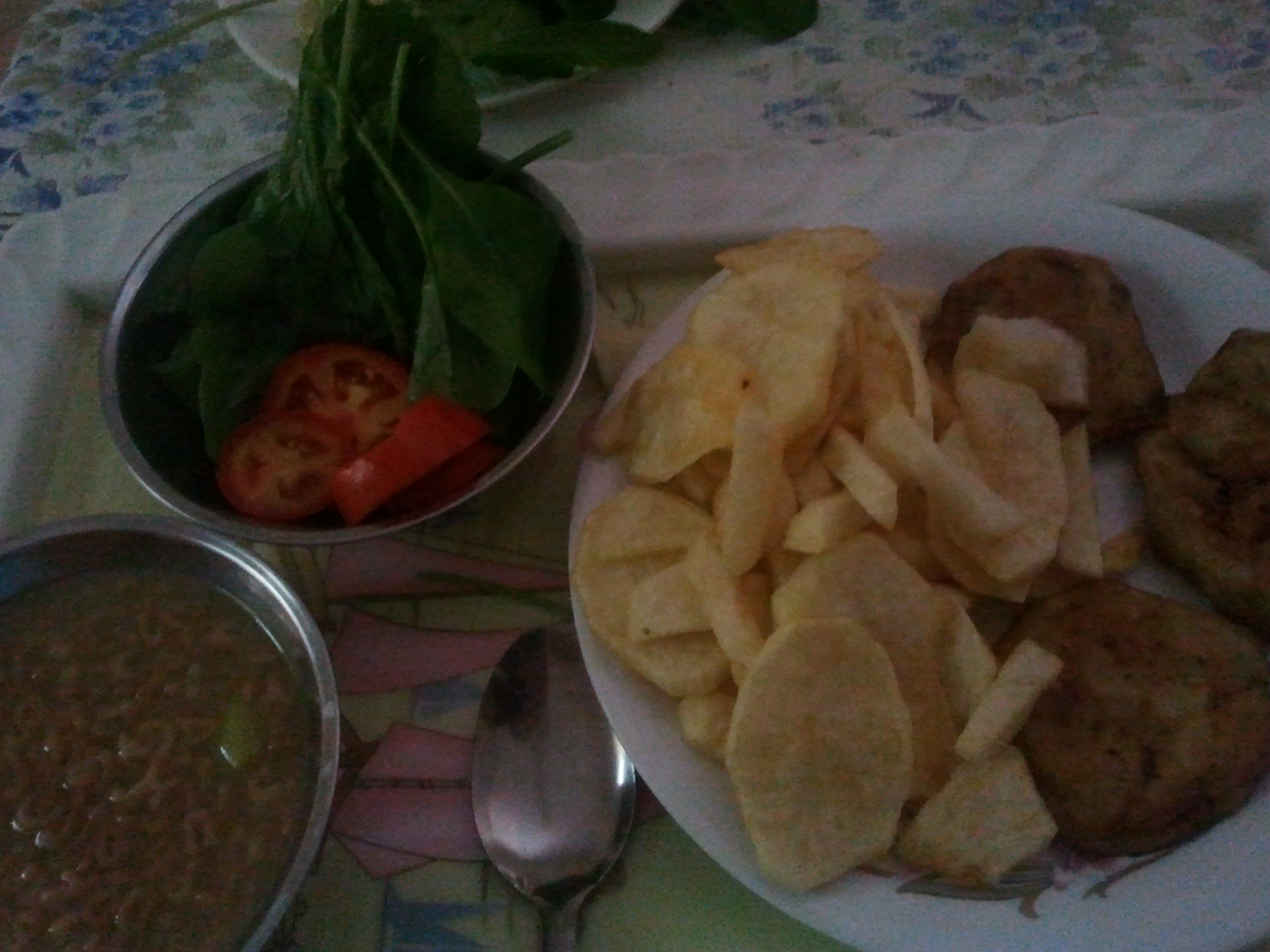
Egyptian breakfast

An Egyptian breakfast, made just for me

Lunch, at 2 pm, is the highlight of the day. We have chicken about every other day or so. The sisters don’t eat pork. They don’t like it, Sister Maria tells me. Sometimes they eat is stewed beef. The sisters eat soups like a green bean soup or the famous molokhaya, to which they can add rice, or just pile some rice along with their chicken or other meat. The rice is always a combination of rice and vermicelli noodles. Once or twice we’ve had a meat-filled dish something like puff-pastry quiche. Sometimes, particularly on Fridays, the food is vegetarian. It can be a macaroni dish, or French fries. There is always fruit for dessert.

The evening meal, served somewhere between 8:30 and 9 pm, is usually the same as breakfast, but sometimes there is a raw vegetable like cucumbers or tomatoes. There is also usually plain yoghurt, served in glasses. Sister Ologaya, who directs the hospital during the day,  makes the the yoghurt every evening from milk and a starter she buys at the market.

Sister Ologaya

Sister Ologaya

After the meal, the sisters collect their dishes and the leftover food and water pitchers, bringing it all into the kitchen. Then someone starts hand-washing the dishes, while someone else rinses and puts the dishes onto a drying rack hanging from the wall. A third person will put the dishes away.  The first week I was here, I wasn’t allowed to help at all, but by now they let me help in the kitchen.

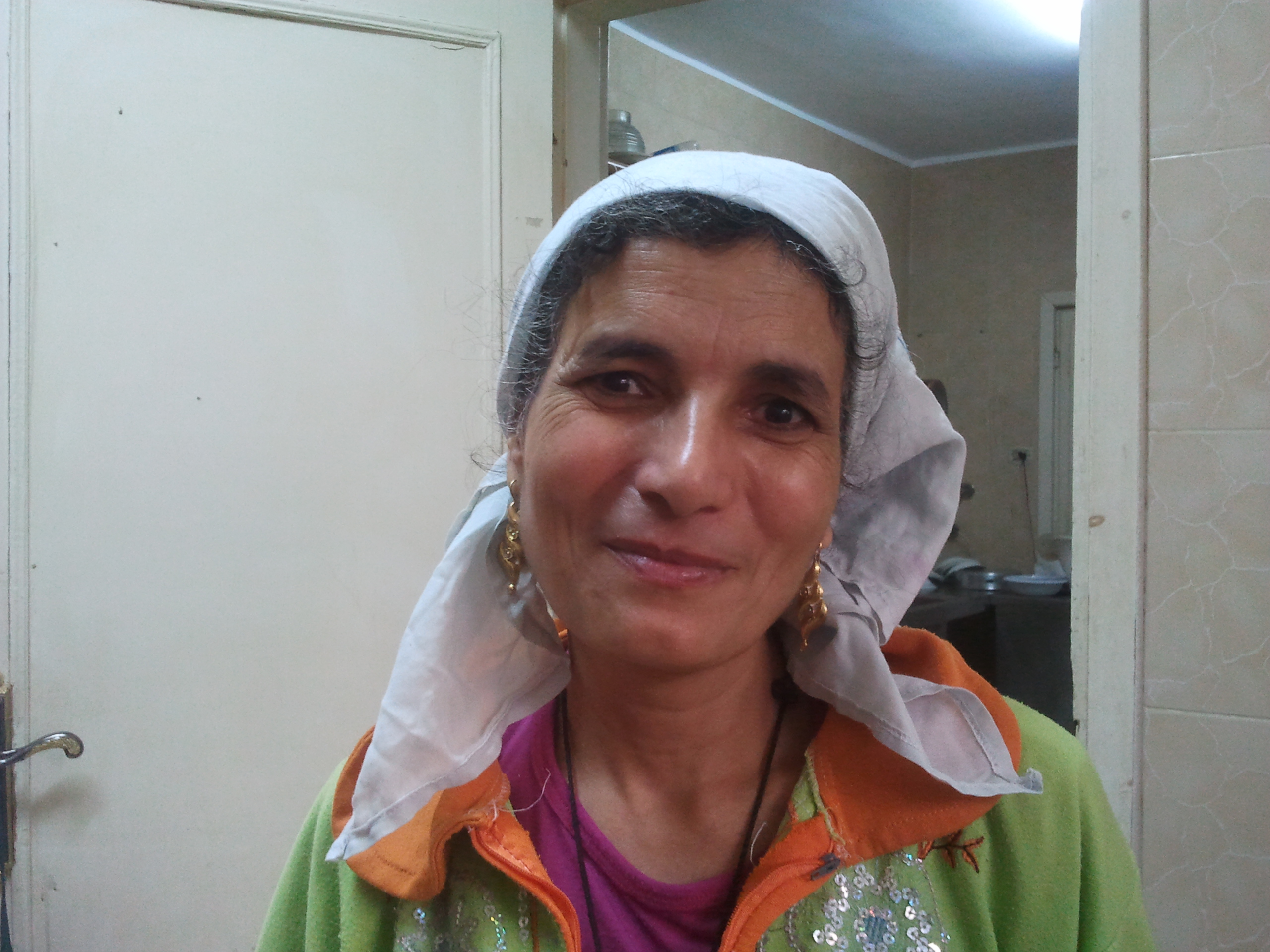
Marsa

Marsa, the cook

Marsa, the cook, came to the convent as an orphan. I’m not sure how old she was at the time, but the sisters adopted her as their own sister. She is always smiling. Every day she has a new English phrase for me, with something in Arabic she wants me to learn. I love this beautiful, tender woman. She works very hard in the kitchen.  For some reason I can’t discern, she doesn’t eat with the sisters.  I know she is beloved by them.  Still, they can be pretty hard on her when she neglects to do things they really want, like warming up their pita bread in the oven.  Martha’s cheery statements she reads to me, messages like, “You are welcome here anytime!  Please sit down.” are part of why I love this place.

← Older posts
Newer posts →

Subscribe

  • Entries (RSS)
  • Comments (RSS)

Archives

  • August 2023
  • August 2022
  • February 2022
  • January 2022
  • December 2021
  • January 2021
  • April 2020
  • March 2020
  • February 2020
  • November 2019
  • October 2019
  • September 2019
  • August 2019
  • July 2019
  • June 2019
  • May 2019
  • April 2019
  • March 2019
  • July 2018
  • April 2018
  • February 2017
  • February 2016
  • July 2015
  • May 2015
  • March 2015
  • December 2013
  • November 2013

Categories

  • Uncategorized

Meta

  • Create account
  • Log in

Create a free website or blog at WordPress.com.

Privacy & Cookies: This site uses cookies. By continuing to use this website, you agree to their use.
To find out more, including how to control cookies, see here: Cookie Policy
  • Subscribe Subscribed
    • Mileage Plus Pilgrim
    • Join 94 other subscribers
    • Already have a WordPress.com account? Log in now.
    • Mileage Plus Pilgrim
    • Subscribe Subscribed
    • Sign up
    • Log in
    • Report this content
    • View site in Reader
    • Manage subscriptions
    • Collapse this bar
 

Loading Comments...